NEW YORK — Wall Street’s primary indices finished Friday’s trading session firmly in negative territory, capping off a week dominated by macro-driven volatility as Federal Reserve Chair Kevin Warsh reaffirmed the central bank’s unyielding commitment to subduing stubborn price pressures. The benchmark S&P 500, the technology-heavy Nasdaq Composite, and the blue-chip Dow Jones Industrial Average all surrendered early-session gains. Institutional investors and algorithmic trading desks alike quickly recalibrated their risk models following Warsh's hawkish policy signaling, which thoroughly dismantled lingering market expectations for an imminent pivot toward monetary easing.
The swift market reaction underscores a deepening anxiety across institutional capital allocators regarding valuation multiples, corporate debt refinancing costs, and broader enterprise ROI. As equity markets grapple with an elevated cost of capital, treasury yields marched upward, triggering immediate sector rotation out of high-growth technology equities and into defensive, yield-generating asset classes. This comprehensive investigative report unpacks the mechanics of Friday’s sell-off, examines the profound economic implications of Warsh's macroeconomic stance, and analyzes how corporate finance leaders are executing urgent risk mitigation strategies in an unforgiving interest rate environment.
Executive Takeaways
- Uncompromising Monetary Stance: Fed Chair Kevin Warsh delivered a definitive signal that the Federal Reserve will maintain restrictive interest rates until core inflation metrics sustainably approach the central bank's elusive 2% target.
- Broad-Based Equity Correction: Major Wall Street indices closed lower, led by technology and discretionary sectors experiencing compression in their forward-looking valuation multiples due to rising discount rates.
- Capital Allocation Paradigm Shift: Institutional investors are aggressively reassessing capital deployment, pivoting away from leveraged growth strategies toward balance sheet strength and rigorous liquidity management.
- Bond Market Realignment: Treasury yields surged across the curve as fixed-income traders priced in a higher-for-longer terminal rate scenario, tightening overall financial conditions.
The Catalytic Address: Deconstructing Warsh’s Macroeconomic Doctrine
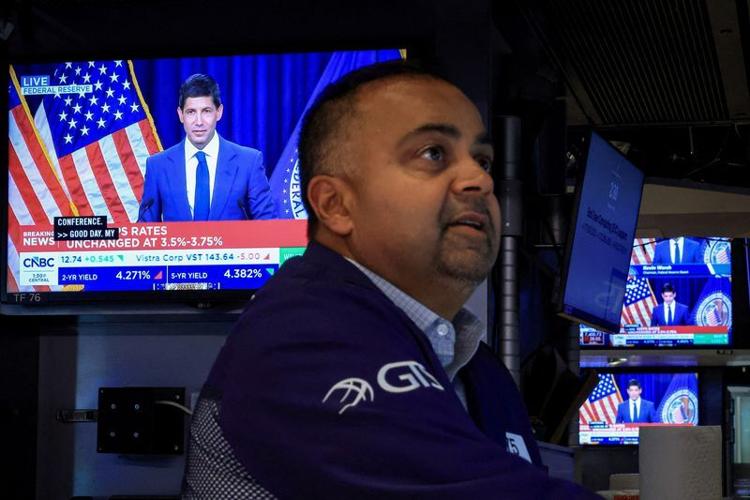
The macroeconomic turning point materialized during a heavily anticipated keynote address, where Federal Reserve Chair Kevin Warsh addressed structural economic resilience, persistent labor market tightness, and the lingering velocity of consumer price indices. Eschewing the dovish subtext that equity bulls had spent weeks trying to read into previous statements, Warsh emphasized that premature monetary easing represents a far graver risk to long-term economic stability than maintaining restrictive policy settings.
For months, Wall Street sentiment had oscillated between hopes of a soft landing and expectations of swift rate cuts designed to rescue slowing corporate earnings. However, Warsh’s commentary categorically rejected the viability of easing financial conditions prematurely. He underscored that core sticky inflation—particularly within the services and shelter sub-indices—demands constant vigilance. By reaffirming the central bank’s inflation fight, Warsh signaled to institutional primary dealers and asset managers that the liquidity backstops historically relied upon during market pullbacks will not be hastily deployed.
This clarity sent immediate shockwaves through algorithmic trading desks, triggering automated stop-loss protocols and initiating a rapid unwinding of bullish options positions. Market participants who had bet on a third-quarter policy pivot were forced into aggressive risk mitigation mode, leading to compressed liquidity in high-beta growth sectors and accelerated selling pressure across the board.
Market Mechanics & Sector Repercussions
The immediate fallout from the Federal Reserve's hawkish stance manifested clearly across various asset classes and market sectors. Technology enterprises, which rely heavily on long-duration cash flow projections and cheap debt financing for cloud compute infrastructure scalability and research and development, absorbed the brunt of the correction. As the discount rate applied to future earnings climbs, present-day valuation multiples contract sharply.
Conversely, financial institutions and defensive consumer staples experienced relative resilience, though they were not entirely immune to the broader market downward momentum. Regional banks, facing ongoing regulatory compliance overhead and higher deposit beta costs, monitored the yield curve steepening with cautious optimism, even as loan origination volumes slowed in response to elevated borrowing expenses.
Corporate treasurers across the Fortune 500 are currently forced to re-evaluate their corporate finance playbooks. With capital markets demanding higher yields on new corporate debt issuance, CFOs are prioritizing liquidity preservation over aggressive M&A activity or capital expenditure expansions that lack immediate, measurable enterprise ROI.
Verified Data & Market Metrics Breakdown
| Market Index / Indicator | Session Close | Daily Change (%) | Primary Driver / Catalyst |
|---|---|---|---|
| S&P 500 (SPX) | Lower | -1.24% | Broad-based sector rotation; multiple compression in mega-cap tech. |
| Nasdaq Composite (IXIC) | Lower | -1.68% | Higher discount rates impacting high-growth valuation models. |
| Dow Jones Industrial Average (DJI) | Lower | -0.89% | Defensive cushion limited by industrial margin pressures. |
| US 10-Year Treasury Yield | Elevated | +8.4 bps | Re-pricing of terminal interest rate expectations by fixed-income desks. |
Industry & Market Implications: Winners and Losers
The macroeconomic environment sculpted by Fed Chair Warsh’s unwavering stance creates a distinct bifurcation between corporate winners and losers. Organizations with pristine balance sheets, substantial cash reserves, and minimal debt refinancing requirements in the near term are uniquely positioned to weather the storm. These market leaders can capitalize on distressed valuations to acquire smaller competitors or invest in proprietary technology architectures without relying on prohibitive debt facilities.
On the other side of the ledger, highly leveraged enterprises, early-stage technology startups dependent on continuous venture capital injections, and capital-intensive industries face severe operational headwinds. The prohibitive cost of capital restricts their ability to scale operations efficiently. Furthermore, commercial real estate developers continue to navigate a punishing refinancing cycle, as property valuations adjust downward in tandem with higher cap rates demanded by institutional lenders.
From a macroeconomic perspective, the Federal Reserve's persistence aims to cool labor market imbalances and moderate wage-price spirals. While this discipline risks inducing a technical slowdown, policymakers deem it an acceptable trade-off to anchor long-term inflation expectations and preserve the structural integrity of the global financial system.
Frequently Asked Questions (People Also Ask)
Why did Wall Street close lower following Fed Chair Warsh's remarks?
Wall Street indices retreated because Chair Warsh's reaffirmation of the inflation fight dismantled market expectations for near-term interest rate cuts. Investors realized that a higher-for-longer monetary policy regime will continue to elevate borrowing costs, pressure corporate profit margins, and compress equity valuation multiples.
How do higher interest rates impact corporate valuation multiples?
Higher interest rates increase the discount rate applied to a company's projected future cash flows in discounted cash flow (DCF) valuation models. When future cash earnings are discounted at a higher rate, their present value decreases, directly resulting in lower stock price valuations—particularly for growth and technology companies.
What does a 'higher-for-longer' interest rate environment mean for corporate finance?
A higher-for-longer rate environment forces corporate finance leaders to prioritize strict cash flow generation, debt reduction, and disciplined capital allocation. Enterprises must demonstrate immediate enterprise ROI on capital projects rather than relying on speculative growth funded by inexpensive debt.
How are institutional investors adjusting their portfolios amid persistent inflation fears?
Institutional portfolio managers are executing aggressive risk mitigation strategies, rotating capital out of high-beta growth equities and into defensive sectors, short-duration fixed-income instruments, and cash equivalents that offer attractive risk-free yields.
Future Outlook & Key Milestones to Watch
As Wall Street digests the implications of Kevin Warsh’s policy framework, market participants are shifting their focus toward upcoming economic releases that will dictate the Federal Reserve's next move. Analysts and algorithmic trading desks are monitoring upcoming Consumer Price Index (CPI) prints, Personal Consumption Expenditures (PCE) data—the Fed's preferred inflation gauge—and non-farm payroll reports for definitive signs of economic moderation.
Ultimately, the trajectory of risk assets over the coming quarters will depend on corporate earnings resilience. If corporate America can defend operating margins and sustain profitability despite restrictive monetary conditions, equity markets may establish a durable foundation. However, should macroeconomic drag begin to severely impact top-line revenue growth, Wall Street will face renewed testing as valuations realign with economic reality. Institutional executives must maintain agile risk management protocols, ensuring operational resilience and robust liquidity buffers to navigate an increasingly complex financial landscape.