Executive Takeaways
- The Collapse of the Castle-and-Moat Model: Legacy perimeter-based defenses fail inside modern hybrid cloud compute architectures where remote work and SaaS sprawl have obliterated traditional network boundaries.
- Economic Imperative & Risk Mitigation: Transitioning to Zero Trust Architecture (ZTA) drastically limits lateral movement during a breach, containing blast radiuses and safeguarding enterprise valuation multiples from catastrophic incident fallout.
- Regulatory Compliance Acceleration: Global regulators, including the SEC and EU oversight bodies, increasingly mandate rigorous identity verification and micro-segmentation, making ZTA a baseline requirement for market liquidity and public trust.
- From Vulnerability to Visibility: True Zero Trust transforms organizational cybersecurity from a reactive cost center into an active, data-driven framework of continuous telemetry and context-aware access decisions.
For decades, the architectural blueprint of enterprise cybersecurity resembled a medieval fortress: build a towering stone wall around the perimeter, station guards at the gates, and trust everyone safely inside the courtyard. In the digital lexicon, this was known as the "castle-and-moat" security model. Once a user, device, or application successfully authenticated at the outer boundary via a Virtual Private Network (VPN) or corporate credential, they were implicitly trusted to roam the internal network unrestricted.
That architectural philosophy is now a liability of historic proportions.
Driven by the migration to multi-cloud environments, the permanent entrenchment of remote and hybrid workforces, and an exponential surge in sophisticated ransomware campaigns, the traditional perimeter has evaporated. In its place, forward-thinking chief information security officers (CISOs) are executing a radical capital allocation shift toward Zero Trust Architecture (ZTA). Grounded in the foundational maxim "never trust, always verify," ZTA replaces implicit trust with continuous, cryptographically secure validation of every user, device, and transaction—regardless of whether they originate from inside or outside the corporate LAN.
The Anatomy of Failure: Why Legacy Models Collapsed
To understand the urgent rush toward Zero Trust, one must examine the systemic vulnerabilities inherent in legacy infrastructure scalability. Traditional network security assumed a clear delineation between the trusted internal network and the untrusted public internet. However, digital transformation initiatives—accelerated by distributed cloud compute architectures, third-party vendor integrations, and mobile devices—have rendered that boundary obsolete.
When threat actors compromise a single endpoint using credential stuffing or sophisticated phishing techniques, legacy perimeters grant them lateral movement. Once inside, attackers can quietly map internal subnets, escalate privileges, and exfiltrate sensitive intellectual property or customer data over weeks or months before detection. High-profile supply chain attacks and zero-day exploits have demonstrated that perimeter defenses act merely as a brittle shell: hard on the outside, but dangerously soft and hollow on the inside.
"The fundamental flaw of the old model was assuming proximity equaled safety," notes a senior financial technology CISO managing infrastructure across European and North American markets. "In a world where corporate assets reside across AWS, Azure, SaaS applications, and employee home offices, the network is no longer the perimeter. Identity is the new perimeter. If your identity verification and micro-segmentation are weak, your entire balance sheet is exposed."
Core Principles of Zero Trust Architecture
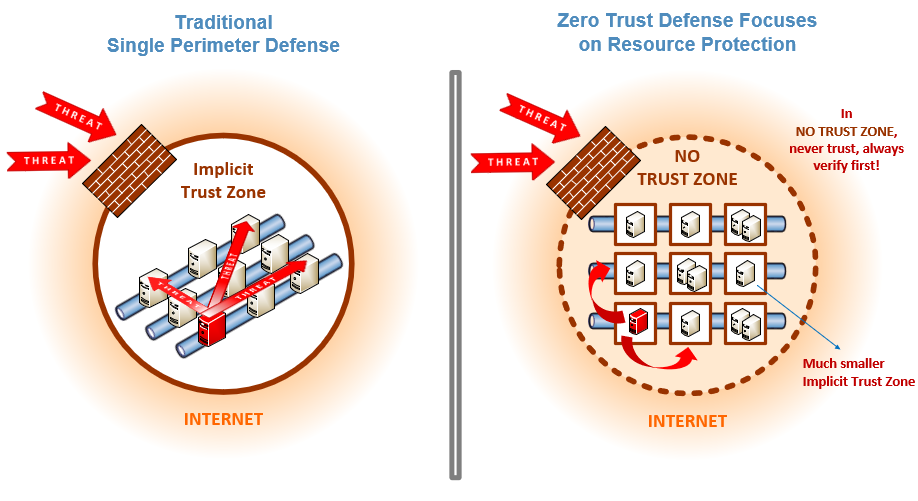
Zero Trust is not a single software product or hardware appliance that an organization can procure off the shelf; it is an overarching operational philosophy and architectural framework. Transforming an enterprise requires strict adherence to several core tenets:
- Verify Explicitly: Always authenticate and authorize based on all available data points, including user identity, location, device health, service or workload, data classification, and anomalies.
- Use Least Privilege Access: Limit user access with Just-In-Time (JIT) and Just-Enough-Access (JEA) models, risk-based adaptive policies, and data protection safeguards to secure both user credentials and operational sessions.
- Assume Breach: Minimize blast radius by segmenting access by network, user, devices, and application awareness. Encrypt all sessions end-to-end and utilize analytics to gain visibility, drive threat detection, and continuously improve defenses.
By enforcing these principles, organizations shift from a state of passive vulnerability to active, high-resolution visibility. Every access request undergoes real-time risk scoring, evaluating contextual telemetry before granting granular, scoped authorization.
Verified Data & Metrics Breakdown
Enterprise adoption of Zero Trust is increasingly driven by hard economic metrics and risk mitigation calculations. The following comparative breakdown illustrates the structural advantages of ZTA over traditional security models across critical operational vectors:
| Security Vector | Traditional Perimeter Model | Zero Trust Architecture (ZTA) |
|---|---|---|
| Trust Assumption | Implicit trust inside the network perimeter | Zero implicit trust; continuous verification |
| Lateral Movement | Unrestricted once initial boundary is breached | Strictly contained via micro-segmentation |
| Credential Compromise Impact | Catastrophic, wide-scale system access | Mitigated via context-aware, least-privilege scoping |
| Average Breach Containment Time | Days to weeks (low visibility) | Minutes to hours (real-time telemetry) |
| Regulatory Compliance Alignment | Reactive, cumbersome auditing processes | Continuous automated logging and governance |
Industry & Market Implications
The macroeconomic shift toward Zero Trust has profound ramifications for global markets, corporate governance, and technology valuation multiples. In the financial sector, institutional investors and credit rating agencies now evaluate an enterprise’s cyber-resilience posture as a core component of overall operational risk.
Who Wins: Cybersecurity vendors specializing in identity and access management (IAM), secure access service edge (SASE), micro-segmentation, and endpoint detection and response (EDR) are experiencing sustained demand. Enterprises that successfully implement ZTA protect their intellectual property, maintain uninterrupted operational workflows, and shield their valuation multiples from the punishing market sell-offs that historically follow severe data breaches.
Who Loses: Legacy hardware firewall manufacturers and vendors reliant on traditional VPN architectures are facing secular decline. Organizations that delay modernization find themselves paying exorbitant ransom demands, facing severe regulatory fines, and suffering permanent reputational damage among enterprise clients.
Furthermore, regulatory compliance frameworks across the globe—including updated Securities and Exchange Commission (SEC) cyber disclosure rules, the European Union's NIS2 Directive, and global banking guidelines—increasingly demand verifiable proof of robust access controls and rapid incident containment capabilities. Zero Trust provides the exact audit trails and governance mechanisms required to satisfy these stringent mandates.
Frequently Asked Questions (People Also Ask)
Q: Is Zero Trust a software product that can be purchased and installed in one go?
No. Zero Trust is a strategic architectural framework and operational model, not a single software application. Implementing ZTA requires a combination of identity providers, micro-segmentation tools, endpoint security, policy engines, and continuous monitoring systems integrated across existing cloud and on-premises infrastructure.
Q: How does Zero Trust improve enterprise ROI during a security incident?
By enforcing least-privilege access and micro-segmentation, Zero Trust limits an attacker's ability to move laterally across the network. This significantly reduces the "blast radius" of a breach, preventing minor credential compromises from escalating into enterprise-wide ransomware attacks, thereby preserving brand equity, lowering incident response costs, and protecting financial valuation multiples.
Q: Does Zero Trust negatively impact employee productivity and user experience?
Early implementations of security controls often introduced friction, but modern Zero Trust solutions leverage risk-based adaptive authentication. When user context (device health, familiar location, secure network) is validated seamlessly in the background, multi-factor authentication (MFA) prompts are minimized, often resulting in a smoother, more secure user experience than clunky legacy VPNs.
Q: What is the first practical step an organization should take toward Zero Trust adoption?
Organizations typically begin by establishing a comprehensive asset inventory and data classification program. Identifying critical data assets ("crown jewels"), mapping data flows across hybrid environments, and modernizing identity and access management (IAM) provide the necessary foundation before deploying advanced micro-segmentation and continuous validation policies.
Future Outlook: What Comes Next
As we look toward the horizon of enterprise technology, Zero Trust is poised to evolve from a best-practice framework into an absolute baseline requirement for digital commerce. Artificial intelligence and machine learning are increasingly integrated into ZTA policy engines, enabling real-time behavioral analytics that can spot anomalous user activity and neutralize threats autonomously before human intervention is required.
For executive leadership and boardrooms, the message is unequivocal. The transition from vulnerability to visibility is no longer an optional IT upgrade; it is a critical pillar of corporate governance and financial risk management. In an era defined by relentless digital warfare, organizations that cling to the illusion of the perimeter will find themselves outmatched, while those that embrace Zero Trust will secure their operations for the decades ahead.