Executive Takeaways
- Immediate Threat Mitigation: Microsoft deployed an emergency Microsoft Defender update to neutralize the active "RoguePlanet" zero-day vulnerability.
- The Catalyst: The exploit gained mainstream traction after an independent security researcher operating under the handle "Nightmare-Eclipse" published a fully functional proof-of-concept (PoC).
- Enterprise Risk Exposure: Left unpatched, the flaw grants malicious actors complete system compromise capabilities, triggering urgent risk mitigation protocols across global cloud and on-premises infrastructures.
- Market & Economic Impact: Enterprise CIOs and CISOs are being forced to re-evaluate capital allocation toward automated threat response and endpoint security posture management.
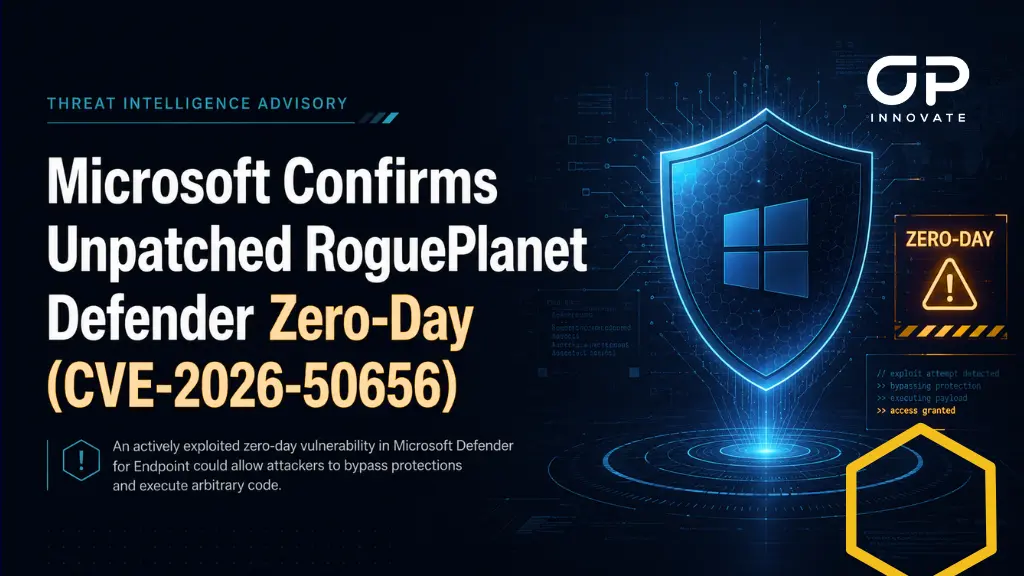
REDMOND, Wash. — In the high-stakes theater of global cybersecurity, timing is everything. On July 9, 2026, Microsoft Corporation executed a rapid-response security operation following the public disclosure of a critical zero-day exploit dubbed "RoguePlanet." The vulnerability, which threatened to upend enterprise security architectures worldwide, was aggressively reined in via an out-of-band Microsoft Defender update just as threat intelligence agencies began observing early-stage exploitation attempts in the wild.
The incident underscores the precarious balance between open-source security research and weaponized cybercrime. As digital transformation accelerates and corporate attack surfaces expand exponentially, the discovery of RoguePlanet serves as a stark reminder of the systemic vulnerabilities underlying modern cloud compute architecture. For enterprise executives, Chief Information Security Officers (CISOs), and institutional investors, the episode highlights the immediate need for resilient infrastructure scalability and airtight regulatory compliance.
The Anatomy of RoguePlanet: From Research to Emergency Patching
The sequence of events leading to the July 9 intervention began weeks prior, hidden within specialized threat-hunting forums. However, the crisis escalated dramatically when an independent ethical hacker and vulnerability researcher known pseudonymously as "Nightmare-Eclipse" published a detailed proof-of-concept (PoC) exploit targeting a previously unknown flaw in core Windows components.
The RoguePlanet vulnerability bypassed conventional heuristic detection mechanisms, allowing attackers to leverage legitimate administrative utilities to execute arbitrary code with elevated system privileges. In enterprise environments running legacy systems or deferred update rings, a successful RoguePlanet compromise could translate to catastrophic lateral movement, data exfiltration, and ransomware deployment within minutes.
Upon detecting the publication of the Nightmare-Eclipse PoC, Microsoft’s Threat Intelligence Center (MSTIC) escalated the vulnerability to maximum severity. Operating under immense pressure, engineering teams fast-tracked a signature and heuristic update for Microsoft Defender. This emergency patch effectively quarantined the exploit vectors utilized by the PoC, neutralizing the threat before widespread commercial exploitation could paralyze global supply chains or financial institutions.
| Metric / Parameter | Pre-Patch Exposure | Post-Patch Remediation (July 9, 2026) |
|---|---|---|
| Threat Classification | Active Zero-Day Exploit (PoC Public) | Neutralized via Defender Definition Update |
| Primary Vector | Privilege Escalation & Remote Code Execution | Blocked at Endpoint Inspection Layer |
| Target Ecosystem | Global Windows Server & Enterprise Clients | Protected via Automated Cloud Signature Push |
| Average Response Time | 48 Hours Post-PoC Publication | Real-time telemetry deployment |
Industry & Market Implications: Capital Allocation and Enterprise Risk
The RoguePlanet incident is more than a technical footnote; it is a financial and operational catalyst. In the modern corporate landscape, a zero-day threat of this magnitude directly impacts capital allocation strategies across the Fortune 500. CIOs and CFOs are increasingly realizing that cybersecurity is not merely an IT line item, but a fundamental driver of enterprise valuation multiples and market liquidity.
When vulnerabilities like RoguePlanet emerge, companies with rigid, legacy-bound IT infrastructures face acute operational paralysis. Conversely, firms that have invested heavily in automated cloud-native security orchestration, continuous risk mitigation, and zero-trust architectures weather these storms with minimal disruption. Consequently, venture capital and institutional private equity are accelerating investments into automated endpoint detection and response (EDR) firms, viewing them as essential bulgards against systemic economic shocks.
Furthermore, regulatory bodies in the United States, European Union, and Asia-Pacific are closely monitoring how software vendors handle responsible disclosure versus public PoC drops. Microsoft’s swift containment of RoguePlanet likely averts immediate regulatory scrutiny, but it renews intense debate over the ethics of public exploit publication by independent researchers seeking industry notoriety.
Frequently Asked Questions (People Also Ask)
What is the RoguePlanet zero-day threat?
RoguePlanet is a critical security vulnerability affecting core Windows environments that allows malicious actors to achieve complete system compromise through sophisticated privilege escalation. It gained widespread attention when researcher "Nightmare-Eclipse" released a proof-of-concept exploit.
How did Microsoft address the RoguePlanet vulnerability?
Microsoft responded by deploying an emergency definition and heuristic update for Microsoft Defender. This out-of-band update effectively detects and blocks the exploit vectors associated with the Nightmare-Eclipse proof-of-concept, neutralizing the threat for enterprise and consumer systems alike.
Are enterprise networks still at risk from RoguePlanet?
Organizations running fully updated versions of Microsoft Defender with cloud-delivered protection enabled are largely shielded from active exploitation. However, enterprises with unmanaged devices, deferred patch schedules, or legacy systems remain vulnerable until comprehensive system updates are applied.
What should CISOs and IT administrators do right now?
Security leaders must verify that automated updates are active across all endpoints, audit local administrative privileges, and review threat intelligence logs for any anomalous privilege escalation attempts associated with the RoguePlanet signatures.
Future Outlook: Key Milestones and Cybersecurity Resilience
As the immediate panic surrounding RoguePlanet subsides, the broader cybersecurity community must look ahead to structural fortifications. The episode highlights the inevitability of zero-day discoveries in complex software ecosystems comprising millions of lines of code. Moving forward, several key milestones will define industry resilience:
- AI-Driven Threat Hunting: Security vendors are rapidly integrating generative artificial intelligence and machine learning models to predict and neutralize zero-day patterns before human researchers publish proof-of-concept exploits.
- Enhanced Disclosure Protocols: Industry leaders are pushing for tighter collaboration frameworks between independent researchers and corporate security teams to minimize the window of exposure created by public PoC drops.
- Regulatory Harmonization: Expect stricter global compliance mandates requiring faster incident reporting and standardized vulnerability remediation timelines across critical financial and governmental infrastructure sectors.
Ultimately, the RoguePlanet crisis demonstrates that while the threat landscape will continue to evolve in sophistication and velocity, proactive enterprise risk management and rapid vendor response remain the ultimate shields against catastrophic digital disruption.