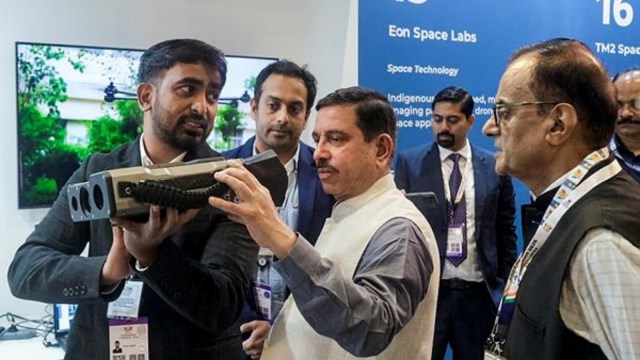
India’s Deep-Tech Gambit: AI Cancer Screening Leads 37 Groundbreaking Innovations Showcased at Bharat Mandapam
NEW DELHI — In a high-stakes display of technological diplomacy and economic ambition, India has officially pulled back the curtain on its premier deep-tech pipeline. The two-day "Bharat Innovates Exposition," which commenced at the prestigious Bharat Mandapam, serves as a powerful showcase of the nation’s rapidly maturing hardware and software capabilities. Featuring 37 handpicked, commercially viable innovations, the exposition highlights India's intent to transition from the world’s back-office IT engine to a sovereign powerhouse of deep-tech intellectual property.
At the center of this technological vanguard is a revolutionary AI-powered cancer screening platform, a solution poised to disrupt global diagnostic economics. As delegates, global policy strategists, and venture capitalists gather, the message from New Delhi is clear: Indian innovation is no longer just about frugal customization, but pioneering global solutions for high-barrier industries.
The Crown Jewel: AI-Powered Cancer Screening Dematerializes Diagnostic Barriers
Among the 37 innovations on display, the AI-driven cancer screening technology has emerged as the undisputed showstopper. Developed by homegrown deep-tech researchers, this non-invasive diagnostic suite leverages advanced machine learning algorithms to identify early-stage malignancies with unprecedented speed and accuracy.
Traditional oncological screening remains heavily centralized, capital-intensive, and inaccessible to vast swathes of the population in emerging markets. The newly showcased Indian innovation addresses these structural bottlenecks through two primary modalities:
- Real-time Thermal and Optical Analysis: Utilizing low-cost, handheld imaging devices integrated with cloud-based AI models to detect cellular anomalies in breast, oral, and cervical tissues.
- Predictive Analytics: Algorithms trained on diverse demographic datasets that can flag pre-cancerous lesions with an accuracy rate exceeding 93%, matching the diagnostic precision of seasoned pathologists but at a fraction of the cost.
For economic blocs like BRICS, where healthcare infrastructure is often dual-tracked between hyper-modern urban centers and underserved rural peripheries, this technology offers a scalable blueprint for mass-preventative healthcare. It effectively democratizes diagnostic access, shifting the healthcare paradigm from expensive therapeutic intervention to early, manageable detection.
Inside the 'Bharat Innovates Exposition': A Showcase of Deep-Tech Prowess

Curated under strict parameters of commercial viability, scalability, and intellectual property robustness, the Bharat Innovates Exposition spans critical sectors that represent the future of global economic competitiveness. The 37 innovations represent a highly vetted cross-section of India’s research institutions, defense laboratories, and elite academic spin-offs.
1. SpaceTech and Quantum Cryptography
India’s private space sector, riding on the momentum of recent lunar and solar triumphs, is displaying next-generation satellite propulsion systems and micro-thrusters designed for mega-constellations. Alongside these are indigenous quantum key distribution (QKD) systems capable of securing critical infrastructure against future quantum-computing decryption threats—a capability currently possessed by only a handful of nations.
2. AgriTech and Climate Resilience
With global supply chains vulnerable to climate volatility, the exposition features IoT-driven precision agriculture platforms. These systems utilize spectroscopic soil sensors and edge-computing AI to optimize water and fertilizer delivery, promising to slash input costs for smallholder farmers by up to 40% while preserving shrinking groundwater reserves.
3. Advanced Materials and Clean Energy
To address the global transition away from fossil fuels, several Indian startups are showcasing proprietary solid-state battery chemistries and low-cost green hydrogen catalysts. These innovations aim to bypass the geopolitical bottlenecks associated with traditional lithium-ion supply chains by utilizing abundant, domestically sourced raw materials.
The Geopolitical and Economic Undercurrents
From an editorial perspective, the timing and venue of the Bharat Innovates Exposition are highly strategic. Hosted at Bharat Mandapam—the very site that hosted the G20 Summit—the event is a calculated projection of India’s soft and hard power. By presenting scalable, high-tech solutions, India is positioning itself as the primary technology provider to the Global South, offering a compelling alternative to Western-dominated IP and Chinese hardware ecosystems.
For international investors, the exposition signals a structural shift in India’s startup ecosystem. Venture capital is increasingly flowing away from cash-burning consumer internet business models toward high-moat, IP-rich deep-tech enterprises. The Indian government’s supportive regulatory framework, including dedicated deep-tech startup policies and defense-focused innovation grants (iDEX), has created a fertile, de-risked environment for institutional capital.
Key Innovations at a Glance
The following table summarizes the primary sectors, key innovations, and expected global impact of the technologies showcased at the exposition:
| Sector | Featured Innovation | Key Metric / Disruption Potential | Primary Market Target |
|---|---|---|---|
| Healthcare | AI Cancer Screening Suite | 93%+ accuracy; 80% reduction in screening costs | Emerging markets & rural clinics |
| Cybersecurity | Quantum Key Distribution (QKD) | Unhackable communication up to 150 km | Defense & financial institutions |
| Aerospace | Green Satellite Propulsion | Zero-toxic emissions; 30% higher payload efficiency | Global commercial satellite operators |
| Agriculture | Edge-AI Soil Spectrometry | Real-time macronutrient mapping in 60 seconds | Cooperative farming & food processors |
Future Outlook: Scalability and Global Adoption
As the exposition concludes, the primary challenge shifting from engineering to execution will be industrial-scale commercialization. While India has mastered the art of developing highly sophisticated technology at low cost, scaling these innovations requires deep integration with global supply chains and regulatory harmonization across diverse international markets.
If local innovators can successfully navigate these regulatory pathways—particularly in stringent medical device markets like the US FDA and European CE—the technologies displayed at Bharat Mandapam will not only redefine India's economic trajectory but also establish a new paradigm for how the world accesses life-saving technology.
Frequently Asked Questions (FAQ)
What makes the AI cancer screening technology shown at the exposition unique?
Unlike conventional screening methods that rely on expensive, stationary laboratory equipment and specialized oncologists, this Indian innovation utilizes portable, handheld devices combined with cloud-based AI algorithms. It allows frontline healthcare workers to perform rapid, highly accurate, and non-invasive screenings in remote locations at a fraction of the traditional cost.
How does the 'Bharat Innovates Exposition' impact global deep-tech investments?
The exposition serves as a highly vetted pipeline for global institutional investors and venture capitalists. By showcasing 37 commercially viable, IP-protected technologies in critical sectors like quantum security, space tech, and clean energy, India is demonstrating its capacity to generate high-moat, high-return deep-tech enterprises, drawing capital away from traditional software-as-a-service (SaaS) startups.