When India Went Viral Without the Internet: The Inside Story of the 1995 Ganesha Milk Miracle
NEW DELHI — Thirty-one years ago today, long before the era of smartphones, algorithmic newsfeeds, and viral social media challenges, India experienced a phenomenon that paralyzed the nation in real time. On September 21, 1995, a seemingly impossible rumor erupted from a modest temple in South Delhi and cascaded across the entire subcontinent within hours: statues of Lord Ganesha were reportedly drinking milk.
What began as a whispered local miracle snowballed into one of the most remarkable mass psychological and cultural events of the late 20th century. In an era reliant on landline telephones, word-of-mouth, and afternoon print newspapers, this unprecedented wave of collective belief traveled faster than conventional communication channels should have allowed, offering an early blueprint for how information—and misinformation—goes viral.
The Genesis of a Continental Phenomenon
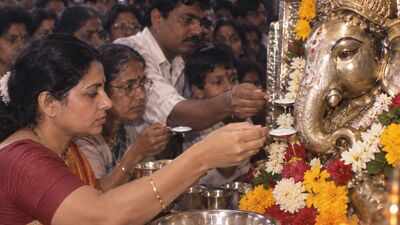
The morning of September 21, 1995, started like any other autumn day in the Indian capital. According to historical accounts and primary archives from The Times of India, the event originated at a temple in the Delhi cantonment area. A devotee allegedly dreamed that Ganesha, the elephant-headed Hindu god of wisdom and prosperity, was thirsty. Upon waking, the devotee rushed to the nearest temple and offered a spoonful of milk to the deity's marble idol.
To the utter astonishment of those present, the liquid disappeared. As the spoon was brought close to the trunk, the milk appeared to vanish, swallowed by the stone.
News of the incident spread instantly among neighbors and local shopkeepers. Within an hour, telephone lines were buzzing. Families called relatives across the city, urging them to test the phenomenon at their local temples. By noon, the rumor had jumped state lines, triggering massive queues outside shrines in Mumbai, Kolkata, Chennai, and thousands of smaller towns.
- The Speed of Spread: Propelled entirely by word-of-mouth, landlines, and frantic local radio chatter before widespread consumer internet access.
- Economic Impact: Milk sales across major metropolitan areas surged dramatically as millions rushed to purchase offerings, causing brief localized shortages.
- Scientific Interventions: Rationalist groups and physicists mobilized rapidly, pointing to the elementary laws of surface tension and capillary action to explain the phenomenon.
- Global Echoes: The phenomenon crossed international borders within 24 hours, replicating in Hindu diaspora communities in the United Kingdom, Canada, and the United States.
Anatomy of a Pre-Digital Viral Loop

To modern digital analysts, the 1995 Ganesha milk event bears all the hallmarks of a contemporary social media trend, executed entirely through analog networks. The "content" was hyper-accessible, emotionally resonant, and participatory. Citizens were not passive consumers of news; they became active validators of the claim by conducting their own field experiments at neighborhood temples.
By late afternoon, stock markets in Mumbai reportedly saw a dip in trading activity as traders left their desks to verify the miracle. Government offices emptied out early. Traffic ground to a halt near prominent religious sites as millions converged on temples carrying plastic bags and steel cups filled with milk.
Sociologists and media theorists have long studied the event as a masterclass in collective behavior. In the mid-1990s, India was undergoing rapid economic liberalization. The country was navigating a complex intersection of ancient traditions and fast-paced modernization. The sudden eruption of a collective spiritual event provided a powerful psychological anchor for millions.
The Scientific Counter-Offensive
As the frenzy reached a fever pitch, the scientific community stepped in to decode the spectacle. Researchers from institutions like the Synopsis of Science and Technology demonstrated that the phenomenon was a textbook example of surface tension, adhesion, and capillary action.
When a spoon of milk is touched to a porous or smooth surface—such as marble, stone, or metal coated in a thin film of moisture—the liquid adheres to the surface and is drawn upward into tiny crevices or simply flows downward via gravity, giving the visual illusion of being "drunk" or absorbed.
| Category | Observation | Scientific Explanation |
|---|---|---|
| Primary Mechanism | Liquid disappearing from spoons held near statues | Surface tension, adhesion, and gravity flow |
| Medium of Spread | Landline phones, word-of-mouth, local transit | Pre-internet interpersonal communication networks |
| Duration of Peak | Approx. 12 to 18 hours | Rapid intervention by rationalist societies by evening |
| Geographic Reach | Nationwide across India + global diaspora | Synchronized cultural receptivity and media amplification |
By the evening of September 21, organizations such as the Maharashtra Loknidhi and various rationalist associations began holding public demonstrations, using the exact same scientific principles to show that statues would "drink" water, juice, or tea just as readily as milk.
By the next morning, the frenzy had largely subsided, leaving behind empty milk packets, crowded temple floors, and a profound case study in how human belief networks operate.
Legacy in the Age of Algorithms
Thirty-one years later, the Ganesha milk miracle holds a unique place in cultural history. It stands as a fascinating bridge between an analog past and our hyper-connected present. Today, a similar claim would generate millions of TikTok videos, viral WhatsApp forwards, and rigorous fact-checking threads on X (formerly Twitter) within minutes.
Yet, the core dynamic remains unchanged: human beings retain a deep-seated desire to witness the extraordinary, and communities possess a staggering capacity to mobilize around shared wonder. As we navigate an age dominated by deepfakes and algorithmic echo chambers, the events of September 21, 1995, serve as a timeless reminder that viral contagion is fundamentally a human phenomenon—one that requires neither servers nor smartphones to conquer the world.
Frequently Asked Questions
What caused the statues to appear to drink milk in 1995?
Scientists and rationalist groups explained that the phenomenon was driven by surface tension and capillary action. When milk on a spoon made contact with the cool, slightly porous surface of the stone statues, adhesion pulled the liquid upward and around the object, making it appear as though it was being absorbed.
How did the news spread so quickly without social media?
The rumor spread through rapid interpersonal communication, primarily via landline telephone networks, office chit-chat, word-of-mouth in neighborhoods, and local community gatherings. Within hours, afternoon newspapers and evening news broadcasts picked up the story, amplifying it nationwide.