WASHINGTON, NEW YORK, AND LONDON — For the past decade, the rapid expansion of cloud compute architecture and generative artificial intelligence resembled an unstoppable industrial juggernaut. Wall Street capital allocation favored high-yield digital infrastructure, rewarding developers with soaring valuation multiples and seemingly endless enterprise ROI. Today, that narrative is fracturing on the suburban frontier.
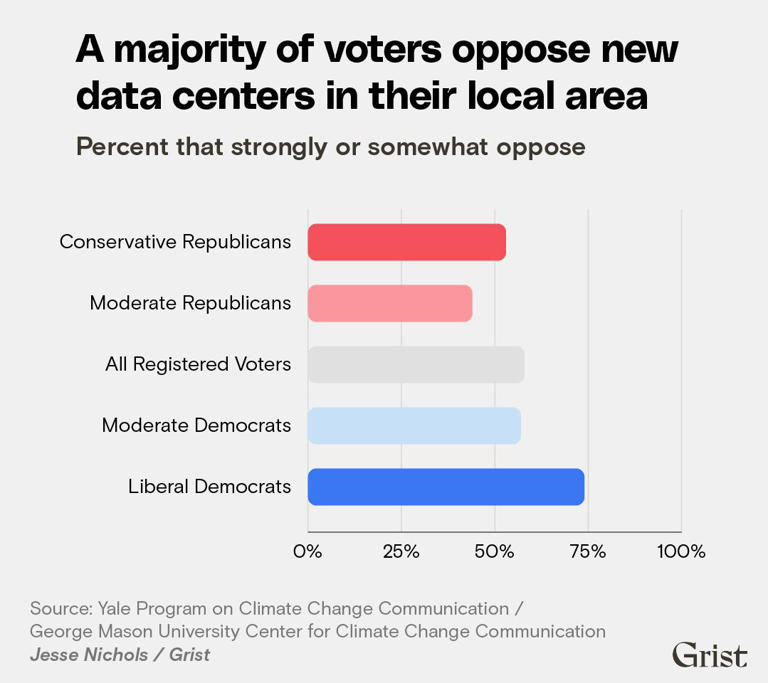
A nationwide backlash against data centers has erupted at the polls, transforming local zoning boards and municipal elections into high-stakes battlegrounds. From the rolling hills of Prince William County, Virginia—historically known as "Data Center Alley"—to burgeoning tech hubs in Maricopa County, Arizona, and rural precincts in Georgia, everyday voters are exercising unprecedented veto power over the physical footprint of the digital economy.
The Catalytic Turning Point: Grid Capacity Meets Main Street
The roots of this electoral rebellion lie in a fundamental collision between energy consumption and civic quality of life. Hyperscale facilities operated by trillion-dollar technology conglomerates routinely demand between 100 and 1,000 megawatts of continuous power—equivalent to the electrical load of mid-sized cities. As utilities strain to accommodate this unprecedented load growth driven by Large Language Model (LLM) training clusters, local residents are experiencing tangible externalities: soaring utility bills, persistent low-frequency hums from industrial-grade cooling fans, and the transformation of agrarian landscapes into seas of tilt-up concrete and diesel backup generators.
Market liquidity and infrastructure scalability have historically allowed developers to bypass protracted public friction by acquiring cheap agricultural acreage near high-capacity electrical substations. However, municipal elections over the past two vertical voting cycles have exposed critical vulnerabilities in this risk mitigation strategy. When local town councils approved multi-billion-dollar campuses over neighborhood objections, grassroots organizations mobilized political action committees (PACs), weaponized referendum laws, and unseated pro-development incumbents.
Financial Fallout: Reassessing Capital Expenditure and Enterprise ROI
For institutional investors, private equity titans, and hyperscalers, this civic uprising introduces profound volatility into financial modeling. Capital expenditure (CapEx) directed toward digital infrastructure faces indefinite delays, forcing corporate treasurers to reevaluate risk mitigation protocols.
When a municipal referendum stalls a $2 billion hyperscale installation:
- Development Yields Compress: The cost of carrying idle land while navigating protracted litigation or redesigning site plans erodes projected internal rates of return (IRR).
- Valuation Multiples Adjust: Real estate investment trusts specializing in data center assets are experiencing downward multiple adjustments as institutional allocators price in regulatory friction and zoning risk.
- Stranded Capital Risk: Equipment orders—including high-voltage transformers, liquid-cooling manifolds, and specialized server racks—cannot be easily repurposed when a primary site is blocked, leading to severe supply chain bottlenecks.
Furthermore, corporate compliance burdens are escalating. Institutional debt providers now demand granular environmental, social, and governance (ESG) verifications regarding water consumption in drought-prone regions, alongside ironclad guarantees of renewable energy procurement that do not destabilize local grids.
Data Breakdown: The Hyperscale Expansion vs. Electoral Resistance
To understand the sheer magnitude of the clash between digital demand and local governance, consider the comparative metrics across key operational theaters:
| Metropolitan Region | Average Facility Load (MW) | Primary Point of Friction | Market Valuation Impact |
|---|---|---|---|
| Northern Virginia (Loudoun/Prince William) | 150 – 500+ MW | Grid saturation, historic preservation, and transmission line noise | Moderate multiple compression; increased litigation reserves |
| Phoenix Metro (Maricopa County) | 100 – 300 MW | Aquifer depletion and intensive industrial water cooling | High regulatory scrutiny; pivot to closed-loop systems |
| Atlanta Suburbs (Newton/Gwinnett) | 75 – 250 MW | Residential proximity and municipal tax incentive pushback | CapEx delays averaging 18 to 36 months per campus |
| Central Ohio (Columbus Exurbs) | 200 – 600 MW | Agricultural land loss and residential power rate hikes | Heightened ballot referendum risks for greenfield sites |
Industry Implications: Winners, Losers, and Strategic Pivots
As the political landscape hardens, corporate strategies are undergoing mandatory evolution. The traditional playbook of securing quick zoning approvals through fiscal promises of municipal tax windfalls is no longer yielding guaranteed results. Communities have grown sophisticated, recognizing that automated server farms offer remarkably few permanent jobs relative to their immense physical and environmental footprint.
Who Wins: Established operators with fully permitted, operational brownfield assets in legacy markets retain immense pricing power. Furthermore, engineering firms specializing in closed-loop liquid cooling, modular micro-nuclear power integration, and advanced acoustic baffling are seeing unprecedented demand as developers race to appease local stakeholders.
Who Loses: Pure-play greenfield land speculators who banked on perpetual suburban expansion without accounting for local political blowback face stranded asset risk. Additionally, regional utilities caught between state-level economic development mandates and furious local ratepayers are struggling to reconcile grid capacity requirements.
Frequently Asked Questions (People Also Ask)
Why are voters suddenly rejecting data center developments at the ballot box?
Voters are increasingly concerned about the staggering electrical and water demands of modern hyperscale facilities, particularly their impact on local utility rates and grid stability. Coupled with noise pollution, heavy industrial truck traffic, and the transformation of rural or suburban landscapes, residents are leveraging local referendum laws to halt projects that were previously rubber-stamped by municipal councils.
How does local zoning pushback affect cloud compute architecture and AI expansion?
When municipal approvals stall or fail, tech giants and cloud providers face severe bottlenecks in deploying high-density GPU clusters required for generative AI training. This forces architects to redesign deployment models, seek secondary and tertiary markets, or invest heavily in behind-the-meter power generation to bypass congested local grids.
What are the financial implications for real estate investment trusts (REITs) and developers?
Institutional developers face prolonged capital expenditure cycles, increased legal expenses, and compressed valuation multiples. Projects delayed by ballot initiatives or litigation suffer from impaired internal rates of return (IRR), prompting Wall Street to apply stricter risk premiums to greenfield digital infrastructure investments.
Are state legislatures stepping in to override local zoning decisions?
It is a mixed regulatory landscape. While some states eager for technology tax revenues are considering preemption bills to limit municipal blocking power, others are enacting stricter statewide water-use limits and noise ordinances, creating a complex compliance matrix for infrastructure developers.
Future Outlook: Strategic Horizons and Key Milestones
As the dust settles from recent municipal elections, institutional market participants are recalibrating their long-term infrastructure roadmaps. The era of frictionless, rapid greenfield deployment is effectively over. Moving forward, successful data center capital allocation will hinge on proactive community engagement, advanced technological efficiency, and ironclad regulatory compliance.
Key operational and financial milestones to monitor over the next twelve to twenty-four months include:
- State-Level Preemption Battles: Legislative showdowns in tech-heavy states determining whether municipal governments retain absolute veto power over digital infrastructure.
- Behind-the-Meter Energy Innovation: Direct corporate investments in modular nuclear reactors (SMRs), geothermal power, and advanced battery storage to decouple hyperscale campuses from fragile public grids.
- Valuation Re-ratings: Quarterly earnings reports from major data center REITs detailing the impact of zoning friction on forward-looking revenue guidance and development pipelines.
Ultimately, the nationwide backlash at the polls serves as a potent reminder to the technology sector: the virtual cloud rests entirely on physical infrastructure, and physical infrastructure must answer to the communities upon which it is built.