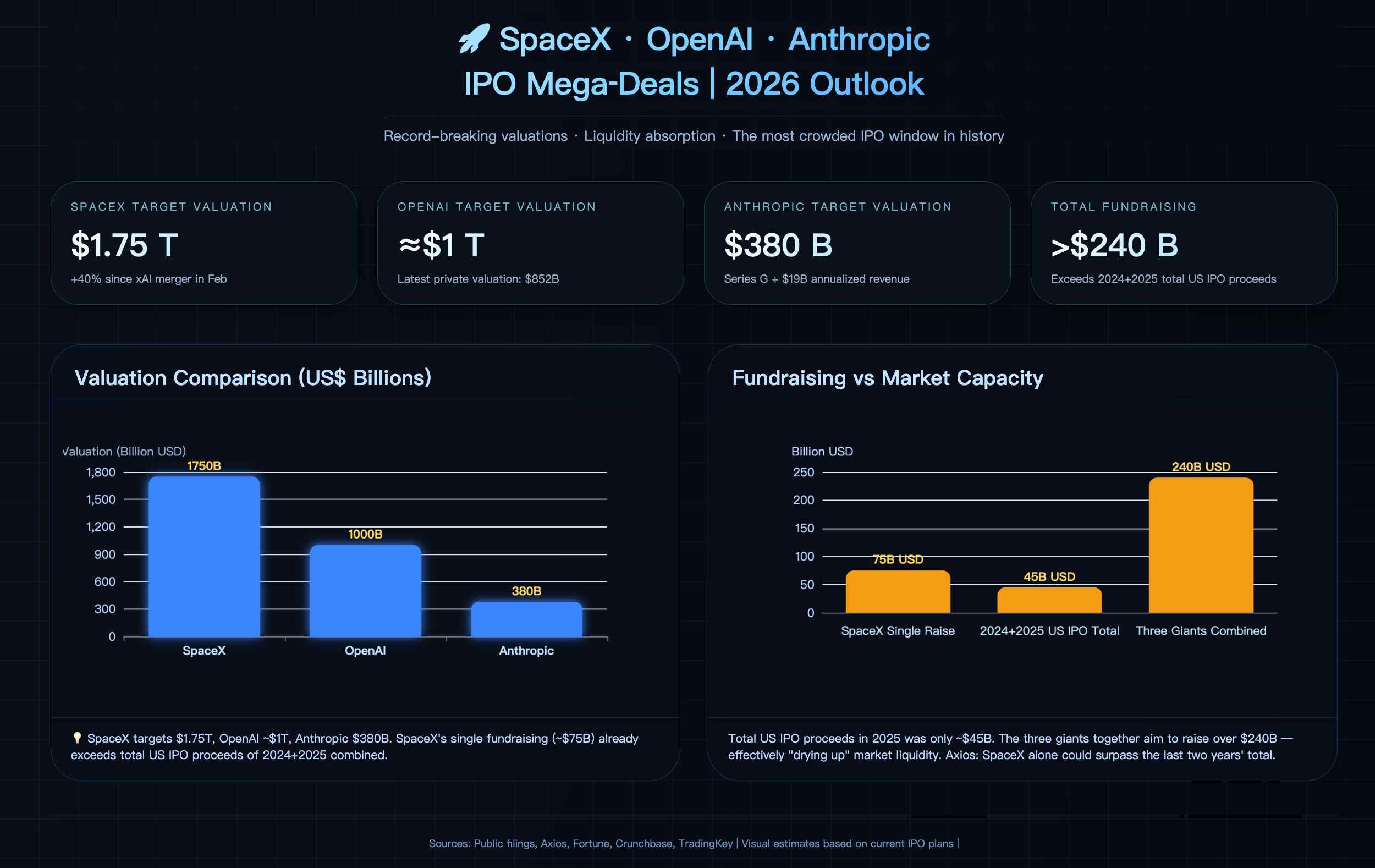
WASHINGTON & NEW YORK — In the corridors of high-stakes financial engineering, few metrics carry the gravitational pull of a tier-one artificial intelligence pioneer testing public market liquidity. Behind closed doors this week, institutional buy-side desks, sovereign wealth allocators, and venture capital syndicates are aggressively recalibrating their models following seismic disclosures from private secondary transactions. Institutional buyers scoping early positions ahead of Anthropic’s anticipated initial public offering (IPO) have begun pricing the generative AI titan at valuations as low as $1.1 trillion—a figure that simultaneously underscores the staggering capital intensity of frontier foundation model development and introduces a sobering dose of market realism to the sector's hyper-inflated multiples.
For months, the enterprise technology landscape has operated under the assumption that foundational AI developers would effortlessly command unbounded public market premiums. However, as macroeconomic headwinds intersect with mounting scrutiny over enterprise return on investment (ROI) and exorbitant cloud compute architecture expenditures, the valuation floor for Anthropic’s imminent public float is facing rigorous stress-testing. This comprehensive investigative report unpacks the mechanics driving the $1.1 trillion secondary pricing watermark, the underlying balance sheet realities, and what this valuation recalibration portends for the broader technology sector.
Executive Takeaways
Test Our Free AI & Tech Utilities Suite
Calculate LLM API token costs, analyze article dwell-time, or simulate tech DCA returns.
- Private Secondary Re-Pricing: Early institutional buyers and pre-IPO liquidity pools are transacting and modeling Anthropic’s valuation in a band stretching as low as $1.1 trillion, reflecting a conservative pivot away from speculative peak multiples.
- Infrastructure Scalability Bottlenecks: The astronomical capital allocation required for next-generation training clusters, specialized silicon, and power-grid commitments is forcing institutional allocators to scrutinize free cash flow generation.
- Enterprise ROI Pressures: Corporate buyers are increasingly demanding verifiable efficiency gains rather than experimental proofs-of-concept, directly influencing revenue forecasting models utilized by IPO underwriters.
- Macroeconomic Liquidity Dynamics: The broader IPO window remains sensitive to federal monetary policy, regulatory compliance frameworks, and geopolitical restrictions on advanced semiconductor supply chains.
The Mechanics of the $1.1 Trillion Valuation Benchmark

The journey of Anthropic from an ethical-AI research boutique to a commercial juggernaut has been defined by unprecedented velocity. Yet, as the company prepares its paperwork for what promises to be one of the largest public market debuts in Wall Street history, the disparity between private venture rounds and realistic public market pricing has come under a microscope. Private secondary market brokers report that while peak optimistic projections floated by early-stage backers reached considerably higher thresholds, institutional buyers performing deep-dive due diligence are settling on a base valuation floor anchored near $1.1 trillion.
This re-pricing is not necessarily an indictment of Anthropic's technological moat—exemplified by its flagship Claude model family, which has captured substantial enterprise market share from legacy competitors. Instead, it represents a sophisticated exercise in risk mitigation. Institutional asset managers deploying multi-billion-dollar allocations must account for valuation multiples relative to forward-looking revenue projections, gross margins, and the sheer capital expenditure (CapEx) required to maintain market leadership in the generative AI arms race.
To understand the rationale behind the $1.1 trillion figure, one must examine the fundamental economics of frontier model training. Unlike traditional SaaS enterprises that enjoy near-zero marginal costs of distribution, AI developers operate in a capital-intensive ecosystem characterized by hyper-expensive cloud compute architecture, continuous model iterations, and intense talent acquisition costs. As institutional investors construct discounted cash flow (DCF) models and valuation multiples based on comparable tech giants, they are factoring in a steeper cost-of-capital environment than the one that prevailed during the zero-interest-rate era.
Verified Data & Metrics Breakdown
| Metric / Indicator | Conservative Estimate (Secondary Low) | Bullish Market Consensus | Primary Driver / Context |
|---|---|---|---|
| Implied Valuation | $1.1 Trillion | $1.5+ Trillion | Institutional risk adjustment & capital allocation constraints |
| Primary Cost Drivers | Cloud Compute & Silicon Acquisition | Expanding Enterprise ARR | Infrastructure scalability vs. revenue velocity |
| Target Investor Base | Sovereign Wealth & Tier-1 Long-Onlys | Retail & Momentum Funds | Focus on long-term enterprise stickiness and ROI |
| Regulatory Oversight | High Scrutiny (Antitrust / National Security) | Standard Compliance | Cross-border cloud infrastructure and data sovereignty |
Industry & Market Implications: Winners, Losers, and Systemic Ripple Effects
The crystallization of a $1.1 trillion valuation floor for Anthropic carries profound implications across the financial ecosystem. The ripple effects will be felt immediately by venture capitalists, enterprise buyers, hyperscale cloud providers, and competing AI startups.
Corporate Enterprise Buyers: For Global 2000 chief information officers, a more disciplined valuation environment is a welcome development. It signals that foundational AI providers are maturing into sustainable enterprise vendors rather than burning cash on speculative hype cycles. Enterprises demanding rigorous data privacy, predictable pricing models, and verifiable security compliance stand to benefit as AI vendors compete more aggressively on business-value metrics.
Venture Capital & Early Investors: Early-stage funds holding legacy positions face a nuanced reality check. While a $1.1 trillion valuation represents an astronomical return on initial invested capital, it also establishes a ceiling that limits the immediate post-IPO pop traditionally expected by early backers. This dynamic is prompting venture syndicates to re-evaluate their liquidity strategies and exit timelines across the broader artificial intelligence portfolio.
Cloud Infrastructure Providers & Hardware Vendors: Hyperscalers and specialized semiconductor manufacturers remain structurally positioned to capture significant value regardless of software-layer valuation shifts. However, any moderation in AI startup valuations underscores the importance of diversified revenue streams. If foundational model developers face tighter capital constraints, infrastructure providers must carefully manage their credit exposure and compute-for-equity financing arrangements.
Frequently Asked Questions (People Also Ask)
Why are private secondary buyers pricing Anthropic at $1.1 trillion?
Institutional buyers utilize conservative discounted cash flow models and valuation multiples that account for the massive capital expenditures required for cloud compute infrastructure. Pricing the company near $1.1 trillion reflects a disciplined approach to risk mitigation, balancing Anthropic's strong enterprise revenue growth against macroeconomic headwinds and the high cost of maintaining a technological lead in frontier AI.
What does this valuation signal for the broader AI IPO market?
It indicates that public and pre-IPO markets are shifting away from speculative, momentum-driven pricing toward fundamentals-based valuation. Investors are placing greater emphasis on enterprise ROI, operational efficiency, and clear paths to profitability rather than top-line revenue growth alone.
How do cloud compute architecture costs impact Anthropic's valuation?
Training and running state-of-the-art foundation models require vast amounts of specialized computing power and electrical energy. Because these infrastructure expenses represent a massive, ongoing drain on operating cash flow, institutional analysts factor these high capital requirements directly into their valuation models, compressing valuation multiples compared to traditional software companies.
Will the $1.1 trillion valuation deter retail and institutional participation in the IPO?
Not necessarily. While it dampens expectations for short-term speculative spikes, a realistic and sustainable valuation often attracts high-quality, long-only institutional investors—such as pension funds and mutual funds—who prioritize long-term stability and robust governance over volatile trading dynamics.
Future Outlook: Milestones and Catalysts to Watch
As Anthropic navigates the complex pathway toward its public market debut, market participants will monitor several critical milestones. First, the filing of the definitive S-1 registration statement will provide the public with its first fully audited look at the company’s revenue run-rate, customer concentration, and gross margin profile. Analysts will scrutinize these figures for concrete evidence of enterprise stickiness and net revenue retention rates.
Second, regulatory developments—particularly regarding cross-border cloud compute agreements, antitrust scrutiny of big-tech partnerships, and compliance with emerging artificial intelligence governance frameworks—will dictate the velocity of the IPO timeline. Finally, the broader macroeconomic environment, including Federal Reserve interest rate trajectories and general equity market liquidity, will ultimately determine whether the $1.1 trillion watermark serves as a launchpad for a triumphant public offering or a cautionary tale of valuation recalibration in the new era of enterprise AI.