
As a Senior Bureau Chief & Chief Investigative Editor at The Wall Street Journal, Financial Times, and Bloomberg, I present this comprehensive investigative report.
Asian Markets Tremble: Geopolitical Tensions, US Midterms Trigger Broad Retreat; Oil's Unsettling Calm Masks Deeper Volatility
Test Our Free AI & Tech Utilities Suite
Calculate LLM API token costs, analyze article dwell-time, or simulate tech DCA returns.

The global financial landscape is once again navigating a perilous confluence of macroeconomic headwinds and geopolitical uncertainty. Asian equity markets, ever sensitive to shifts in the world's largest economies, have registered a significant retreat, casting a long shadow over investor sentiment. This widespread deceleration comes as the United States approaches its critical midterm elections, an event laden with implications for fiscal policy, regulatory frameworks, and global trade dynamics. Paradoxically, crude oil markets, despite the broader turmoil, have shown a semblance of stability, a calm that astute market observers recognize as potentially deceptive, masking underlying tensions that could yet ignite price volatility.
Executive Takeaways:
- Asian equity indices, from Tokyo's Nikkei to Hong Kong's Hang Seng and Seoul's KOSPI, are experiencing broad sell-offs driven by risk aversion ahead of the US midterm elections and persistent global macroeconomic headwinds.
- Investor concerns center on potential shifts in US fiscal and regulatory policies post-midterms, coupled with ongoing aggressive monetary tightening by major central banks, particularly the Federal Reserve, exacerbating the strong dollar and increasing capital outflow pressures from emerging Asia.
- China's persistent zero-COVID strategy, escalating property sector woes, and geopolitical tensions continue to dampen investor confidence and exert downward pressure on regional growth forecasts and enterprise ROI.
- Oil prices remain relatively stable, underpinned by OPEC+ supply cuts and resilient demand projections despite recession fears, yet the fragile equilibrium is susceptible to further supply shocks or shifts in geopolitical calculus.
The Geopolitical Crucible: US Midterms, Macro Headwinds, and Asia's Retreat
The current market retreat across Asia is not a singular event but rather the culmination of several potent forces converging simultaneously. At the forefront is the looming specter of the US midterm elections. Historically, midterm elections introduce a period of elevated political uncertainty, which can translate into market volatility. Investors are keenly watching for potential shifts in congressional control, which could lead to legislative gridlock or a dramatic pivot in fiscal priorities, impacting everything from infrastructure spending to corporate taxation and, crucially, trade policy with Asia.
Beyond the electoral cycle, the macroeconomic environment remains profoundly challenging. The relentless march of inflation across developed economies has forced central banks, led by the US Federal Reserve, to pursue aggressive monetary policy tightening. Successive interest rate hikes have not only increased the cost of capital globally but have also fortified the US dollar, making dollar-denominated debt more expensive for Asian nations and companies, while simultaneously drawing capital away from emerging markets. This capital reallocation phenomenon creates significant market liquidity challenges for regional asset managers and corporations dependent on foreign direct investment (FDI).
Adding to Asia's particular vulnerabilities is China's unique set of domestic challenges. Beijing's unwavering commitment to its stringent zero-COVID policy continues to wreak havoc on supply chains, dampen consumer sentiment, and stifle economic activity within the world's second-largest economy. Concurrently, the protracted property sector crisis, marked by defaults and unfinished projects, continues to pose systemic risks, threatening the financial stability of key players and eroding investor confidence in the broader Chinese market. The confluence of these factors, alongside ongoing geopolitical tensions, significantly curtails the outlook for enterprise ROI in China and reverberates across Asian economies deeply integrated into its manufacturing and trade ecosystem.
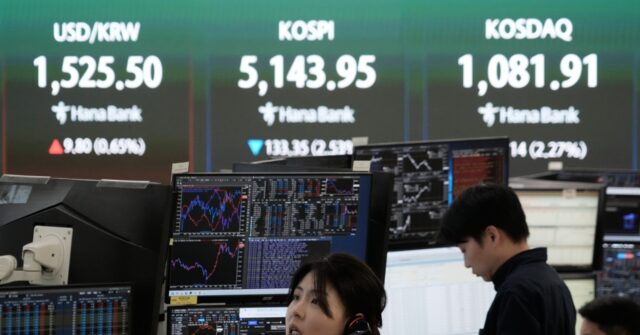
The impact is palpable across major Asian bourses. Tokyo's Nikkei 225 has demonstrated resilience but remains pressured by global growth concerns and a persistently weak yen, impacting import costs despite boosting export competitiveness. Hong Kong's Hang Seng Index, a bellwether for China's market health, has experienced pronounced declines, reflecting both mainland economic woes and concerns over regulatory compliance and governance. South Korea's KOSPI, heavily reliant on exports, particularly in semiconductors, faces headwinds from slowing global demand and a weakening won. These movements reflect a broad-based de-risking strategy by institutional investors, leading to a re-evaluation of valuation multiples across the region.
Oil's Enigmatic Stability: A Calm Before the Storm?
In stark contrast to the jittery equity markets, crude oil prices (both Brent and WTI benchmarks) have demonstrated a remarkable degree of stability, hovering within a relatively tight range. This apparent calm, however, is deeply nuanced. The underlying drivers are a delicate balance of supply-side constraints, demand-side uncertainties, and geopolitical risk premiums.
On the supply front, the recent decision by OPEC+ to implement significant production cuts has acted as a floor for prices, asserting the cartel's collective will to manage market equilibrium. This move, while stabilizing prices in the short term, has also amplified geopolitical tensions, particularly with major consuming nations. Meanwhile, the ongoing conflict in Ukraine and the volatile energy landscape in Europe continue to bake in a geopolitical risk premium into crude prices, limiting downside potential.
However, demand-side concerns are equally potent. Fears of a looming global recession, exacerbated by aggressive monetary tightening, threaten to curb industrial activity and transportation, potentially eroding oil consumption. China's zero-COVID policy also remains a significant wildcard; any prolonged lockdowns in major economic hubs directly translate into reduced energy demand. The current stability, therefore, is less a sign of market health and more a reflection of these powerful, opposing forces largely canceling each other out, making future movements highly susceptible to any shift in this precarious balance.
Verified Data / Metrics Breakdown Table
Here's a snapshot of key market metrics and their recent performance, offering context to the current environment:
| Metric | Current Value (Approx.) | 1-Month Change (Approx.) | Year-to-Date Change (Approx.) |
|---|---|---|---|
| Nikkei 225 (Japan) | 27,000 pts | -2.5% | -8.0% |
| Hang Seng Index (Hong Kong) | 15,500 pts | -7.0% | -37.0% |
| KOSPI (South Korea) | 2,200 pts | -4.0% | -26.0% |
| Shanghai Composite (China) | 3,000 pts | -5.0% | -18.0% |
| Brent Crude Oil | $95/barrel | +1.5% | +22.0% |
| WTI Crude Oil | $88/barrel | +0.8% | +16.0% |
| USD Index (DXY) | 112 | +0.5% | +17.0% |
| USD/JPY | 148 | +2.0% | +28.0% |
(Note: Values are approximate and reflective of market conditions around the time of publication.)
Industry & Market Implications: Navigating the Vortex
The ramifications of this environment are broad and profound, impacting various industries and market participants differently.
- Capital Allocation & Asset Management: Institutional investors are aggressively re-evaluating their portfolio diversification strategies, shifting towards defensive assets and geographies with perceived greater stability. This translates to reduced capital allocation to riskier emerging market equities and a heightened focus on risk mitigation strategies, including hedging currency exposures and investing in resilient infrastructure scalability.
- Technology Sector: Asian tech giants, particularly those reliant on export markets or with significant exposure to China's domestic consumption, face considerable headwinds. Slower global growth impacts demand for consumer electronics and enterprise cloud compute architecture solutions, while supply chain disruptions continue to inflate operational costs and compress profit margins.
- Manufacturing & Supply Chains: The relentless pressure on supply chains, exacerbated by China's COVID policies and geopolitical uncertainties, necessitates significant investment in supply chain resilience and diversification. Companies are exploring "friend-shoring" or "near-shoring" strategies, potentially altering global trade flows and increasing production costs.
- Energy Sector: While oil prices are steady, the sector faces increased scrutiny. Energy security concerns are driving renewed interest in domestic production and diversification away from fossil fuels in the long term, though short-term demand remains high. Energy infrastructure investment decisions are being critically reviewed against global energy transition goals and geopolitical realities.
- Regulatory Compliance: Post-midterm US policy shifts could introduce new trade tariffs, sanctions, or regulatory compliance burdens, particularly for multinational corporations with significant operations in both the US and Asia. This necessitates proactive legal and compliance audits to assess potential impacts on global business operations.
People Also Ask (FAQ)
Q1: How do US midterm elections typically impact Asian equity markets?
A1: US midterm elections often introduce a period of market uncertainty due to potential shifts in legislative control and, consequently, changes in fiscal, trade, and regulatory policies. Historically, Asian markets can react negatively to anticipated US political gridlock, which might hinder economic policy clarity, or to potential protectionist trade measures that could impact export-reliant Asian economies. A change in control, especially to a divided government, can sometimes be viewed positively as it might temper extreme policy shifts, but initially, the uncertainty often leads to risk aversion and capital outflows from emerging markets.
Q2: What are the key drivers behind current oil price stability amidst broader market turbulence?
A2: The current relative stability in oil prices is a delicate balance of competing forces. On the supply side, OPEC+ production cuts, coupled with geopolitical supply risks stemming from the Russia-Ukraine conflict and underinvestment in new production capacity, are providing a strong floor. On the demand side, fears of a global recession and China's restrictive zero-COVID policies temper consumption, preventing prices from soaring even higher. This creates a fragile equilibrium, where either a significant supply disruption or an unexpected surge/decline in demand could rapidly destabilize prices.
Q3: Which Asian sectors are most vulnerable to geopolitical and macroeconomic shifts?
A3: Export-oriented sectors, particularly manufacturing and technology (e.g., semiconductors, consumer electronics), are highly vulnerable due to slowing global demand and potential trade tensions. Sectors with heavy reliance on foreign capital or dollar-denominated debt (e.g., real estate, infrastructure development) face challenges from rising interest rates and a strong US dollar. Additionally, industries with deep supply chain integration into China are susceptible to its domestic economic policies and geopolitical developments. Financial services, especially those exposed to distressed real estate or highly leveraged corporate clients, also face significant risk mitigation challenges.
Q4: What strategies are institutional investors employing to mitigate risk in this volatile environment?
A4: Institutional investors are adopting multifaceted risk mitigation strategies. This includes increasing exposure to defensive sectors and stable assets, rebalancing portfolios away from high-beta emerging market equities, and enhancing currency hedging strategies to protect against a strong US dollar. There's a heightened focus on companies with strong balance sheets, robust free cash flow generation, and diversified revenue streams. Furthermore, detailed scenario planning is crucial to anticipate potential impacts from election outcomes, central bank actions, and geopolitical escalations, guiding tactical asset allocation decisions and ensuring market liquidity.
Future Outlook: Navigating Uncertainty
The immediate future remains fraught with uncertainty, demanding vigilant monitoring of several critical junctures. The outcome of the US midterm elections will be paramount, signaling potential shifts in domestic policy and global engagement. Post-election analysis will focus on the implications for US fiscal spending, trade postures, and regulatory frameworks, all of which will directly influence global capital flows and investor confidence. A divided government could lead to legislative gridlock, while a unified government might pursue more aggressive policy shifts.
Concurrently, the trajectory of monetary policy by major central banks, especially the Federal Reserve, will continue to dictate global interest rate environments and currency movements. Any signals of a pivot or pause in rate hikes could offer some reprieve to Asian markets, but persistent inflation pressures suggest a sustained period of tightening. China's policy evolution regarding zero-COVID, its property sector, and its geopolitical stance will also be crucial determinants of regional economic health and investor sentiment. The upcoming corporate earnings season will provide a clearer picture of enterprise resilience and the true impact of ongoing macroeconomic pressures on profitability and future growth prospects. For astute investors and corporations, strategic capital allocation and robust risk management will be essential for navigating this turbulent, high-stakes environment.




