Executive Takeaways
Test Our Free AI & Tech Utilities Suite
Calculate LLM API token costs, analyze article dwell-time, or simulate tech DCA returns.
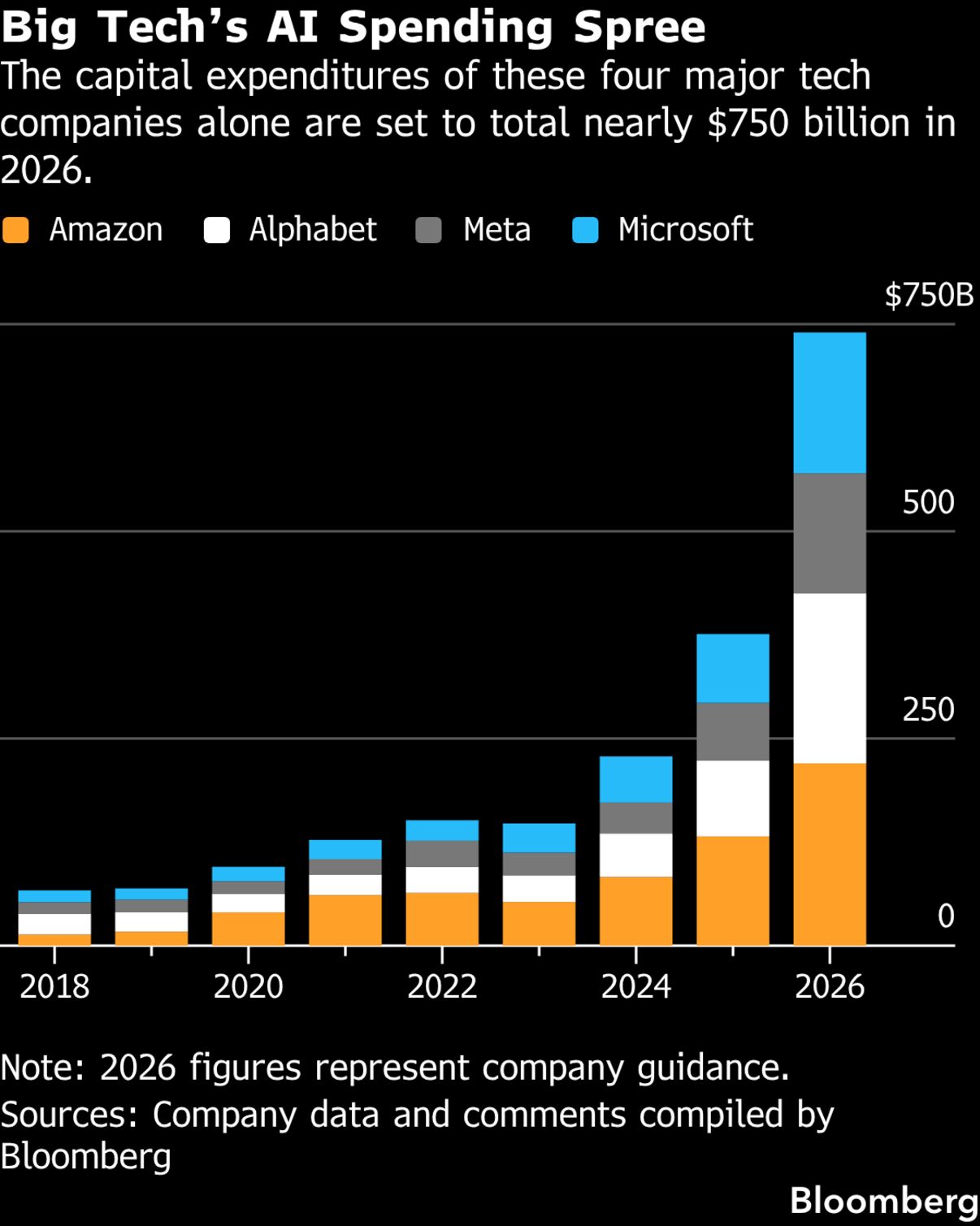
- Unprecedented Capital Outlays: The aggregate capital expenditure (CapEx) commitment across hyperscalers—Microsoft, Alphabet, Meta, and Amazon—is on track to top $750 billion cumulatively through 2026, driven almost entirely by AI data center builds, custom silicon, and enterprise GPU clusters.
- Core Revenue Friction: This historic capital allocation phase is directly colliding with decelerating growth in legacy engines: cloud compute migration rates are normalizing, digital advertising yields are flattening, and hardware replacement cycles remain stretched.
- The Sovereign & Emerging Market Compute Rush: Global appetite for accelerated compute is expanding beyond Silicon Valley, highlighted by Indian AI infrastructure firms aggressively seeking up to $3 billion in project financing to secure massive Nvidia chip allotments.
- Institutional Investor Impatience: Wall Street is pivoting from rewarding speculative infrastructure spending to demanding immediate, margin-accretive enterprise ROI, placing historic compression pressure on tech earnings multiples.
The $750 Billion Infrastructure Supercycle vs. The Core Growth Deceleration

In the executive suites of Menlo Park, Mountain View, Redmond, and Seattle, a quiet tension is reshaping corporate finance. Over the next three fiscal years, the four dominant hyperscale cloud and platform providers—Microsoft, Alphabet, Meta, and Amazon—are projected to deploy over $750 billion in cumulative capital expenditure. The objective is total market dominance over the emerging artificial intelligence stack, ranging from high-bandwidth memory (HBM) architectures to gigawatt-scale data centers designed for large-model training and real-time inference.
Yet, this mega-cap investment wave is running headlong into a structural reality: the core engines that generate the free cash flows financing this transition are slowing down. Digital advertising revenues across search and social platforms are maturing into single-digit or lower double-digit growth trajectories. Meanwhile, enterprise cloud migrations, which drove sustained 30%+ annual expansions for AWS, Azure, and Google Cloud over the past decade, have entered an optimization phase. Enterprise chief information officers (CIOs) are scrutinizing balance sheets, rationalizing legacy software seats, and demanding strict cost controls before expanding enterprise workloads.
The result is a glaring divergence between corporate spending and enterprise revenue realization. While balance sheet investments in data centers and accelerated hardware continue to rise exponentially, direct monetization of generative AI tools—such as copilot add-ons, proprietary LLM APIs, and customized agentic enterprise workflows—is accumulating at a far more modest, linear pace. Institutional investors are beginning to ask whether Big Tech is committing the classic macroeconomic error of overbuilding physical infrastructure well ahead of terminal software demand.
The Global Compute Race: Inside India’s $3 Billion Nvidia Procurement Blitz
The supply-side bottleneck for AI hardware has created a secondary, highly aggressive global debt and equity capital market dynamic. The scramble for accelerated silicon is no longer confined to hyperscalers in North America. In a dramatic signal of regional technology sovereignty, leading Indian AI infrastructure consortia and datacenter developers are actively negotiating project financing structures worth up to $3 billion to lock down multi-thousand-unit orders of Nvidia’s advanced GPU architectures, including H100, H200, and Blackwell B200 systems.
This massive Indian financing initiative highlights a fundamental structural trend: sovereign AI mandates and regional compute hubs are competing directly with Western technology conglomerates for precious supply chain quotas. Indian technology conglomerates and specialized cloud providers are utilizing structured asset-backed loans, vendor financing, and private equity syndicates to underwrite hardware orders before global allocation windows close. The goal is to build domestic compute clusters that can service India’s surging developer base, banking sector, and localized AI applications without relying entirely on cross-border cloud routing subject to high latency and data residency constraints.
However, this global procurement frenzy amplifies financial systemic risk across the tech hardware ecosystem. As sovereign entities, specialized cloud providers, and tier-1 hyperscalers all bid for identical semiconductor supply, Nvidia and memory manufacturers are enjoying historic gross margins exceeding 75%. In contrast, the end-operators taking on heavy long-term debt loads face steep amortization schedules, rapid GPU hardware depreciation cycles (typically 3 to 5 years), and elevated power density costs—forcing an urgent search for immediate enterprise monetization to service this expensive capital structure.
Data Breakdown: Hyperscaler Capital Intensity vs. Core Engine Financials
To contextualize the scale of this capital reallocation, the following table breaks down estimated capital expenditures, core revenue growth deceleration, and projected AI revenue run-rates across the key industry players:
| Company / Entity | Est. 2024-2026 Cumulative AI CapEx | Core Revenue Engine YoY Growth Trend | Current Est. Annualized AI Revenue Run-Rate | Primary Hardware & Infrastructure Focus |
|---|---|---|---|---|
| Microsoft | $185B - $210B | Azure Cloud: Decelerating from 31% to ~28-29% | $10.0B+ (Copilot + Azure OpenAI) | Nvidia H100/B200, Custom Maia 100 ASICs, Data Centers |
| Alphabet (Google) | $160B - $180B | Search & YouTube Ads: Normalizing to 11-13% | $6.5B+ (Google Cloud AI & Gemini Enterprise) | Custom TPU v5p & Trillium, Nvidia Infrastructure |
| Amazon (AWS) | $190B - $215B | AWS Core Migration: Stabilizing at 17-19% | $7.0B+ (Bedrock, Trainium, Q) | Custom Trainium2/Inferentia2, Nvidia Systems |
| Meta Platforms | $110B - $130B | Family of Apps Ads: Fluctuation between 14-18% | Indirect (Ad Targeting & Recommendation Engine ROI) | Nvidia Clusters, Custom MTIA Silicon, Open Source Llama |
| Indian AI Infrastructure Firms | $3.0B - $5.0B (Project Financing) | Regional Cloud Services: Rapid base expansion | Early-stage (< $500M localized compute rental) | Nvidia H100/H200/B200 direct enterprise allocations |
Margin Compression and the Enterprise ROI Bottleneck
The economic dilemma facing corporate leadership centers on fundamental margin architecture. Traditional software-as-a-service (SaaS) business models enjoyed gross margins between 75% and 85%, given the near-zero marginal cost of replicating code and distributing cloud instances. Generative AI fundamentally shifts these financial physics. Inference requests require significant real-time compute power, continuous high-bandwidth memory access, and massive electricity consumption. Consequently, every AI query incurs a tangible operational expense, driving gross margins down toward 50% to 60% for AI-native software applications.
At the same time, enterprise enterprise procurement teams are exercising strict fiscal discipline. Chief Information Security Officers (CISOs) and enterprise tech buyers are expressing hesitation around several key implementation friction points:
- Data Privacy & Governance: Concerns over proprietary corporate data leaking into public inference pipelines or multi-tenant foundational models.
- Hallucination & Reliability Limits: High error rates in domain-specific tasks (e.g., legal discovery, quantitative finance, clinical diagnostics) requiring manual human-in-the-loop oversight, negating cost savings.
- Unclear Productivity Offsets: Difficulty in attributing concrete revenue expansion or direct headcount cost reductions specifically to AI software seat licenses.
- Integration Costs: Heavy consulting and system integration fees required to clean legacy unstructured enterprise data before LLMs can interact with internal datastores securely.
Because enterprise revenue ramps up slowly through protracted pilot programs and complex implementation lifecycles, hyperscalers are bearing the immediate cash drag of multi-billion-dollar hardware deployments today for revenues that may only materialize late in the decade. Wall Street analysts have responded by trimming target valuation multiples, signaling that capital expenditure without clear visibility into near-term free cash flow accretion will no longer command a market premium.
Industry & Market Implications: Winners, Losers, and Macro Shifts
This dynamic is reordering the balance of power across the global technology value chain, creating distinct cohorts of structural winners and margin-squeezed operators:
The Structural Winners
- Upstream Semiconductor and Memory Producers: Chip designers (Nvidia, AMD) and advanced foundry ecosystem partners (TSMC, SK Hynix, Micron) remain primary capital beneficiaries, capturing immediate, high-margin cash flow upfront.
- Energy, Grid Infrastructure, and Power Utilities: Data center expansion has turned electric utilities, nuclear power generators, and grid hardware providers into critical bottlenecks, granting them high pricing power and long-term supply agreements.
- Specialized ASIC & Custom Silicon Designers: Broadcom and Marvell, alongside internal hyperscaler ASIC development teams, stand to gain as tech firms seek to reduce dependency on premium third-party GPUs.
The At-Risk Cohort
- Legacy Tier-2 SaaS Vendors: Middleware and point-solution enterprise software vendors lacking deep native AI capabilities face seat contraction, severe pricing pressure, and customer attrition.
- Capital-Constrained Hyperscale Challengers: Middle-tier cloud providers attempting to build out competing foundational infrastructure without mega-cap balance sheets risk catastrophic leverage levels and liquidity distress.
- Broad Market Valuations: Big Tech equities, which comprise an unprecedented percentage of index market capitalization, risk multiple compression if free cash flow yields continue to deteriorate under heavy capital intensity.
Frequently Asked Questions (People Also Ask)
Why are Big Tech companies continuing to increase AI capital expenditure despite slowing legacy business growth?
Technology executives view the shift toward artificial intelligence as an existential platform transition, comparable to the arrival of the commercial internet or the mobile ecosystem. Falling behind in raw compute power or model capability risks structural obsolescence across core software, search, and cloud markets. Consequently, management teams are deliberately choosing short-term margin compression and reduced free cash flow over the strategic risk of under-investing in foundational compute capacity.
How is the $750 billion AI infrastructure cycle impacting enterprise cloud margins?
Unlike traditional cloud compute infrastructure—where fixed hardware assets are amortized over five to seven years while supporting highly scalable software hosting—AI compute involves much higher operational expenditure per workload due to chip power demands, cooling requirements, and high inference costs. This higher cost of delivery lowers overall cloud operating margins, forcing hyperscalers to continually optimize internal hardware via custom ASICs while attempting to pass token usage costs down to enterprise buyers.
What role are emerging sovereign AI initiatives, such as India's $3 billion chip acquisitions, playing in global GPU demand?
Sovereign AI initiatives represent a significant secondary source of non-hyperscaler demand for high-end accelerators. Nations are viewing compute capability as strategic infrastructure essential for domestic economic competitiveness, data privacy, and security. Deals like India's $3 billion project-backed procurement squeeze global hardware allocations further, maintaining high hardware prices for commercial tech firms while extending lead times across the entire global supply chain.
When can institutional investors expect measurable Enterprise ROI from generative AI deployments?
While consumer-facing AI usage and developer assistance tools have demonstrated rapid adoption, deep enterprise integration is progressing on a 18-to-36-month lag. Institutional visibility into broad-based enterprise ROI is expected to coalesce between late 2025 and 2027, as legacy enterprise data structures are modernized, customized agentic workflows displace manual administrative processes, and consumption-based business models reach steady-state scale.
Future Outlook: Strategic Milestones to Watch (2025–2027)
As the tech sector navigates this multi-year capital deployment cycle, executive teams and global institutional investors will closely monitor several key milestones to judge whether Big Tech’s historic bet pays off or requires dramatic discipline:
First, the market will scrutinize the commercial ramp of next-generation accelerator architectures—specifically Nvidia’s Blackwell platforms and internal hyperscaler proprietary chips like Google's Trillium TPUs and Amazon's Trainium2. If custom silicon fails to significantly lower inference cost-per-token, hyperscaler operating margins will remain under intense pressure.
Second, power grid access will dictate physical infrastructure deployment schedules. The speed at which energy developers, nuclear operators, and regional utilities can deliver gigawatt-scale grid connections will become as vital to revenue realization as chip availability.
Finally, enterprise contract metrics will serve as the ultimate operational test. Investors will demand direct transparency around non-GAAP AI software retention rates, average revenue per user (ARPU) expansion from integrated AI capabilities, and concrete productivity metrics from corporate early adopters. If enterprise monetization accelerates, Silicon Valley’s $750 billion bet will be vindicated as the foundational infrastructure of a new industrial era. If enterprise adoption stagnates, Big Tech will face a painful corporate restructuring phase defined by severe capital cutbacks, write-downs, and lower structural market multiples.