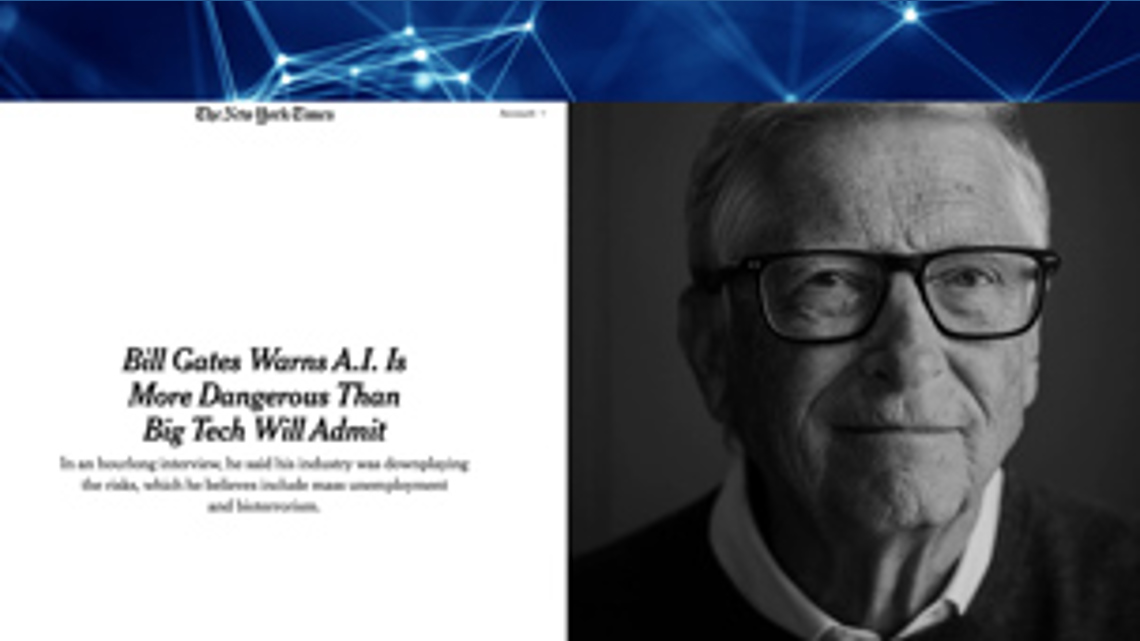
The Gates Alarm: Why Tech’s Co-Founder Says A.I. Is Far More Dangerous Than Silicon Valley Admits
NEW YORK — In a sweeping, unvarnished critique that threatens to rattle corporate boardrooms from Silicon Valley to Wall Street, Microsoft co-founder Bill Gates has issued a severe warning: the technology industry is systematically downplaying the existential and societal risks of artificial intelligence.
Speaking candidly during an exhaustive, hourlong interview, Gates cut through the breathless corporate marketing surrounding generative AI. He argued that current industry leaders are either blind to the profound disruptions on the horizon or willfully ignoring them to protect soaring share prices and investor confidence. According to Gates, the true threat profile of rapid automation extends far beyond routine job displacement into volatile territory, encompassing everything from systemic mass unemployment to catastrophic national security breaches like engineered bioterrorism.
The intervention by one of technology’s most historic figures marks a critical turning point in the global debate over how to govern an industry racing forward with little regulatory oversight. As institutional investors pour trillions into AI infrastructure, Gates’s sobering assessment forces a hard look at the hidden costs of unchecked technological acceleration.
Inside the Warning: Mass Unemployment and Bioterrorism
While tech executives frequently highlight AI’s potential to revolutionize healthcare, streamline logistics, and boost global productivity, Gates insists that the darker side of the ledger is not receiving proportional attention. During his extensive remarks, he zeroed in on two primary vectors of catastrophic risk that corporate messaging routinely sanitizes.
First is the economic shockwave of widespread automation. Unlike previous industrial revolutions that primarily replaced manual labor, advanced cognitive systems are poised to displace white-collar professionals, administrative personnel, creative workers, and software engineers alike. Gates warns that the speed of this transition could outpace the labor market's ability to absorb displaced workers, leading to structural, long-term unemployment and unprecedented socioeconomic inequality.
Second, and perhaps more alarmingly, Gates raised red flags regarding the democratization of dangerous knowledge. As open-source AI models grow increasingly sophisticated, the barrier to entry for synthesizing lethal biological agents drops precipitously. Bad actors, ranging from rogue state-sponsored hackers to domestic terror cells, could potentially leverage advanced language and reasoning models to bypass traditional safeguards and weaponize pathogens.
- Economic Disruption: Cognitive automation threatens white-collar and knowledge-based sectors at an unprecedented velocity.
- Security Vulnerabilities: Sophisticated AI models lower the technical barriers required to design and synthesize dangerous biological materials.
- Corporate Complacency: Big Tech stakeholders face perverse financial incentives to downplay systemic risks to maintain rapid market expansion.
The Market Reaction and Broader Context
The timing of Gates’s intervention has sent ripples through global financial markets. Institutional investors, already navigating a macroeconomic landscape defined by high interest rates and sticky inflation, have hitched their wagon to the AI hyper-growth narrative. Major indices have repeatedly hit record highs driven almost exclusively by semiconductor manufacturers, cloud infrastructure providers, and mega-cap platform companies.
By publicly breaking ranks, Gates is challenging the prevailing Wall Street consensus that self-regulation and rapid deployment are the optimal paths forward. Market analysts note that while institutional shareholders have largely rewarded companies prioritizing speed over safety, regulatory bodies across the European Union and the United States are taking notice. Antitrust regulators and national security agencies are increasingly scrutinizing whether hyper-scale AI developers are adequately equipped to police themselves.
| Risk Category | Big Tech Narrative | Bill Gates’s Assessment |
|---|---|---|
| Employment Impact | Short-term friction; net creation of new, higher-value jobs. | Rapid structural displacement; potential for prolonged mass unemployment. |
| Security & Safety | Managed effectively via internal alignment and guardrails. | High risk of dual-use exploitation, notably in bioterrorism and cyber warfare. |
| Regulatory Oversight | Light-touch rules to avoid stifling rapid innovation. | Urgent need for external accountability and strict enforcement frameworks. |
The Road Ahead: Balancing Innovation with Survival
As the debate intensifies, the core challenge facing policymakers and industry leaders is how to harness the undeniable economic upside of artificial intelligence without inviting systemic collapse. Gates’s critique serves as an urgent reminder that technological determinism is not an immutable law of physics; it is a choice shaped by human governance, corporate responsibility, and regulatory foresight.
For Wall Street and global economic policymakers, the message is clear: the era of uncritical techno-optimism is drawing to a close. As the capabilities of artificial intelligence continue to compound exponentially, the cost of underestimating its dangers may ultimately prove too high for global society to bear.
Frequently Asked Questions
What are the primary risks highlighted by Bill Gates regarding advanced artificial intelligence?
Bill Gates specifically points to systemic mass economic displacement—leading to widespread unemployment across white-collar and cognitive sectors—and severe national security threats, including the lowered technical barriers for creating engineered bioterrorism.
Why does Gates claim that Big Tech is downplaying these risks?
Gates argues that major technology companies face immense financial and market pressures to maintain investor confidence, boost stock valuations, and drive rapid product adoption. Admitting to profound existential risks could invite heavy regulatory intervention and slow down lucrative commercial deployment.