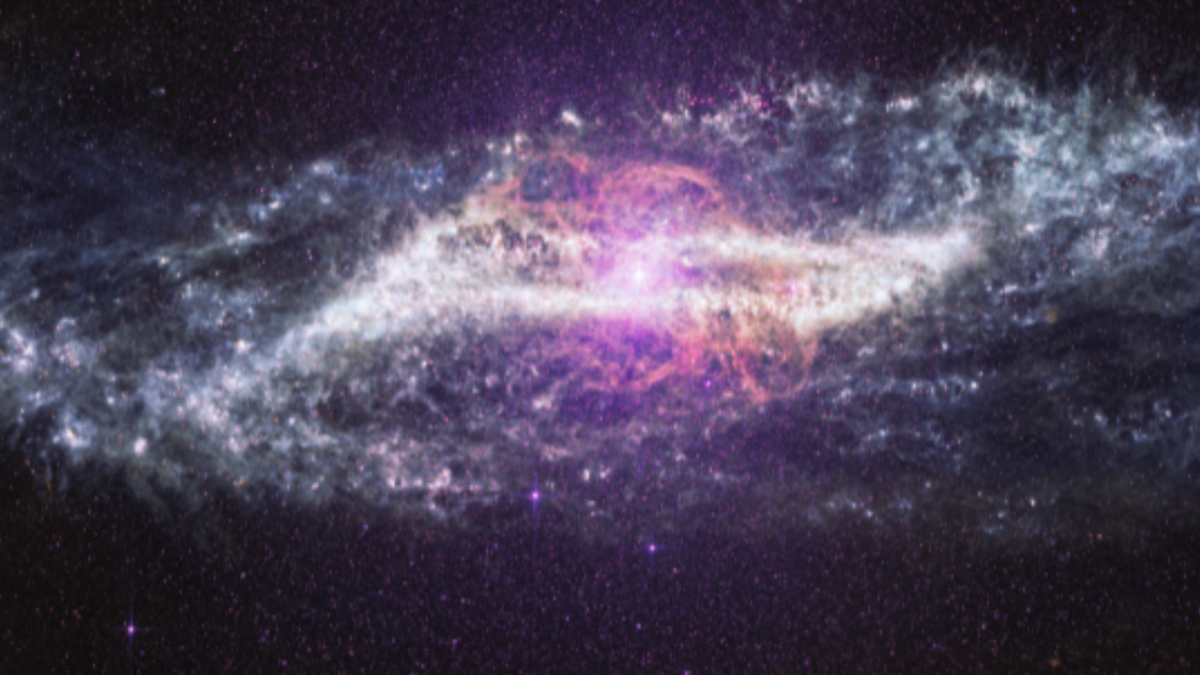
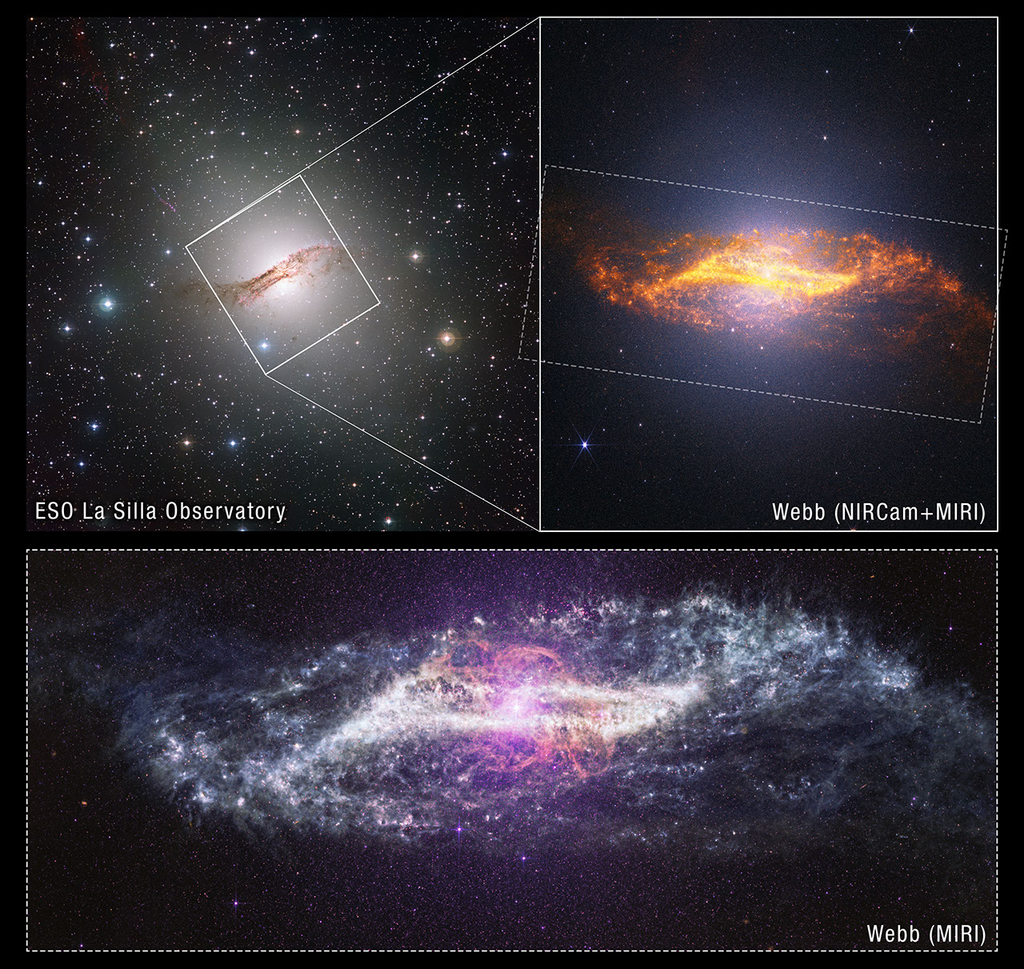
WASHINGTON — Four years into its historic mission of rewriting textbooks, the James Webb Space Telescope (JWST) has delivered yet another masterpiece from the deep cosmos. To mark its fourth anniversary in space, NASA and its international partners have unveiled a breathtaking, high-resolution portrait of Centaurus A—a peculiar galaxy that serves as a colossal, hyper-energetic crash site for two ancient star systems.
The image, released early Monday morning by the Space Telescope Science Institute, leverages Webb’s state-of-the-art infrared vision to peer through the thick, obscuring lanes of cosmic dust that have hidden Centaurus A’s violent inner mechanics from optical astronomers for centuries. The result is a vibrant, intricate look at galactic archaeology in real-time, showcasing how the collision of two galaxies sparks both catastrophic destruction and frantic, beautiful stellar birth.
Inside the Crash Site: What the New JWST Image Reveals
Centaurus A, also known scientifically as NGC 5128, is located approximately 12 million light-years away in the southern constellation Centaurus. It is the nearest giant radio galaxy to Earth, making it a premier laboratory for astrophysicists studying active galactic nuclei and galaxy evolution. However, its strange, warped elliptical shape has puzzled scientists since its discovery.
The new JWST composite image exposes the smoking gun of this cosmic fender-bender: a massive spiral galaxy that was swallowed by a larger elliptical galaxy roughly 500 million years ago. Using its Near-Infrared Camera (NIRCam) and Mid-Infrared Instrument (MIRI), Webb has cut through the dense dust belt slicing across the galaxy's center, revealing glittering clusters of newborn stars, chaotic shockwaves, and the glowing accretion disk swirling around a supermassive black hole.
- Unprecedented Detail: JWST's infrared sensors penetrated the dark dust lanes, exposing previously hidden stellar nurseries where thousands of baby stars are igniting simultaneously.
- Supermassive Engine: At the heart of Centaurus A lies a black hole with a mass equivalent to 55 million suns, currently blasting out high-energy jets of matter at near-light speed.
- Multi-Wavelength Synergy: The new data complements historical observations from the Hubble Space Telescope and Chandra X-ray Observatory, offering a complete multi-messenger picture of the collision.
"No single telescope tells the whole story," project scientists noted in a joint release accompanying the anniversary drop. "Discoveries build upon discoveries. What Hubble saw as a dark, impenetrable lane of cosmic debris, Webb reveals as a bustling, luminous factory of star formation driven by gravitational cataclysm."
Four Years of Rewriting Astronomy
Launched on December 25, 2021, and stationed a million miles away at the second Lagrange point (L2), the $10 billion observatory has far exceeded its initial technological expectations. Over the past 48 months, JWST has pushed the boundaries of human knowledge, identifying candidate galaxies from the cosmic dawn, analyzing the atmospheric composition of potentially habitable exoplanets, and capturing stunning details of stellar nurseries within our own Milky Way.
The celebration of its fourth year with Centaurus A underscores a shift in Webb's operational focus: moving from breaking records for the most distant objects to resolving complex astrophysical processes in our relatively nearby cosmic neighborhood.
| Observatory Metric | Specification |
|---|---|
| Target Name | Centaurus A (NGC 5128) |
| Distance from Earth | ~12 Million Light-Years |
| Primary Instrument Used | NIRCam & MIRI (Infrared Spectrum) |
| Significance | Nearest active galactic nucleus and major merger site |
| Mission Milestone | 4th Anniversary of Operations (Dec 2021 – July 2026) |
The Economic and Scientific Stakes of Deep Space Research
Beyond the aesthetic wonder, insights gleaned from objects like Centaurus A carry significant weight for the global aerospace and technology sectors. The algorithms required to process JWST’s massive infrared datasets have driven commercial innovations in data compression, optical engineering, and machine learning. Furthermore, international cooperation on space science infrastructure continues to anchor multi-billion-dollar R&D investments across North America and Europe.
Astrophysicists are already queuing up observational time for Webb's fifth year, aiming to track how the gas and dust in Centaurus A will eventually settle, stabilize, and perhaps form a new, unified galactic structure over the next billion years.
Frequently Asked Questions
Why does Centaurus A look so strange compared to regular galaxies?
Centaurus A looks warped and bisected by a dark band because it is the result of a major galactic merger. A smaller spiral galaxy crashed into and was absorbed by a larger elliptical galaxy hundreds of millions of years ago, leaving behind a chaotic ring of dust, gas, and newly formed stars.
How does the James Webb Space Telescope see through cosmic dust?
Unlike optical telescopes like Hubble, which primarily view visible light that gets blocked by dust particles, JWST captures infrared light. Infrared wavelengths possess longer frequencies that can pass right through dense clouds of space dust, allowing astronomers to see what is happening directly behind or inside them.