The Pharmacy Unbundling: Inside CVS Health’s High-Stakes Blueprint to Sever Aetna and Caremark
Test Our Free AI & Tech Utilities Suite
Calculate LLM API token costs, analyze article dwell-time, or simulate tech DCA returns.
By Our Investigative Economics Desk | Updated Real-Time From New York, Washington, and London
Executive Takeaways
- Strategic Reversal: CVS Health is actively evaluating a historic corporate unbundling to separate its retail and pharmacy services divisions from its insurance wing, Aetna, and pharmacy benefit manager (PBM), Caremark.
- Capital Allocation & Valuation: The contemplated structural pivot aims to unlock trapped enterprise value, compress conglomerate discounts, and optimize market liquidity amidst intense antitrust scrutiny and margin compression.
- Ecosystem Disruption: A structural split threatens to upend the modern vertical integration model in American healthcare, forcing institutional investors and competitors to recalibrate risk mitigation and infrastructure scalability.
- Regulatory Crosswinds: The maneuvers arrive against a backdrop of aggressive federal oversight targeting PBM rebate practices, medical loss ratios (MLR), and healthcare consolidation.
The Anatomy of a Megamerger’s Undoing
The contemporary architecture of American healthcare is facing its most severe stress test to date. In executive suites across Rhode Island and Wall Street advisory desks, preliminary blueprints are being drawn up to dismantle what was once heralded as the ultimate triumph of vertical integration: CVS Health’s conglomerate model. Years after dropping tens of billions of dollars to absorb insurance giant Aetna and pharmacy benefit manager Caremark, CVS Health is confronting the sobering reality of diminishing returns, mounting regulatory hostility, and relentless shareholder pressure.
For institutional investors tracking market liquidity and valuation multiples, the contemplated split is less a sudden shock than a long-overdue reckoning. The once-praised synergy of housing pharmacies, insurance underwriting, and PBM operations under a single corporate umbrella has increasingly morphed into a sprawling operational labyrinth. This structure has routinely punished the company’s equity value with a punishing conglomerate discount. As capital allocation strategies shift toward operational purity, the board’s willingness to entertain a breakup signals a seismic shift in how modern healthcare empires calculate enterprise ROI.
Catalytic Pressures: Margin Compression and Regulatory Heat
To understand the forces driving this unbundling, one must examine the fierce economic headwinds buffeting each business unit. Aetna, once the reliable cash cow of the enterprise, has faced severe margin compression driven by higher-than-expected utilization rates in Medicare Advantage plans. Medical loss ratios have climbed aggressively, squeezing profitability and forcing senior leadership to divert capital away from growth initiatives to shore up balance sheet reserves.
Simultaneously, the pharmacy services segment—anchored by Caremark—finds itself in the crosshairs of federal regulators and state legislators. The traditional PBM business model, predicated on complex drug rebate negotiations, spread pricing, and formulary management, is experiencing unprecedented legislative friction. Antitrust investigators from the Federal Trade Commission (FTC) have trained their sights on PBM practices, probing accusations of anti-competitive behavior and inflated drug costs. This regulatory compliance burden has introduced a level of existential risk mitigation overhead that traditional retail and insurance operations struggle to absorb efficiently.
Furthermore, the retail pharmacy footprint—the historic face of the enterprise—grapples with structural labor shortages, declining front-store foot traffic, and reimbursement rate cuts from rival PBMs. Navigating these disparate operational realities requires distinct leadership focuses, specialized cloud compute architecture for data analytics, and bespoke regulatory compliance frameworks that a unified corporate structure can no longer seamlessly accommodate.
Comparative Metrics: The Pre- and Post-Split Economic Landscape
| Metric / Dimension | Integrated Conglomerate Model | Proposed Unbundled Architecture |
|---|---|---|
| Primary Focus | Closed-loop healthcare ecosystem & cross-selling | Pure-play operational efficiency & market agility |
| Valuation Multiple | Suppressed by persistent conglomerate discount | Re-rated to align with distinct industry peers |
| Regulatory Exposure | High systemic exposure across retail, PBM, and payer lines | Segmented isolation of legal and compliance liabilities |
| Capital Allocation Strategy | Centralized triage across competing business units | Targeted reinvestment per standalone business lifecycle |
Industry and Market Implications: Winners and Losers
A corporate divorce of this magnitude will send shockwaves across the healthcare landscape, redrawing competitive boundaries for pharmaceutical distributors, commercial insurers, and independent retail chains alike.
The Winners: Unlocking Shareholder Value
Wall Street equity analysts stand among the primary beneficiaries of this strategic realignment. By separating Aetna from Caremark and the retail pharmacy division, each entity can command valuation multiples that more accurately reflect its standalone risk-reward profile. Managed care investors who previously avoided CVS due to the volatile retail and PBM headwinds may re-enter the stock once Aetna operates as an independent balance sheet. Similarly, pure-play pharmacy investors gain a transparent vehicle unencumbered by medical loss ratio volatility.
The Losers: The Erosion of Synergistic Cross-Flows
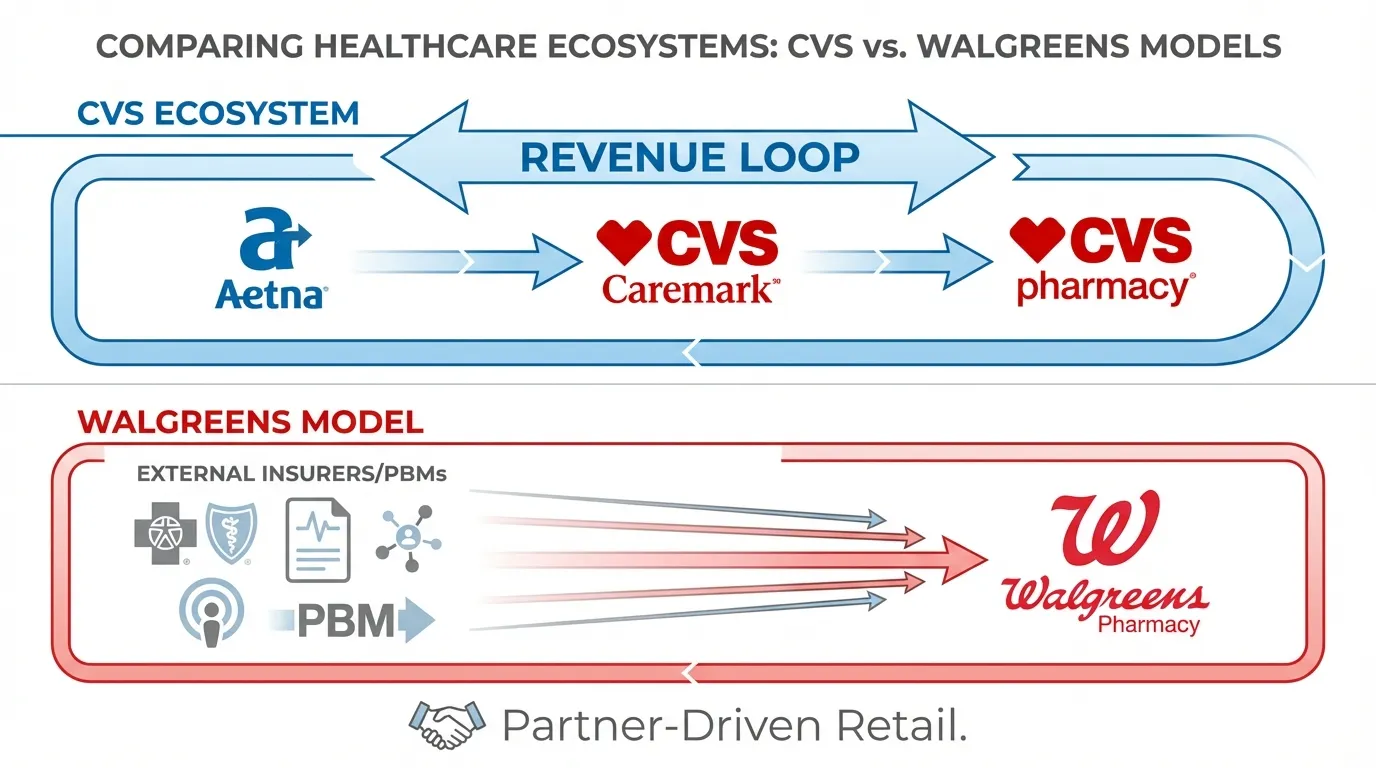
Conversely, corporate strategists who championed vertical integration will view the split as a defensive retreat. The ability to route an Aetna insurance member through a Caremark PBM formulary and into a CVS retail storefront represented a powerful closed-loop customer acquisition engine. Dismantling this apparatus eliminates proprietary cross-selling channels, forcing each business unit to compete aggressively on its own standalone merits in an open market.
Frequently Asked Questions (People Also Ask)
Why is CVS Health considering splitting Aetna and Caremark from its pharmacy business?
CVS Health is evaluating a split primarily to address severe margin compression, regulatory scrutiny, and a persistent conglomerate discount on its stock valuation. By unbundling the assets, leadership aims to grant each operating unit the strategic independence required to optimize capital allocation and navigate complex federal oversight more effectively.
What impact would this unbundling have on existing Aetna and Caremark customers?
In the immediate term, day-to-day policy administration, prescription fulfillment, and insurance claims processing will remain uninterrupted. However, over the medium to long term, corporate separation could alter network partnership terms, formulary designs, and cross-company discounts as each entity establishes independent vendor agreements.
How does current federal regulatory pressure influence this decision?
Intense antitrust scrutiny from agencies like the FTC, alongside congressional investigations into Pharmacy Benefit Manager (PBM) pricing transparency, has significantly elevated the compliance overhead of maintaining an integrated healthcare monopoly. Separating the divisions allows for more precise risk mitigation and insulates sounder business units from concentrated regulatory actions.
When could a potential transaction or corporate split materialize?
While preliminary strategic reviews and advisory consultations are actively underway, any formal corporate restructuring remains subject to complex tax considerations, debt re-issuances, and regulatory approvals. Analysts project that a definitive path forward will take many months to formalize.
Future Outlook: Milestones and Key Indicators to Watch
As this investigative narrative continues to unfold, market participants must monitor several critical leading indicators. First, watch for official announcements regarding leadership changes or the engagement of specialized investment banking advisory teams tasked with structuring a tax-free spin-off under IRS Section 355 guidelines. Second, track upcoming quarterly earnings calls for commentary on segment-specific debt loads and capital expenditure allocations.
Ultimately, CVS Health’s potential unbundling serves as a bellwether for the broader corporate economy. It illustrates the hard limits of conglomerate synergy in an era defined by aggressive antitrust enforcement, rapid technological disruption, and demanding institutional investors. Whether this gambit succeeds in restoring shareholder value or merely exposes the vulnerabilities of standalone units will define the trajectory of American healthcare finance for the next decade.