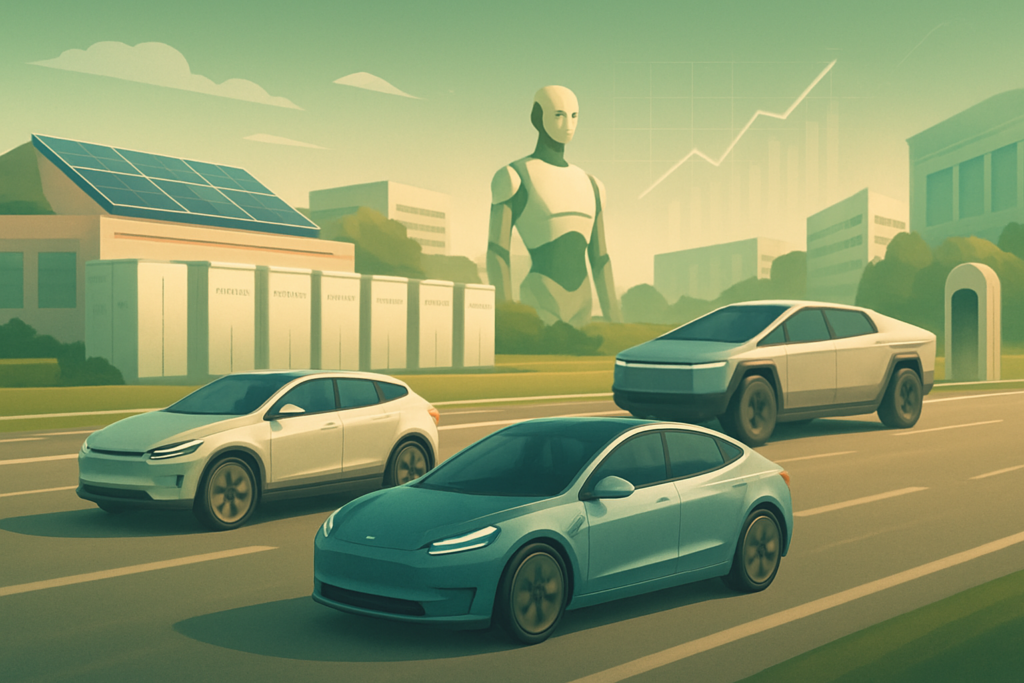
Tesla at the Crossroads: How AI, Autonomy, and Energy Storage Are Redefining the EV Giant’s Playbook
NEW YORK & MUMBAI — For over a decade, Tesla Inc. (NASDAQ: TSLA) defined the global electric vehicle revolution, single-handedly turning battery-powered transportation from a niche environmentalist dream into a multi-trillion-dollar mainstream market. But as the automotive landscape matures into 2026, the narrative surrounding Elon Musk’s flagship enterprise is undergoing a seismic shift. Wall Street is no longer pricing Tesla merely as a car manufacturer; instead, institutional heavyweights are forcing a fundamental re-evaluation of the company as an artificial intelligence, autonomous robotics, and grid-scale energy conglomerate.
Recent deep-dive market analyses, wire service reports from FinancialContent, and evolving regional delivery metrics paint a picture of a company aggressively pivoting its core DNA. With traditional EV adoption curves moderating in key Western markets and fierce margin pressures mounting, Tesla's future is increasingly tethered to unproven, high-margin technological bets: Full Self-Driving (FSD) software monetization, humanoid robotics, and massive deployments of utility-scale energy storage systems like the Megapack.
The Evolving Regional Playbook: United States and Beyond
At the center of Tesla’s strategic transition is a noticeable cooling and shifting of market share dynamics in its primary stronghold: the United States. While Tesla remains the undisputed volume leader in domestic battery-electric vehicle (BEV) sales, the domestic market is no longer a monolithic growth engine.
According to recent industry tracking, regional breakdowns reveal that Tesla is facing aggressive incursions from legacy Detroit automakers and well-capitalized Asian competitors. In response, leadership has leaned heavily on localized financing incentives, price adjustments, and software trial periods to protect its domestic moat. However, industry analysts note that hardware margins are compressing, forcing the company to look toward high-margin software-as-a-service (SaaS) models—specifically its supervised and unsupervised autonomous driving ambitions—to support long-term valuation multiples.
Key Strategic Pillars Transforming TSLA
- Autonomous Horizons: Accelerating the deployment of Full Self-Driving (FSD) hardware and software updates, paving the way for eventual robotaxi network operations.
- Energy Storage Surge: Megapack deployments are scaling at record rates, providing a crucial, high-growth revenue buffer against automotive cyclicality.
- AI and Robotics Integration: Leveraging real-world neural network training derived from millions of active vehicles to feed both vehicle autonomy and the Optimus humanoid robot project.
- Margin Defense Strategy: Balancing aggressive localized pricing strategies with software upselling to protect profitability amid intensifying global EV competition.
The Energy Division: Tesla’s Secret Weapon
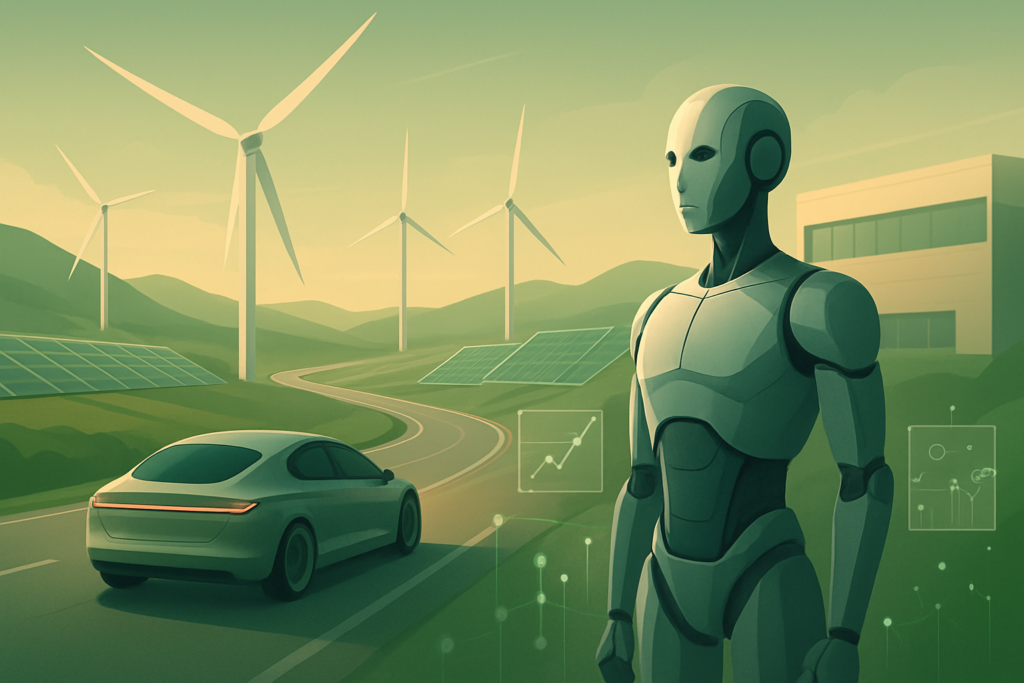
While mainstream media headlines routinely fixate on delivery numbers and quarterly automotive gross margins, institutional investors are increasingly turning their attention to Tesla’s Energy Generation and Storage segment. Unlike the volatile car market, the global demand for grid stabilization, renewable energy integration, and backup power solutions is surging exponentially.
Tesla’s Megapack factory in Lathrop, California, alongside planned and existing international manufacturing nodes, has emerged as a cash-flow-positive powerhouse. Utilities and independent power producers are snapping up battery storage units to manage peak loads and prevent grid failures, particularly as wind and solar penetration deepens worldwide. Analysts point out that the energy storage division is scaling faster than the automotive business did at a comparable stage of maturity, offering a vital hedge against traditional auto-sector downturns.
Market Data Snapshot: TSLA Core Metrics
| Metric / Indicator | Current Status / Trend | Strategic Significance |
|---|---|---|
| Primary Exchange & Ticker | NASDAQ: TSLA | Core benchmark for global clean-tech and AI sentiment. |
| Core Business Drivers | EVs, FSD Software, Megapack Energy Systems | Diversifying away from pure hardware sales into recurring tech revenue. |
| U.S. Market Position | Defending market share amid rising competition | Shifting focus toward incentives, software trials, and fleet loyalty. |
| Next Growth Frontier | Autonomous Robotaxis & Optimus Robotics | Long-term valuation pivot toward artificial intelligence and robotics. |
The Road Ahead: High Stakes and High Rewards
As Tesla navigates this delicate transitional phase, the fundamental debate on Wall Street boils down to timing and execution. Bulls argue that Musk has a proven track record of defying skeptics, transforming nascent concepts into dominant industries, and that the convergence of Tesla’s AI fleet data with physical robotics creates an unbeatable competitive moat. Bears, conversely, caution that regulatory hurdles for autonomous driving remain formidable, and that increased competition could permanently compress automotive margins before AI initiatives fully materialize.
For investors and industry observers alike, the coming quarters will be critical. Tesla is no longer just racing to put more cars on the road; it is racing to redefine the future of automated transport and global energy infrastructure. Whether it can successfully execute this grand vision will dictate not only its own stock performance, but the trajectory of the broader clean-tech and artificial intelligence revolutions.
Frequently Asked Questions
1. How is Tesla shifting its business model beyond traditional electric vehicles?
Tesla is actively transitioning from a pure-play automotive manufacturer into an AI, autonomy, and energy infrastructure company. While electric vehicles remain its foundational product, the company is placing heavy strategic emphasis on recurring software revenue through Full Self-Driving (FSD), utility-scale battery storage solutions (Megapacks), and long-term artificial intelligence applications like autonomous robotaxis and humanoid robotics.
2. Why is the energy storage division becoming so crucial for Tesla's financial health?
The energy storage segment—anchored by products like the Megapack—is scaling rapidly as global demand for grid stabilization and renewable energy backup surges. This division provides Tesla with a high-growth, high-margin revenue stream that helps offset cyclical volatility and margin compression within the traditional automotive sector.