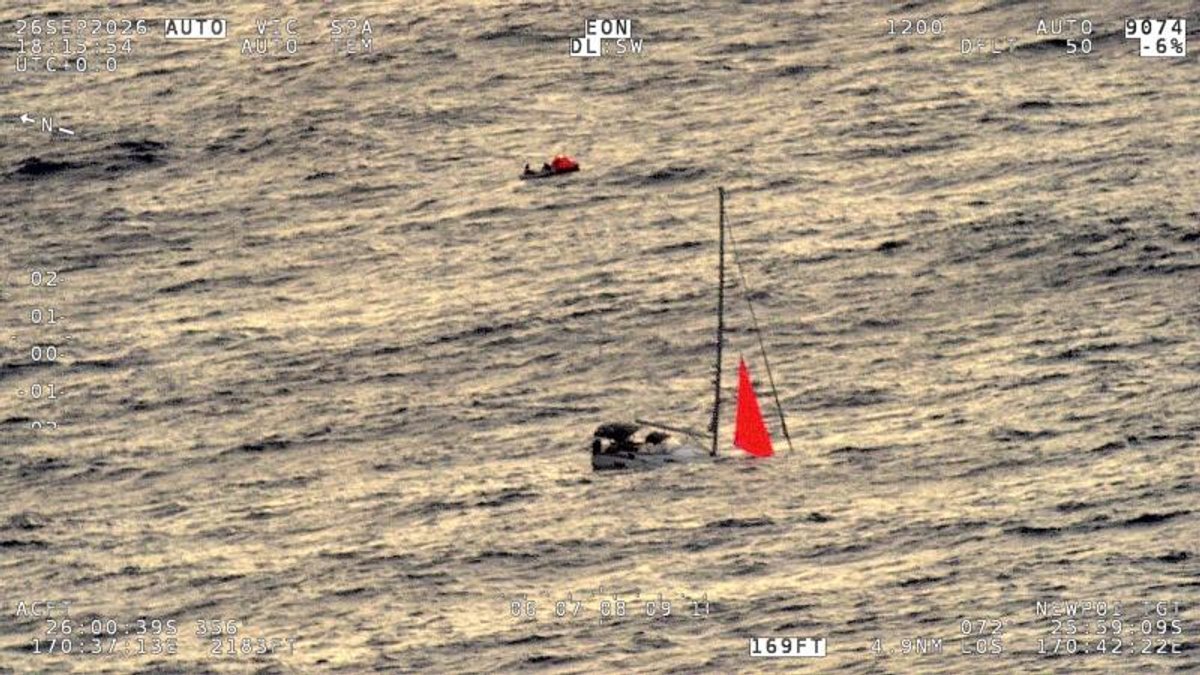
LONDON/SYDNEY — In an era where maritime technology has reached unprecedented heights of sophistication, the primal forces of the open ocean continue to command the ultimate respect. Maritime authorities have confirmed the successful rescue of a crew of seasoned sailors whose vessel suffered a catastrophic structural failure following a violent, high-speed collision with a whale. The dramatic incident, which unfolded in remote deep-water coordinates, highlights a rapidly growing and alarming trend of marine mammal encounters that is baffling marine biologists and sending shockwaves through the global sailing community.
The ordeal, which transformed a routine blue-water passage into a desperate fight for survival, underscores the razor-thin margin between safety and disaster when traversing the world's oceans. As commercial shipping lanes grow busier and populations of certain cetacean species rebound, the intersection of human navigation and marine wildlife has become an increasingly volatile battleground. Industry stakeholders, insurers, and maritime safety regulators are now urgently reviewing protocol to address a hazard that radar, sonar, and human vigilance often fail to prevent.
An Unprovoked Strike in the Open Sea
According to preliminary incident reports released by maritime rescue coordination centers, the vessel—a heavily reinforced cruising yacht manned by an experienced delivery crew—was making good speed under favorable wind conditions when the disaster struck without warning. Crew members reported hearing a thunderous, explosive impact beneath the waterline, immediately followed by the sickening sound of fracturing fiberglass and rushing water.
Unlike collisions with semi-submerged shipping containers or uncharted reefs, which typically result in a sudden, jarring halt, encounters with marine mammals often possess a dynamic, kinetic violence. In this instance, the vessel was struck by what experts deduce was a large baleen whale, likely a fin or sperm whale breaching or transiting just beneath the surface. The kinetic energy transfer was immense, instantly compromising the keel attachment points and breaching the hull compartments.
Recognizing within seconds that their vessel was doomed, the skipper initiated emergency procedures with military-like precision. An EPIRB (Emergency Position-Indicating Radio Beacon) distress signal was manually triggered, transmitting their precise GPS coordinates via satellite to regional rescue authorities, while the crew scrambled to don survival suits and deploy the life raft.
Swift Coordination and High-Stakes Rescue Operations

The ensuing rescue operation was a masterclass in international maritime cooperation. Within minutes of receiving the distress alert, maritime rescue coordination centers diverted nearby commercial and recreational shipping traffic toward the disaster zone.
- Immediate Distress Activation: The crew deployed a satellite-linked EPIRB, ensuring instantaneous global positioning transmission regardless of cellular or VHF radio range.
- Multi-Vessel Response: A nearby container ship altered its course, steaming at maximum knots to serve as an on-scene coordinator and windbreak for the stranded sailors.
- Air-Sea Coordination: Long-range search and rescue aircraft were scrambled to visually locate the life raft amidst turbulent swells, vectoring surface vessels directly to the survivors.
- Zero Casualties: Due to the flawless execution of safety drills and rapid response times, all crew members were recovered from the life raft with only minor injuries and hypothermic symptoms.
The psychological toll, however, remains palpable. Rescuers noted that the sailors were visibly shaken, recounting the surreal experience of locking eyes with the massive marine animal moments before their world literally began to sink beneath them.
The Rising Tide of Cetacean Encounters
While whale strikes have historically been viewed as rare, freak maritime occurrences, recent data suggests a troubling upward trajectory. Marine biologists and insurance underwriters have noted a sharp spike in structural damage reports attributed to marine mammal interactions over the past five years.
"We are looking at a complex convergence of factors," says Dr. Elena Vance, a marine ecologist specializing in cetacean migratory patterns. "On one hand, conservation efforts have successfully allowed certain whale populations to recover, meaning there are simply more animals in the water. On the other hand, acoustic pollution, shifting ocean temperatures, and changing food sources are altering how these animals move, often drawing them closer to high-traffic maritime corridors."
For the sailing and commercial shipping industries, this represents an operational nightmare. Unlike navigational hazards that can be mapped or detected via modern sonar, whales are highly mobile, unpredictable, and frequently difficult to spot until it is too late to alter course. Anti-collision acoustic deterrents and thermal-imaging cameras are currently being tested by ocean-racing syndicates, but a foolproof, universally adopted solution remains elusive.
Key Incident Metrics and Response Data
| Parameter | Incident Details |
|---|---|
| Nature of Emergency | Catastrophic hull breach via high-speed whale collision |
| Response Time | Initial distress acknowledged in < 3 minutes; on-scene recovery within 4 hours |
| Rescue Assets Utilized | Satellite EPIRB, Long-Range SAR Aircraft, Commercial Container Vessel |
| Casualties | Zero fatalities; all crew safely recovered |
| Vessel Status | Submerged/Total Loss |
Economic and Insurance Implications
Beyond the immediate human drama, this high-profile incident is sending ripples through the maritime insurance sector. Underwriters are increasingly hesitant to issue comprehensive blue-water coverage without mandatory clauses regarding offshore safety gear, structural impact mitigation, and real-time tracking systems.
Furthermore, marine salvage operations face mounting liabilities when attempting to recover or tow vessels crippled by animal strikes in deep water. As repair costs soar and premiums for ocean-going vessels climb, shipowners and skippers are demanding clearer regulatory guidance on how to navigate waters with high densities of protected marine species.
Outlook: Navigating an Increasingly Crowded Ocean
As the rescued sailors recuperate on dry land, the global maritime community is left to grapple with a sobering reality: the ocean is not an empty highway, but a living, breathing ecosystem that demands absolute humility.
Future ocean voyages will undoubtedly incorporate smarter, AI-driven detection systems and stricter speed restrictions in known cetacean habitats. However, as this latest incident proves, Mother Nature retains the upper hand. The line between an unforgettable ocean voyage and a fight for survival remains razor-thin, governed by the unpredictable movements of the planet's largest inhabitants.
Frequently Asked Questions
How common are whale collisions with boats?
While exact figures are difficult to track due to unreported incidents in remote waters, marine authorities report hundreds of documented strikes globally each year. The International Whaling Commission (IWC) considers ship strikes a major threat to cetacean populations and an escalating hazard for human vessels.
What should a skipper do immediately after a whale collision?
The priority is assessing structural integrity and checking for water ingress. Skippers must immediately inspect bilge levels, prepare life rafts, check emergency communications gear (EPIRB and VHF radio), and be prepared to abandon ship if the hull has been fatally compromised.