Executive Takeaways
- The Multi-Model Convergence: Dell Technologies has executed a decisive architectural pivot, rolling out turnkey "AI Factory" infrastructure that runs enterprise instances of OpenAI’s ChatGPT, Google’s Gemini, and xAI’s Grok concurrently within private on-premises enclaves.
- The Video World Model Frontier: Beyond static text and code generation, Dell’s hardware stack is explicitly tuned for spatial intelligence and generative video world models—marking the transition from generative language tasks to physical AI, robotics simulation, and industrial digital twins.
- Cloud Repatriation Economics: Driven by spiraling inference OpEx, strict data sovereignty mandates, and data egress penalties, Tier-1 enterprise CIOs are utilizing this architecture to achieve up to a 42% lower three-year Total Cost of Ownership (TCO) compared to public hyperscale compute.
- Capital Allocation Shift: The move pressures public cloud margins (AWS, Microsoft Azure, Google Cloud) by transforming volatile cloud consumption budgets into depreciable, high-efficiency private capital assets powered by dense Nvidia Blackwell and liquid-cooled PowerEdge nodes.
The Shift: Breaking the Hyperscaler Monopoly
For the past three years, the dominant playbook across enterprise technology followed an uncompromising trajectory: surrender proprietary data to public cloud hyperscalers or risk missing the generational surge of artificial intelligence. That era of cloud-rentier dominance just hit a critical inflection point. In a calculated offensive, Dell Technologies has engineered a hardware and orchestration fabric capable of running OpenAI’s private models, Google’s Gemini ecosystem, and xAI’s Grok within a unified, sovereign, on-premises deployment.
The strategic deployment, marketed under the Dell AI Factory portfolio in deep co-engineering with Nvidia, represents far more than an incremental server refresh. It is an aggressive attempt to resolve the structural trilemma that has plagued Fortune 500 boardrooms since generative AI captured corporate budgets: the tension between algorithmic performance, operational cost predictability, and intellectual property containment.
By bringing the three competing frontier model ecosystems onto a single bare-metal chassis, Dell is fundamentally rewriting the power dynamics between legacy enterprise infrastructure vendors and hyperscale cloud providers. Rather than signing restrictive multi-year compute commitments with individual cloud ecosystems, enterprises can now ingest raw multi-modal weights into proprietary, liquid-cooled data centers, running inferences behind corporate firewalls with zero external data leakage.
The Engineering Feat: Unifying ChatGPT, Gemini, and Grok on Bare Metal
The technical challenge of orchestrating disparate model architectures on a single on-premises footprint is formidable. OpenAI’s GPT family relies heavily on specialized transformer optimizations tightly integrated with Microsoft Azure’s distributed orchestration. Google’s Gemini was architected from the silicon up to maximize Google’s proprietary Tensor Processing Units (TPUs) alongside bespoke pathways infrastructure. Grok, designed by Elon Musk’s xAI, leverages a radically lean, high-throughput training and inference architecture built on massive parallel clusters.
To homogenize these distinct runtime requirements, Dell has deployed an advanced software-defined abstraction layer on top of its flagship PowerEdge XE9680 and XE9680L servers. Operating in tandem with enterprise container engines and Nvidia’s NIM (Inference Microservices), the architecture decouples model weights from cloud-native runtimes. High-Bandwidth Memory (HBM3e) allocation, dynamic tensor parallelism, and low-latency interconnects via 400Gb/800Gb Ethernet switches allow an enterprise to dynamically allocate compute clusters between OpenAI models for enterprise intelligence, Gemini for multi-modal analysis, and Grok for real-time unstructured reasoning.
Crucially, this cross-model orchestration operates across a unified Retrieval-Augmented Generation (RAG) vector database pipeline. Corporate data housed within Dell PowerScale storage appliances can be indexed once and queried simultaneously by multiple competing frontier engines. An enterprise risk committee, for instance, can evaluate a corporate acquisition by running due-diligence data through Gemini’s million-token context window, verifying structured contractual liabilities via fine-tuned GPT instances, and querying Grok for unstructured market sentiment—all occurring entirely on private silicon without a single byte crossing over public transit networks.
Beyond Text: The Strategic Pivot to Video World Models
While industry analysts have spent months debating whether LLM text generation has reached commoditized performance plateaus, Dell’s hardware configuration exposes where the enterprise AI battlefield is truly heading: high-fidelity generative video and physical world models. The breakthrough of spatial AI, exemplified by systems capable of understanding geometric physics, structural causality, and temporal continuity, requires orders of magnitude more raw throughput, memory capacity, and thermal dissipation than conversational chatbots.
Video world models do not merely render pixels; they simulate reality. In pharmaceutical discovery, precision manufacturing, autonomous logistics, and defense engineering, these models ingest millions of hours of spatial video to predict physical outcomes before capital is committed to the physical world. A Tier-1 automotive manufacturer, for instance, can utilize spatial world models to simulate millions of crash-test permutations or robotic assembly-line calibrations in synthetic 3D space.
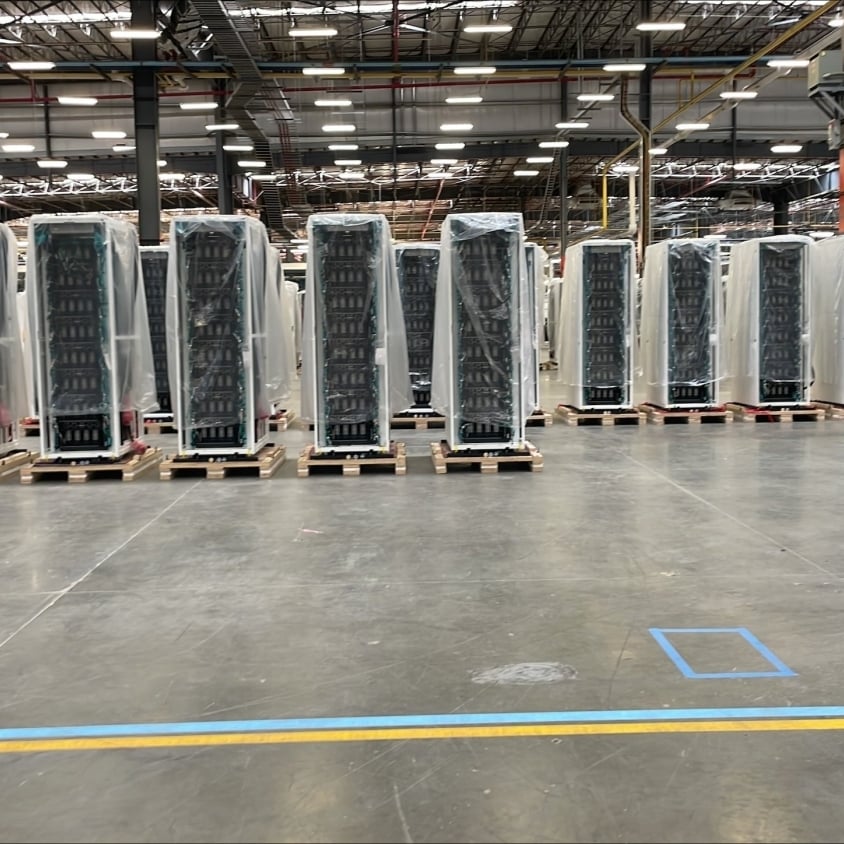
Deploying these spatial models on public clouds presents an operational bottleneck: the sheer scale of video telemetry creates crippling data transfer costs and untenable network latency. Dell’s on-premises AI Factory directly resolves this by placing petascale high-density compute directly adjacent to the edge where the video data is produced. Utilizing direct-to-chip liquid cooling architectures capable of dissipating up to 100 kilowatts per rack, Dell’s hardware supports sustained, unthrottled FP8 and FP4 floating-point operations necessary for continuous video spatial modeling.
Comparative Economics: On-Premises AI Factory vs. Hyperscale Infrastructure
The economic logic underpinning this on-premises migration is grounded in cold enterprise capital allocation. Below is an institutional-grade comparative assessment of enterprise deployment parameters:
| Strategic Metric | Public Hyperscaler (Multi-Cloud) | Dell On-Premises AI Factory | Operational Impact / Variance |
|---|---|---|---|
| Inference Cost Predictability | Variable (Volatile token-based billing; dynamic API rate hikes) | Fixed (Amortized silicon CapEx over 36–60 months) | Eliminates unpredictable operational cost spikes for Tier-1 workloads. |
| Data Egress & Transfer Penalties | High ($0.05–$0.09 per GB; astronomical at multi-petabyte video scale) | Zero (Internal LAN/SAN fabric across PowerScale architecture) | Saves millions annually on high-bandwidth video and telemetry models. |
| Model Flexibility & Multi-Tenancy | Siloed (AWS/Bedrock, Azure/OpenAI, GCP/Gemini lock-in) | Agnostic (Unified deployment of GPT, Gemini, Grok, and open weights) | Mitigates single-vendor algorithmic obsolescence risk. |
| Regulatory & Sovereignty Compliance | Complex (Shared tenancy, cross-border jurisdictional exposure) | Absolute (Full air-gapped capability; total data isolation) | Meets strict Basel III, HIPAA, and GDPR sovereign mandates instantly. |
| Thermal & Compute Density | Managed externally (Limited visibility into thermal throttling) | Direct Liquid Cooling (DLC) supporting 100kW+ rack architectures | Maximizes sustained throughput for dense physical AI and video modeling. |
Financial Implications: Valuation Multiples, CapEx, and Cloud Repatriation
The macroeconomic backdrop of this announcement reflects a structural shift in chief information officer (CIO) priorities. The era of unconditional "cloud-first" mandates has ended, replaced by rigorous return-on-investment (ROI) scrutiny. High-interest-rate environments and persistent inflation have forced chief financial officers to scrutinize cloud OpEx line items that compound exponentially as enterprise AI adoption scales.
From an enterprise finance perspective, public cloud infrastructure represents pure operational expenditure with zero residual balance-sheet value. In contrast, on-premises AI Factories transform generative compute into depreciable capital assets. By amortizing enterprise-grade server infrastructure across three-to-five-year lifecycles, institutional enterprises can achieve internal rates of return (IRR) that make cloud leasing look financially indefensible for non-bursty, steady-state inference workloads.
This dynamic poses a clear threat to hyperscaler margin profiles. For the past decade, AWS, Azure, and Google Cloud have enjoyed elevated valuation multiples precisely because they positioned themselves as the unavoidable tollbooths of modern corporate computing. If mission-critical frontier inference—and the associated video world model workloads—shift decisively back toward sovereign private infrastructure, hyperscaler cloud revenue growth could decelerate, forcing a recalibration of tech-sector market valuations.
Conversely, for Dell and its strategic partners, this evolution unlocks high-margin, sticky enterprise revenue streams. Dell is no longer merely shipping metal boxes at hardware-commodity margins; it is delivering high-value end-to-end integration, orchestrating proprietary systems software, container virtualization, high-speed switching, and long-term enterprise maintenance agreements. This transition elevates Dell’s enterprise status, driving margin expansion and recurring revenue streams that could justify a structural re-rating of its equity valuation multiples.
Industry Winners and Losers
The Strategic Winners
- Dell Technologies: Solidifies its position as the premier infrastructure architect for the enterprise AI era, capitalizing on compute repatriation and capturing market share from pure-play server assemblers.
- Nvidia: Reinforces its CUDA ecosystem across on-premises data centers worldwide, cementing hardware dominance whether clients choose cloud or bare metal.
- Enterprises with Sovereign Data: Global investment banks, healthcare systems, defense contractors, and specialized manufacturing conglomerates can finally deploy top-tier intelligence systems without compromising legal compliance or corporate trade secrets.
- xAI (Grok): Secures rapid enterprise footprint expansion without having to build a massive global salesforce, leveraging Dell’s enterprise channel infrastructure to compete head-to-head with Azure-backed OpenAI.
The Vulnerable Incumbents
- Pure-Play Public Hyperscalers: Face margin compression and risk losing their most lucrative, compute-heavy enterprise workloads as customers repatriate persistent inference and video modeling pipelines.
- Traditional Storage and Legacy Networking Providers: Vendors that failed to optimize their fabrics for the blistering throughput demands of 800Gb networking and direct-liquid-cooled AI clusters will find themselves locked out of greenfield data center builds.
- Proprietary Model Silos: Frontier model developers that refuse to support on-premises enterprise runtimes risk losing the massive sovereign enterprise market to multi-model platforms that offer deployment flexibility.
Frequently Asked Questions (People Also Ask)
Can OpenAI’s ChatGPT, Google’s Gemini, and xAI’s Grok legally and technically run on private on-premises servers?
Yes. While these models originated as cloud-native software-as-a-service platforms, their parent companies have introduced containerized runtime environments, distilled weights, and specialized enterprise licensing programs to capture the lucrative private sovereign data market. Dell’s AI Factory acts as the certified hardware and orchestration host, deploying authorized enterprise instances behind the corporate firewall while maintaining regulatory isolation and preventing data leakage back into public training corpora.
What is the primary advantage of running video world models on-premises instead of in the public cloud?
The primary advantage comes down to bandwidth physics and data economics. Video world models consume and generate massive multi-dimensional datasets. Uploading petabytes of high-definition industrial video, synthetic 3D meshes, and autonomous telemetry into public clouds creates severe latency and triggers millions of dollars in cloud data egress and storage fees. Running models on-premises directly adjacent to the edge where video data is captured enables real-time physical simulation, zero latency, and zero egress cost.
How does on-premises AI deployment impact corporate regulatory compliance (e.g., GDPR, HIPAA, Basel III)?
On-premises AI deployment dramatically simplifies regulatory compliance by enforcing strict physical data residency. Because the entire inference pipeline—from raw data storage in local arrays to GPU processing and vector embedding—remains within a company-controlled, air-gapped, or privately managed facility, sensitive customer data and intellectual property never transit public networks, mitigating the cross-border legal liabilities associated with public cloud processing.
What are the power and cooling requirements for deploying a Dell AI Factory in an existing enterprise data center?
Modern AI factories running modern accelerated clusters require significant power and thermal infrastructure upgrades. Traditional enterprise racks typically consume between 7 to 15 kilowatts (kW), whereas high-density AI clusters require between 40 kW to upwards of 100 kW per rack. Dell addresses this by integrating Direct Liquid Cooling (DLC) architectures, manifold distributions, and closed-loop liquid-to-air cooling systems, allowing enterprises to retrofit existing data center footprints without requiring complete greenfield civil engineering projects.
Future Outlook: Strategic Milestones to Watch
As the enterprise AI deployment landscape matures over the next 12 to 24 months, several critical operational milestones will determine the speed and durability of this on-premises migration:
The first metric to track is enterprise software integration. Keep a close watch on Dell’s upcoming enterprise earnings calls for sequential increases in AI-driven Infrastructure Solutions Group (ISG) backlog and high-margin recurring services revenue. A rapidly expanding backlog will confirm that enterprise CIOs are accelerating the repatriation of mission-critical AI workloads from the public cloud.
The second watershed event will be the mainstream deployment of Nvidia Blackwell-based architectures within Dell’s liquid-cooled chassis. As these next-generation GPUs deploy en masse, the cost per token of running on-premises multi-modal inference is projected to plunge, widening the TCO advantage over cloud-hosted APIs and putting pressure on hyperscaler pricing models.
Finally, monitor the regulatory arena. As the European Union’s AI Act and United States sovereign data mandates take full operational effect, expect highly regulated industries—finance, defense, national critical infrastructure, and biotechnology—to mandate on-premises, multi-model execution. In this unfolding corporate transformation, Dell has staked its claim: the future of enterprise artificial intelligence will not be leased from hyperscale landlords; it will be owned, managed, and executed within the private enterprise factory.