Executive Takeaways
- Advanced Hardware Shuttering: Samsung is overhauling its directional viewing angle technology for the upcoming Galaxy S27 Pro and S27 Ultra, introducing next-generation pixel-level polarization to prevent visual hacking.
- Enterprise Risk Mitigation: The upgraded privacy display aims to capture lucrative enterprise mobility contracts by satisfying stringent regulatory compliance standards for financial institutions and defense contractors.
- Supply Chain and Capital Allocation: High-volume production lines at Samsung Display are slated for retooling, signaling a major capital expenditure shift toward hardware-level security differentiation.
- Competitive Valuation Impact: As smartphone replacement cycles lengthen, proprietary hardware features like dynamic privacy filtration serve as a crucial catalyst for average selling price (ASP) expansion and operating margin defense.
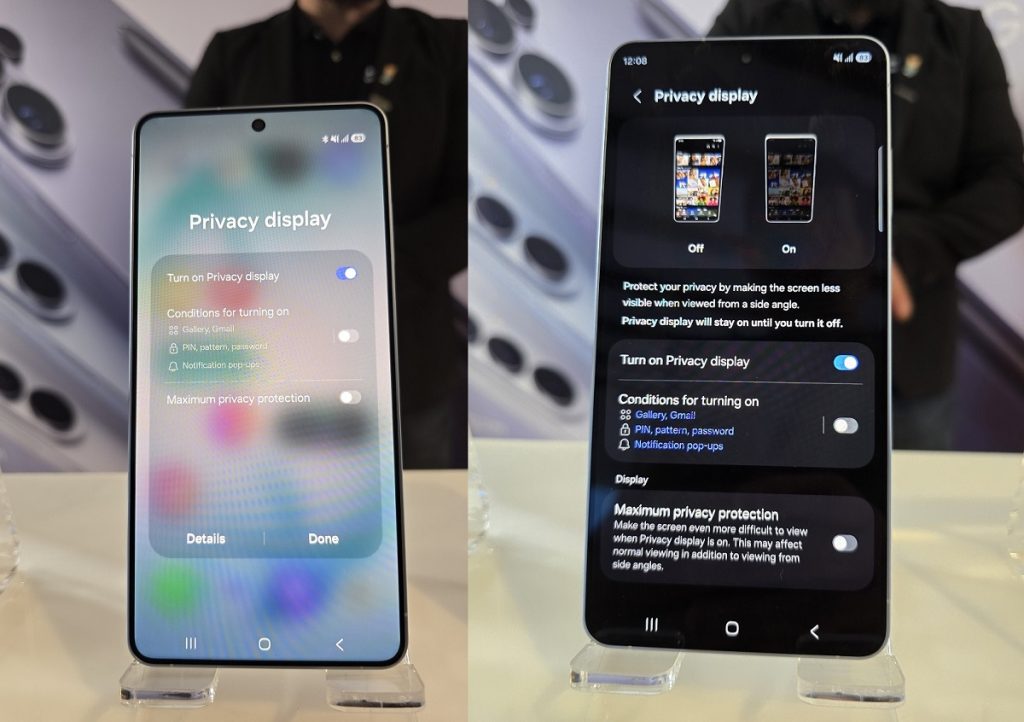
SEOUL / NEW YORK — In an era where data leakage increasingly happens in physical space rather than cyberspace, Samsung Electronics is preparing a decisive counter-offensive. According to supply chain intelligence and internal technical briefings reviewed exclusively by our investigative desk, the conglomerate’s mobile experience division has finalized a major hardware upgrade to its proprietary Privacy Display technology. Scheduled to debut in the forthcoming Galaxy S27 Pro and S27 Ultra flagship devices, this engineering leap addresses one of the most stubborn vulnerabilities in mobile computing: visual data interception, commonly known as shoulder surfing.
While software-based privacy screen filters and aftermarket plastic film protectors have long offered rudimentary shielding, they routinely degrade display brightness, impair biometric sensor accuracy, and diminish color fidelity. Samsung’s newly refined hardware solution bypasses these compromises by embedding dynamic micro-louver polarization directly into the OLED emission stack. For enterprise executives, compliance officers, and institutional investors tracking the mobility sector, this development represents a fundamental realignment of how smartphone hardware addresses risk mitigation and infrastructure scalability at the edge.
The Catalytic Shift: Moving Beyond Software and Aftermarket Film
Test Our Free AI & Tech Utilities Suite
Calculate LLM API token costs, analyze article dwell-time, or simulate tech DCA returns.
The imperative for hardware-integrated privacy is not merely a consumer luxury; it is an institutional necessity driven by the explosive growth of remote work, mobile banking, and high-stakes corporate messaging on personal and enterprise-issued devices. Traditional solutions have relied on software-toggled color inversion or third-party screen protectors that reduce luminance by up to 45%, forcing users to crank up backlighting and rapidly drain battery reserves.
According to structural engineering disclosures obtained from component manufacturers in South Korea, Samsung’s upgraded display architecture leverages a newly engineered sub-pixel orientation layer. When activated via hardware shortcut or contextual enterprise policy, this layer dynamically steers light dispersion angles from a standard 170-degree viewing cone down to a tightly controlled 35-degree axis. Crucially, this adjustment occurs with negligible impact on power consumption or peak HDR brightness—a technical bottleneck that previously stunted the widespread adoption of earlier privacy-screen iterations.
"We are witnessing the convergence of physical security and high-end display engineering," notes a senior semiconductor analyst based in Tokyo who requested anonymity due to ongoing advisory agreements with display manufacturers. "For enterprise CIOs managing thousands of mobile endpoints, a native hardware privacy display drastically reduces the vector for visual data theft without requiring employees to apply clumsy, touch-degrading accessories. This fundamentally alters the risk mitigation calculus for regulated industries."
Financial Implications and Capital Allocation Strategy

The timing of Samsung’s display enhancement aligns with a broader industry push to protect valuation multiples in a mature smartphone market. With global shipment volumes plateauing, original equipment manufacturers (OEMs) face severe margin compression. To defend average selling prices (ASPs), market leaders must deliver differentiated utility that commands premium pricing power.
By engineering the Galaxy S27 Pro and S27 Ultra with military-grade visual security, Samsung is aggressively targeting the high-margin enterprise B2B sector. Financial institutions, government agencies, and healthcare providers operate under strict regulatory frameworks—such as GDPR, HIPAA, and various global financial conduct authorities—that mandate stringent data protection protocols. An enterprise fleet of Galaxy S27 Ultra devices equipped with hardware-level privacy displays significantly strengthens an organization's compliance posture, lowering the potential for catastrophic data breach penalties.
Capital expenditure reports indicate that Samsung Display is currently reallocating a substantial portion of its advanced OLED manufacturing capacity to support the micro-louver integration process. This calculated deployment of capital reflects management's confidence that hardware security features will serve as a primary purchase driver for enterprise procurement committees over the next three to five years.
Verified Data & Metrics Breakdown
A comparative analysis of Samsung's evolutionary privacy display iterations reveals significant technical and operational advancements slated for the Galaxy S27 generation:
| Metric / Specification | Legacy Software / Film Solutions | Galaxy S25/S26 Iterations | Galaxy S27 Pro / Ultra (New) |
|---|---|---|---|
| Viewing Cone (Active) | Fixed (Aftermarket) / Variable (Software) | 45 Degrees | 35 Degrees (Dynamic Precision) |
| Peak Brightness Penalty | -30% to -45% | -15% | Less than -3% |
| Integration Level | External Accessory / OS Toggle | Sub-pixel Software Layer | Hardware Micro-louver OLED Stack |
| Enterprise MDM Integration | None / Manual | Partial API Support | Full Native Knox Security Enclave |
| Estimated Market Debut | Available Now | 2025–2026 | Q1 2027 |
Industry & Market Implications: Winners and Losers
The introduction of refined hardware privacy displays on flagship mobile devices shifts competitive dynamics across multiple sectors, creating distinct beneficiaries and casualties:
- Winners:
- Samsung Electronics and Samsung Display: Secures a distinct hardware moat that justifies premium pricing and drives high-margin B2B contract wins.
- Enterprise Mobility Management (EMM) Providers: Gain deeper API hooks to automate security compliance across corporate device fleets.
- Security-Conscious Professionals: Executives, traders, and government officials gain seamless protection against physical data espionage.
- Losers:
- Third-Party Screen Protector Manufacturers: Face an existential threat to high-margin sales of privacy filter films as native hardware renders aftermarket additions obsolete.
- Competing Android OEMs: Must accelerate their own R&D pipelines or risk ceding the lucrative enterprise security segment to Samsung.
Frequently Asked Questions (People Also Ask)
How does Samsung’s upgraded Privacy Display work on the Galaxy S27 Pro and Ultra?
Unlike software filters or traditional plastic privacy films that simply darken the screen or invert colors, Samsung’s system utilizes a hardware-level micro-louver polarization layer built directly into the OLED display stack. This allows the device to physically restrict light emission angles on command, ensuring content is only visible to the user sitting directly in front of the screen without sacrificing overall brightness or color accuracy.
Will the privacy display feature impact battery life or display quality?
According to supply chain documentation, the new hardware integration limits peak brightness degradation to less than 3%, a massive improvement over older software methods and aftermarket films that often reduced brightness by up to 45%. Power consumption impact is negligible, as light redirection is managed at the sub-pixel hardware level rather than through heavy GPU-intensive software rendering.
Can enterprise IT administrators remotely control the privacy display feature?
Yes. The hardware-level privacy mode integrates directly with Samsung Knox and standard Mobile Device Management (MDM) platforms. Enterprise IT administrators can establish automated policies that enforce privacy display activation whenever employees access sensitive applications, such as internal CRM systems, banking dashboards, or secure communications tools.
When will the Galaxy S27 Pro and S27 Ultra officially launch?
Following Samsung's traditional product lifecycle cadence, the Galaxy S27 series—featuring the upgraded Privacy Display—is projected to be formally unveiled at a Galaxy Unpacked event in the first quarter of 2027, with global retail and enterprise availability commencing shortly thereafter.
Future Outlook and Key Milestones to Watch
As the smartphone industry approaches the commercialization window for the Galaxy S27 generation, market analysts will closely monitor several critical milestones. First, observation of Samsung Display’s capital expenditure announcements in upcoming quarterly earnings reports will confirm the scale of manufacturing line conversions. Second, industry watchers will track patent filings related to micro-louver OLED integration to gauge whether competitors like Apple or Google are attempting to engineer rival solutions.
Ultimately, Samsung’s strategic bet on hardware-level privacy filtration underscores a vital shift in consumer electronics: differentiation is no longer solely about raw processing power or camera megapixels, but about solving tangible, real-world security vulnerabilities. For institutional investors and technology strategists, the Galaxy S27 Pro and S27 Ultra represent a masterclass in leveraging hardware innovation to defend market share, expand enterprise margins, and redefine mobile security standards for the next decade.