Executive Takeaways
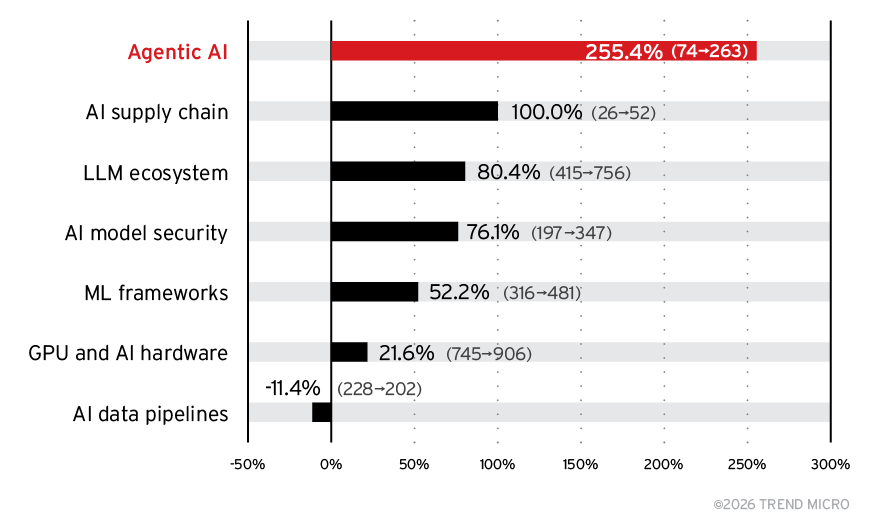
- Ground Zero for Cyber Risk: According to the latest TrendAI™ State of AI Security Report released in early March 2026, artificial intelligence systems became the primary vector for global cyberattacks throughout the second half of 2025.
- Ecosystem Fragility: Vulnerabilities are no longer confined to traditional application layers; threats now systematically target machine learning (ML) frameworks, complex AI supply chains, and large language model (LLM) architectures.
- Capital Allocation Paradigm Shift: Enterprise ROI and tech valuation multiples are facing severe downward pressure as boards are forced to reallocate capital toward mandatory risk mitigation, cloud compute architecture hardening, and regulatory compliance.
- Defensive Innovation: Breakthrough strategies—such as Layered Prompt Injection Representation—are emerging as critical guardrails, though widespread adoption across enterprise deployment pipelines remains dangerously uneven.
The rapid, capital-fueled deployment of generative artificial intelligence across global markets has outpaced the development of fundamental digital safety architecture. According to the groundbreaking TrendAI™ State of AI Security Report published by Trend Micro, the second half of 2025 marked a watershed moment: AI systems officially became ground zero for cyber risk. As enterprises race to capture productivity gains and justify massive capital allocation into cloud compute infrastructure, malicious actors have exploited profound structural weaknesses embedded deep within the AI ecosystem.
This comprehensive investigative report examines the structural fault lines destabilizing the artificial intelligence economy. By analyzing data from the Trend Micro intelligence network, enterprise deployment logs, and expert insights from chief information security officers (CISOs), we dissect how vulnerabilities in machine learning frameworks, complex software supply chains, and unmitigated prompt injection vectors threaten both corporate valuations and global systemic stability.
The Anatomy of the Crisis: Catalytic Shifts in 2025
Throughout the hyperscale AI boom of 2023 and 2024, corporate governance focused primarily on infrastructure scalability, model parameter expansion, and speed-to-market. Security, by contrast, was frequently treated as an afterthought—a secondary operational friction point rather than a primary existential variable. By the third quarter of 2025, that strategic oversight manifested into a widespread operational crisis.
The TrendAI™ report highlights that cybercriminal syndicates and state-sponsored actors shifted their tactical focus away from legacy perimeter defenses. Instead, they targeted the foundational software layers powering modern AI engines. This includes exploiting unpatched vulnerabilities in open-source ML frameworks (such as PyTorch and TensorFlow dependencies), poisoning training datasets, and executing sophisticated multi-stage prompt injections that bypass standard alignment protocols.
Consider the economic stakes. Enterprise AI integration is no longer a localized experimental budget item; it drives core revenue functions, automated financial trading algorithms, autonomous customer service workflows, and proprietary intellectual property generation. When an AI ecosystem fault line is compromised, the blast radius extends far beyond a simple data breach—it compromises automated enterprise logic itself.
Deconstructing the Threat Vectors: ML Frameworks to LLM Guardrails

The fragility of the modern AI architecture stems from its inherently modular nature. An enterprise LLM deployment relies on a dizzying array of upstream components: third-party foundational models, vector databases, retrieval-augmented generation (RAG) pipelines, and customized API wrappers. Each touchpoint represents a distinct fracture point in the supply chain.
- Machine Learning Framework Vulnerabilities: Open-source repositories have become prime targets for dependency confusion and malicious package injection. Attackers have successfully inserted rogue code into common data science libraries, allowing remote code execution (RCE) on enterprise inference servers.
- AI Supply Chain Compromise: Much like the infamous Log4j crisis, organizations routinely pull pre-trained weights and model checkpoints from public model hubs without cryptographic verification. Maliciously altered weights can introduce backdoors that remain completely dormant during standard benchmark testing but activate under specific prompt conditions.
- Sophisticated Prompt Injection Attacks: Traditional filters designed to catch direct command overrides are increasingly ineffective. As detailed in specialized security research such as the Layered Prompt Injection Representation framework, attackers now utilize semantic obfuscation, multi-turn dialogue manipulation, and indirect injection via poisoned web content ingested during RAG operations.
Verified Data & Metrics Breakdown: The State of AI Security
| Metric / Indicator | Pre-2025 Benchmark | H2 2025 / Early 2026 Reality | Enterprise Impact & Significance |
|---|---|---|---|
| Primary Cyber Attack Vector | Legacy Endpoints & Cloud Storage (S3 Buckets) | AI Systems, ML Frameworks, & LLM Pipelines | Mandates a complete overhaul of corporate CISO reporting lines and defensive tooling. |
| Supply Chain Vector Vulnerabilities | Standard NPM/Python Package Dependencies | Unverified Open-Source Model Weights & Checkpoints | Introduces silent backdoors that evade standard automated integration tests. |
| Capital Reallocation to Security | < 5% of Total AI Infrastructure Budget | Estimated 18% to 24% and Climbing | Compresses short-term enterprise ROI on AI projects while protecting long-term valuations. |
| Prompt Injection Sophistication | Basic Jailbreaking & Direct Persona Flips | Layered Semantic Representation & Indirect RAG Poisoning | Requires advanced runtime guardrails and multi-tiered context validation. |
Industry & Market Implications: Winners, Loses, and Economic Realities
The exposure of these structural fault lines is triggering a profound re-pricing of technology sector risk. Financial analysts and venture capital firms are beginning to scrutinize enterprise software stacks through a much harsher lens. Valuation multiples for companies that rushed unverified AI wrappers to market without enterprise-grade security are facing severe downward pressure.
Who Wins: Cybersecurity enterprises and specialized AI governance platforms—such as Trend Micro with their advanced TrendAI™ telemetry—are positioned for explosive growth. Organizations that offer rigorous model scanning, runtime behavioral monitoring, and automated red-teaming are seeing unprecedented demand. Furthermore, cloud service providers (CSPs) that build native, airtight security perimeters into their AI-as-a-Service (AIaaS) offerings will capture market share from risk-averse legacy buyers.
Who Loses: Early-stage startups and legacy enterprises that prioritized rapid deployment over architectural integrity face immense liability. A single high-profile supply chain breach resulting in the exfiltration of proprietary corporate data or the manipulation of automated decision-making engines can destroy market capitalization overnight. Additionally, insurers are tightening underwriting standards, introducing prohibitive premiums for organizations lacking verifiable AI safety frameworks.
From a macroeconomic perspective, this transition marks the maturation of the AI market. The era of unchecked, "move fast and break things" deployment has officially closed, replaced by a rigorous paradigm centered on regulatory compliance, risk mitigation, and structural resilience.
Frequently Asked Questions (People Also Ask)
What are the primary fault lines identified in the TrendAI™ State of AI Security Report?
The report highlights vulnerabilities across machine learning frameworks, unverified open-source AI supply chains (including model weights and checkpoints), and advanced runtime prompt injection techniques. These fault lines expose enterprises to data exfiltration, remote code execution, and automated workflow manipulation.
How do indirect prompt injections threaten enterprise RAG (Retrieval-Augmented Generation) systems?
Indirect prompt injections occur when an LLM ingests external, unvetted data—such as malicious web pages, customer emails, or poisoned documents—during standard RAG retrieval operations. Embedded instructions within this external data trick the model into executing unauthorized commands, bypassing internal safety boundaries without direct user intervention.
Why is securing AI supply chains more complex than traditional software supply chain security?
Unlike traditional software where code can be statically analyzed for known bugs, AI supply chains involve probabilistic components like neural network weights, hyperparameters, and embeddings. A model can pass traditional code linters yet contain hidden behavioral backdoors embedded deep within its statistical parameters, making verification exceptionally difficult.
What impact is this security crisis having on enterprise AI capital allocation and ROI?
Organizations are rapidly shifting capital away from purely experimental, unmanaged deployments and reallocating funds toward comprehensive risk mitigation, runtime guardrails, and compliance infrastructure. While this increases upfront costs and temporarily compresses short-term AI ROI, it is essential for protecting long-term market valuation and avoiding catastrophic liability.
Future Outlook: Navigating the Next Phase of AI Architecture
As the artificial intelligence ecosystem matures past its initial hyper-growth phase, market liquidity and investor confidence will increasingly depend on verifiable security standards. The findings from Trend Micro's early 2026 assessment serve as a definitive wake-up call for executive leadership.
Over the next 12 to 18 months, key milestones to watch include the widespread standardization of cryptographic bill of materials (BOMs) for machine learning models, the integration of autonomous AI red-teaming agents into standard continuous integration/continuous deployment (CI/CD) pipelines, and stringent regulatory frameworks from global oversight bodies penalizing unmitigated algorithmic negligence. Enterprises that successfully re-architect their cloud compute environments and adopt layered defensive paradigms—such as rigorous prompt representation filtering—will safeguard their market position. Those that ignore these structural fault lines do so at their own existential peril.