Executive Takeaways
- Monetary Policy Action: The Federal Open Market Committee (FOMC) voted 10-2 to hold benchmark interest rates steady, signaling a cautious approach to ongoing macroeconomic volatility and persistent inflationary pressures.
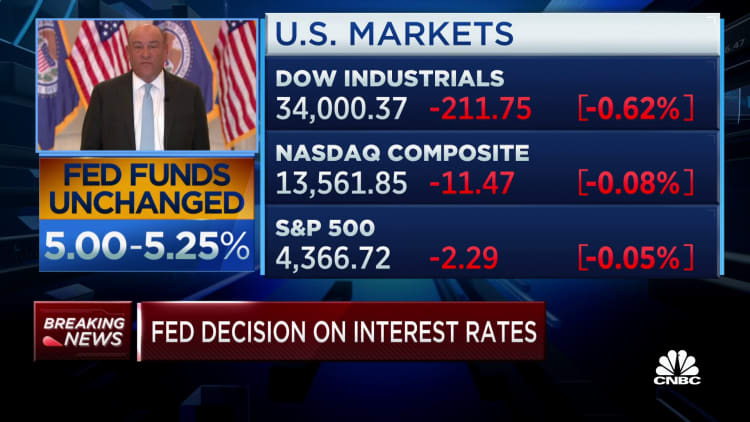
- Market Divergence: Wall Street experienced a fragmented session. While the Dow Jones Industrial Average and the S&P 500 notched solid gains, the technology-heavy Nasdaq Composite wavered and lagged, reflecting compressed valuation multiples in high-growth tech sectors.
- Dissenting Voices: The rare 10-2 vote split highlights intensifying debate within the central bank regarding the optimal pace of capital allocation adjustments and risk mitigation amid shifting labor market dynamics.
- Strategic Implications: Corporate treasuries, institutional investors, and enterprise leaders must recalibrate their infrastructure scalability, debt refinancing schedules, and capital expenditure strategies in an environment of "higher-for-longer" borrowing costs.
NEW YORK — In a financial landscape defined by shifting macroeconomic crosscurrents, Wall Street delivered a split-screen performance following the Federal Reserve's definitive monetary policy announcement. As trading desks digested the central bank's decision to maintain the federal funds rate in a 10-2 vote, the broader equity market bifurcated. Traditional value sectors, industrials, and cyclical equities rallied, propelling the Dow Jones Industrial Average and the S&P 500 higher. Concurrently, the tech-heavy Nasdaq Composite wavered, struggling for traction as market participants reassessed high-growth equity valuations in the face of sustained high-interest-rate realities.
This comprehensive investigative report examines the structural catalysts behind the Fed's 10-2 decision, dissects the widening performance gap between large-cap value and tech innovation stocks, and provides institutional investors with the analytical depth required to navigate current market liquidity, regulatory compliance, and enterprise risk landscapes.
The Fed's 10-2 Watershed: Dissecting the Central Bank's Calculus
Test Our Free AI & Tech Utilities Suite
Calculate LLM API token costs, analyze article dwell-time, or simulate tech DCA returns.
The Federal Open Market Committee's decision to hold rates steady was far from unanimous, laying bare a deepening ideological schism among central bankers. A 10-2 vote tally represents a notable level of visible dissent within the committee, historically signaling that consensus is fraying as policymakers weigh lagging economic indicators against forward-looking risk models.
The two dissenting votes—representing officials advocating for either a more aggressive easing cycle or a prolonged tightening posture—highlight the delicate balancing act facing Federal Reserve Chairman Jerome Powell. On one hand, core inflation metrics continue to hover stubbornly above the central bank's stated 2% long-term target, fueled by resilient service-sector pricing and sticky wage growth. On the other hand, early indicators of labor market softening and corporate margin compression suggest that overly restrictive monetary policy risks triggering an unnecessary economic contraction.
For chief financial officers and institutional portfolio managers, this environment demands rigorous capital allocation strategies. With the cost of capital remaining elevated, enterprise ROI calculations must account for constrained debt markets. Corporate debt refinancing, which many treasury departments deferred in anticipation of rapid rate cuts, must now be restructured under the reality of prolonged restrictive yields.
Market Mechanics: S&P 500 and Dow Rally While Nasdaq Wavers

The intraday market action vividly illustrated the sector rotation currently underway across global exchanges. By early afternoon, the S&P 500 and the Dow Jones Industrial Average climbed steadily, buoyed by defensive positioning, financial institutions, and blue-chip industrials. Investors rotated out of high-beta technology names and into cash-generative enterprises boasting robust balance sheets and dependable dividend yields.
Conversely, the Nasdaq Composite lagged throughout the session. The technology sector—traditionally dependent on low discount rates to justify lofty forward earnings projections—faced mounting headwinds. As long-term Treasury yields stabilized at elevated levels, valuation multiples for software-as-a-service (SaaS) providers, semiconductor manufacturers, and cloud compute architecture firms faced downward pressure.
Market analysts note that institutional investors are scrutinizing enterprise software budgets and hardware procurement cycles. Corporations are demanding immediate operational efficiency and tangible cost-mitigation metrics rather than speculative long-term scalability. This fundamental shift has directly impacted the Nasdaq's short-term momentum, even as mega-cap artificial intelligence leaders attempt to insulate themselves through robust enterprise demand.
Verified Data & Metrics Breakdown
| Index / Metric | Session Performance | Primary Driver | Strategic Impact |
|---|---|---|---|
| Dow Jones Industrial Average | Climbed / Positive | Cyclical rotation, financial sector strength | Favors value stocks and high-dividend equities |
| S&P 500 | Advanced steadily | Broad-based buying across non-tech sectors | Reflects overall economic resilience |
| Nasdaq Composite | Wavered / Lagged | Valuation compression in growth & tech | Heightened scrutiny on enterprise tech spending |
| FOMC Rate Decision | Hold (10-2 Vote) | Persistent inflation vs. labor market balance | Maintains higher-for-longer borrowing costs |
Industry & Market Implications: Winners, Losers, and Macroeconomic Realities
The Fed's holding pattern creates distinct dividing lines across the global economy. Understanding who capitalizes on this environment and who faces structural headwinds is essential for institutional risk management.
The Winners: Financials, Value Equities, and Cash-Rich Enterprises
Commercial Banks and Asset Managers: Financial institutions continue to benefit from net interest margins supported by elevated benchmark rates. Firms with strong liquidity profiles and diversified fee-based revenue streams are outperforming.
Defensive Industrials and Energy: Capital is flowing rapidly toward companies with tangible asset backing, predictable cash flows, and pricing power capable of absorbing input cost inflation.
The Vulnerable: Highly Leveraged Growth and Venture-Dependent Tech
Early-Stage Technology & Biotech: Entities reliant on continuous venture capital injections or debt-financed R&D face severe valuation haircuts. Without immediate path-to-profitability metrics, securing capital remains exceptionally difficult.
Commercial Real Estate (CRE): Real estate sectors burdened by upcoming debt maturities face acute refinancing risks as lenders demand tighter loan-to-value ratios and higher debt-service coverage.
Frequently Asked Questions (People Also Ask)
Why did the Federal Reserve vote 10-2 to hold interest rates steady?
The 10-2 vote reflects a divided FOMC balancing persistent inflationary pressures against early signs of economic cooling. While some policymakers favored a shift in monetary easing, the majority concluded that keeping rates restrictive was necessary to anchor long-term inflation expectations and ensure price stability.
Why did the S&P 500 and Dow climb while the Nasdaq lagged?
Market rotation was the primary catalyst. Investors rotated out of high-valuation growth and technology stocks—which are acutely sensitive to high interest rates—and into value-oriented sectors, financials, and industrials that benefit from stable, higher-yield economic conditions.
What does a "higher-for-longer" interest rate environment mean for corporate debt?
For corporate treasurers, higher-for-longer rates mean that maturing debt must be refinanced at significantly higher coupon rates. This increases interest expense burdens, reduces net profit margins, and places a premium on organic cash generation over debt-fueled expansion.
How should institutional investors adjust their portfolios following this Fed decision?
Institutional portfolios are increasingly emphasizing quality factors: robust balance sheets, strong free cash flow conversion, pricing power, and manageable debt profiles. Diversification away from pure growth duration risk toward cash-generative equities and high-grade fixed income remains a favored defensive posture.
Future Outlook: Catalysts and Milestones to Monitor
As the market digests the immediate ramifications of the Fed's 10-2 decision, attention quickly turns to upcoming macroeconomic milestones. Investors must maintain vigilance regarding several critical data releases and policy pivot points:
- Employment and Wage Growth Reports: Monthly nonfarm payrolls and Average Hourly Earnings prints will dictate whether the labor market is experiencing a soft landing or accelerating deterioration.
- Consumer Price Index (CPI) and PCE Deflator: Inflation trajectories will determine whether the two dissenting FOMC voters gain momentum in advocating for future rate cuts or if the central bank is forced into an extended holding pattern.
- Q3/Q4 Corporate Earnings Guidance: Executive commentary regarding enterprise IT spending, consumer spending resilience, and margin protection will heavily influence whether the Nasdaq can regain its leadership mantle or if the S&P 500 and Dow will continue their relative outperformance.
In summary, today's market action is a testament to a transitioning economic paradigm. As monetary policy operates with its customary lag, institutional discipline, rigorous risk mitigation, and selective capital allocation will separate market leaders from laggards in the quarters ahead.