UN HQ Rattled: Trump Unleashes Volley of Boasts, Threats, and Barbs, Drawing Global Scrutiny
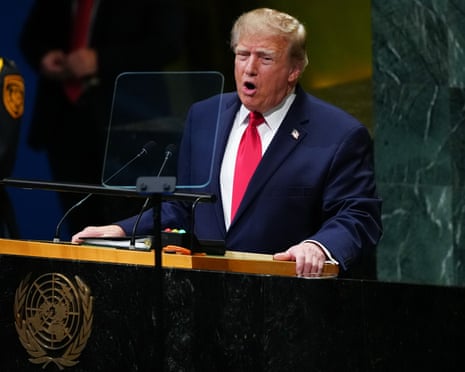
UNITED NATIONS – TRENDING NOW – In a speech that reverberated through the halls of the United Nations General Assembly and across global markets, President Donald Trump delivered an address today that was an unmistakable blend of audacious boasts, stark threats, and characteristic jibes. The highly anticipated appearance, closely monitored on Google Trends, cemented his 'America First' doctrine on the world stage, sparking immediate and diverse reactions from allies and adversaries alike.
For just over an hour, the President painted a picture of American resurgence under his leadership, while simultaneously issuing firm warnings to nations he deemed hostile or unfair. The address, a signature display of his unconventional diplomacy, underscored a deep skepticism towards multilateral institutions and global consensus, often to the visible discomfort of assembled delegates. Martin Belam, reporting from the ground, noted the palpable tension following the speech's conclusion, as diplomats scrambled to decode its implications.
A Symphony of Self-Praise: The Boasts
President Trump opened his remarks with a self-congratulatory assessment of the United States' economic prowess, claiming unparalleled growth and job creation under his watch. "The American economy is booming like never before," he declared, citing record low unemployment rates and a revitalized manufacturing sector. He asserted that his administration had achieved more in a short period than almost any other in history, prompting a notable, if brief, moment of audible reaction from the audience.
He championed the strength of the U.S. military, emphasizing massive investments in defense and technological advancements, positioning America as the undisputed global superpower. "We are rebuilding our military at a record clip, investing in the finest equipment, the finest planes, the finest ships," Trump stated, implying an unparalleled capacity for global projection and protection of American interests.
Unflinching Warnings: The Threats
The tone swiftly shifted to stern warnings, particularly aimed at Iran and its perceived destabilizing activities in the Middle East. Trump reiterated his administration's withdrawal from the Iran nuclear deal, labeling it "horrible" and "one-sided," and pledged to continue applying maximum pressure on Tehran. "Iran's leaders sow chaos, death, and destruction," he asserted, threatening further sanctions and economic isolation unless the regime changes its behavior.
North Korea, while not subjected to the same level of direct condemnation as in previous addresses, still featured in his discourse. Trump highlighted the progress made in denuclearization talks but warned that "much work remains to be done," indicating that the U.S. would not hesitate to revert to a more confrontational stance if diplomatic efforts falter. The message was clear: American patience has limits.
Trade imbalances also formed a significant component of his threats. He lambasted nations that he accused of unfair trade practices, intellectual property theft, and currency manipulation. "We are standing up for our workers, our businesses, and our right to fair and reciprocal trade," he stated, reinforcing his commitment to protectionist policies and signaling potential tariffs against countries failing to meet his administration's demands.
The Diplomatic Darts: Characteristic Jibes
True to form, President Trump peppered his speech with pointed criticisms and lighthearted, yet impactful, jibes. He targeted the very institution he was addressing, suggesting the UN's effectiveness was often hampered by bureaucracy and a lack of accountability. "We are only going to give foreign aid to those who respect us," he proclaimed, linking humanitarian assistance to geopolitical alignment and national interest.
OPEC came under direct fire, with Trump accusing the oil cartel of driving up global prices and exploiting consumers. "OPEC, I don't like it. Nobody likes it. You're charging a lot of money," he declared, urging member nations to increase production to lower energy costs, a move interpreted as a direct challenge to their sovereignty and market control.
The segment where he initially claimed his administration had achieved more than almost any other in U.S. history was met with polite laughter from the delegates, to which Trump responded with a smile and a shrug, "I didn't expect that reaction, but that's okay." This unscripted moment encapsulated his comfort with, and often deliberate provocation of, traditional diplomatic norms.
Iran's Retort: A Counter-Narrative Emerges
The tensions were further inflamed by the subsequent address from Iran's President Hassan Rouhani, who launched a scathing counter-attack. Rouhani accused the United States and Israel of "atrocious crimes" and "economic terrorism," particularly criticizing the renewed sanctions that he argued were inflicting immense suffering on the Iranian populace. He portrayed the U.S. withdrawal from the nuclear accord as a violation of international law and a threat to global peace, painting America as an unreliable partner.
Rouhani emphasized Iran's right to peaceful nuclear energy and denounced attempts to isolate his country, asserting that stability in the Middle East could only be achieved through dialogue, not coercion. His remarks underscored the deep ideological chasm between Washington and Tehran, setting the stage for continued confrontation.
Key Takeaways from the UN Address
- Unwavering 'America First' Stance: Trump solidified his commitment to prioritizing U.S. national interests above traditional multilateral cooperation.
- Economic & Military Power Display: Highlighted perceived American resurgence and strength as a foundation for global influence.
- Direct Confrontation with Adversaries: Iran received the harshest criticism, with threats of continued pressure and sanctions.
- Skepticism Towards Global Bodies: Jibes aimed at the UN and OPEC reflected a desire to reshape international institutions to better serve U.S. interests.
- Demand for Reciprocal Trade: Reiteration of the push for fair trade deals, signaling potential for further trade disputes.
- Challenging the Status Quo: The speech was a deliberate departure from traditional diplomatic rhetoric, aiming to disrupt established norms.
Immediate Global Reactions: A Snapshot
| Entity/Nation | Initial Reaction | Key Concern/Comment |
|---|---|---|
| European Allies | Concerned/Uneasy | Unilateralism, erosion of multilateral agreements, trade implications. |
| Iran | Defiant/Accusatory | U.S. "economic terrorism," violation of international law. |
| China | Cautious/Measured | Potential for escalating trade war, geopolitical rivalry. |
| Russia | Skeptical/Critical | U.S. interference in sovereign affairs, destabilizing rhetoric. |
| U.S. Domestic Media | Divided/Intense Scrutiny | Praise for strong stance vs. criticism for alienating allies. |
Looking Ahead: Implications for Global Order
President Trump's address at the UN General Assembly serves as a clear indicator of the enduring trajectory of American foreign policy under his administration. The blend of assertiveness and isolationism, coupled with a willingness to challenge long-standing alliances and agreements, signals continued volatility in international relations.
The immediate aftermath will likely see heightened diplomatic maneuvering, particularly concerning Iran and ongoing trade negotiations. Global leaders are now tasked with navigating a complex landscape where traditional alliances are tested, and the pursuit of national interest often supersedes collective action. The UN, an institution designed for consensus, finds itself a backdrop for an increasingly fragmented and confrontational global dialogue.
Frequently Asked Questions
Q1: What was the immediate global reaction to President Trump's speech?
A1: The immediate global reaction was sharply divided. European allies expressed concern over unilateralism and trade threats, while adversaries like Iran responded with strong condemnation and counter-accusations. Many international observers noted the departure from traditional diplomatic norms and the potential for increased global instability.
Q2: How does this speech compare to his previous addresses at the UN?
A2: This speech largely maintained the confrontational and 'America First' themes of his previous UN addresses but demonstrated a heightened sense of self-assuredness regarding his administration's achievements. While still delivering stark warnings, particularly on Iran, the tone also included more overt boasts about U.S. economic and military strength, interspersed with characteristic personal jibes, solidifying his unique brand of international diplomacy.