Executive Takeaways
- Unprecedented Joint Directive: On June 22, 2026, cyber security chiefs from the United States, United Kingdom, Canada, Australia, and New Zealand released an urgent, unified statement warning of an existential shift in global cyber risk driven by generative artificial intelligence.
- Democratization of Sophisticated Attacks: State-sponsored APTs and financially motivated cybercrime syndicates are deploying large language models to automate vulnerability discovery, synthesize custom malware variants, and execute hyper-personalized social engineering at scale.
- Bruising Economic Ramifications: Enterprise capital allocation must immediately pivot from legacy perimeter defense to zero-trust architecture, automated threat hunting, and rigorous AI governance to protect valuation multiples and maintain regulatory compliance.
- Infrastructure Vulnerability: Cloud compute architectures and critical national infrastructure face imminent, automated exploitation campaigns requiring radical supply chain visibility and immediate board-level risk mitigation strategies.
WASHINGTON, LONDON, CANBERRA, OTTAWA, WELLINGTON — In a coordinated geopolitical maneuver that has sent shockwaves through global capital markets and corporate boardrooms, the intelligence chiefs of the Five Eyes intelligence alliance delivered an uncompromising joint directive on June 22, 2026. Spearheaded by the U.S. National Security Agency (NSA), the Cybersecurity and Infrastructure Security Agency (CISA), the UK’s Government Communications Headquarters (GCHQ) National Cyber Security Centre (NCSC), alongside counterparts in Canada, Australia, and New Zealand, the statement serves as an unambiguous warning: the weaponization of artificial intelligence has permanently altered the threat landscape.
The advisory, formally titled “Five Eyes Cyber Security Agencies Statement on the AI Shift in Cyber Risk: Why Leaders Must Act Now,” dismantles any lingering corporate complacency regarding traditional cybersecurity frameworks. For chief information security officers (CISOs), chief financial officers (CFOs), and chief executive officers (CEOs) across the Fortune 500 and FTSE 100, the message is stark. The era of human-paced cyber threats is over. State actors and illicit syndicates are now leveraging autonomous AI agents to compress the adversary kill chain from weeks to mere seconds.
The Catalytic Shift: How Generative AI Rewrote the Threat Matrix
Test Our Free AI & Tech Utilities Suite
Calculate LLM API token costs, analyze article dwell-time, or simulate tech DCA returns.
For decades, enterprise risk mitigation relied on asymmetrical defense models where human defenders had time to analyze signatures, patch vulnerabilities, and deploy behavioral analytics. However, the maturation of generative AI, large language models (LLMs), and autonomous agentic workflows has inverted this dynamic. Adversaries now possess the capability to scale sophisticated attacks with virtually zero marginal cost.
According to classified intelligence briefings declassified alongside the June 22 directive, state-sponsored advanced persistent threat (APT) groups—most notably from jurisdictions historically hostile to Western interests—are utilizing custom-trained foundational models to automate zero-day discovery. Where human researchers once spent months reverse-engineering complex software stacks to find memory corruption flaws, automated AI agents now scan millions of repositories concurrently, identifying and exploiting unpatched enterprise software before internal security teams can initiate remediation protocols.
Furthermore, the barrier to entry for lower-tier cybercriminal syndicates has collapsed. The commercialization of offensive AI toolkits on the dark web allows threat actors with minimal technical proficiency to execute hyper-targeted, multi-vector phishing campaigns. These campaigns utilize real-time voice and video synthesis, flawless syntax, and deep contextual knowledge of corporate hierarchies, effectively bypassing legacy employee security awareness training.
Enterprise ROI and Capital Allocation in the Age of Autonomous Warfare
The economic fallout of this intelligence assessment is immediate. Institutional investors and private equity firms are rapidly repricing technology assets based on their resilience to AI-driven cyber threats. Enterprise ROI on legacy endpoint detection and response (EDR) tools is diminishing rapidly, as static rules-based systems prove fundamentally incapable of countering polymorphic malware generated dynamically by adversarial models.
| Metric / Parameter | Legacy Cyber Risk Model (Pre-2025) | Five Eyes AI Shift Mandate (June 2026) |
|---|---|---|
| Attack Velocity | Human-paced; days to weeks for reconnaissance and execution. | Autonomous; seconds to minutes via LLM-driven agents. |
| Vulnerability Discovery | Manual code auditing and periodic vulnerability scanning. | Continuous, automated parsing of source code and APIs by AI. |
| Social Engineering | Generic spear-phishing with recognizable linguistic anomalies. | Context-aware, multimodal deepfakes targeting executive authorization. |
| Capital Priority | Perimeter security, firewalls, and periodic compliance audits. | Zero-trust architecture, AI-driven SIEM, and automated containment. |
Boardrooms must now treat cybersecurity not as an IT expenditure, but as a core determinant of enterprise valuation. Regulatory compliance frameworks—including SEC disclosure mandates, EU NIS2 directives, and regional privacy laws—are tightening concurrently. Organizations that fail to demonstrate proactive AI risk mitigation face severe punitive fines, catastrophic reputational damage, and immediate compression of equity valuation multiples.
Industry & Market Implications: Winners and Losers
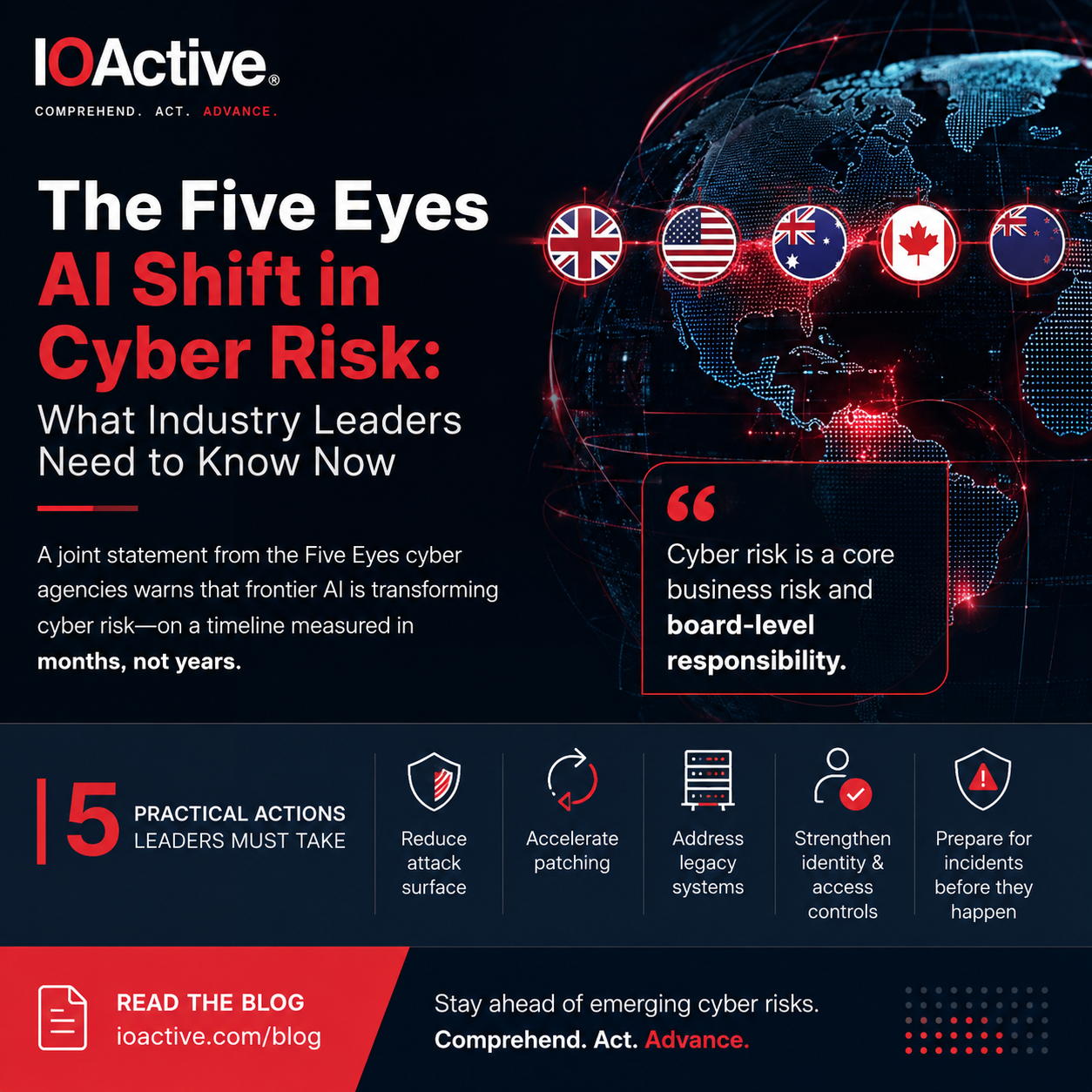
The seismic shift mandated by the Five Eyes intelligence agencies will create immediate market bifurcations across the technology, financial services, and critical infrastructure sectors.
- The Winners: Next-generation cybersecurity vendors specializing in AI-native threat intelligence, automated remediation, and zero-trust identity verification are experiencing unprecedented demand. Firms providing robust AI governance, model validation, and secure cloud compute architecture will capture massive enterprise budgets as corporations scramble to harden their digital perimeters.
- The Losers: Legacy managed security service providers (MSSPs) reliant on human analysts reviewing static alert queues will struggle to maintain margins. Enterprises with bloated, fragmented technology stacks and lagging digital transformation initiatives will see their market valuations severely penalized by institutional investors unwilling to shoulder systemic operational risk.
- Critical Infrastructure Exposure: Energy grids, financial market utilities, and healthcare networks face the most acute exposure. Because these sectors often rely on legacy industrial control systems (ICS) integrated with modern cloud infrastructure, they represent high-value targets for nation-state actors weaponizing AI to disrupt societal stability.
Frequently Asked Questions (People Also Ask)
Expert Answers to Critical Market Queries
What specific threat vectors are highlighted in the June 22, 2026 Five Eyes statement?
The statement emphasizes the automated discovery of zero-day vulnerabilities, the rapid synthesis of custom polymorphic malware via large language models, and hyper-targeted multimodal social engineering (including deepfake executive impersonation) deployed at industrial scale by both nation-state actors and cybercrime syndicates.
How should corporate boards reallocate capital in response to this intelligence directive?
Boards must shift capital away from reactive, perimeter-defense models and invest heavily in zero-trust architecture, automated AI-driven threat hunting platforms, continuous supply chain security auditing, and comprehensive executive training designed to counter sophisticated AI-enabled social engineering.
What are the regulatory implications for publicly traded companies failing to adopt AI-era cybersecurity standards?
Regulatory bodies such as the SEC and international equivalents are increasing scrutiny on cyber governance. Failure to implement robust, verifiable AI risk mitigation exposes firms to severe regulatory penalties, shareholder derivative lawsuits, and significant downward revisions of enterprise valuation multiples.
Why are cloud compute architectures uniquely vulnerable to these emerging AI-driven threats?
Modern cloud ecosystems feature complex APIs, interconnected microservices, and vast attack surfaces. Autonomous AI agents are uniquely suited to map these intricate digital environments, identifying misconfigurations and logic flaws millions of times faster than human auditors.
Future Outlook: Strategic Milestones for Enterprise Leadership
As the global cyber threat landscape enters this turbulent new phase, corporate leadership cannot afford a wait-and-see posture. The NSA, CISA, and their international allies have made it unequivocally clear that resilience requires fundamental architectural transformation rather than incremental patching.
Over the next 12 to 18 months, market observers should monitor several critical milestones: the enactment of stricter international standards for foundational AI model security, the consolidation of fragmented cybersecurity vendors into unified AI-native platforms, and institutional shifts in insurance underwriting standards for cyber risk. Enterprises that proactively integrate these intelligence recommendations into their capital allocation and operational frameworks will secure a decisive competitive advantage, safeguarding both their balance sheets and their long-term enterprise value.