Mars Quakes Prove Valles Marineris Is Alive: The Grand Canyon of the Red Planet Is Tectonically Active Today
Executive Takeaways
- Seismic Revelation: Recent data confirms that Valles Marineris—the colossal canyon system on Mars—is undergoing active tectonic and seismic processes, reshaping our understanding of planetary cooling cycles.
- Enterprise & Aerospace Paradigm Shift: The confirmation of active Martian tectonics redefines risk mitigation strategies for long-term capital allocation in private space infrastructure, orbital asset valuation, and autonomous surface hardware deployment.
- Comparative Planetology: Unlike Earth’s mobile lithospheric plates, Martian activity is driven by interior thermal contraction and localized faulting, offering a rare window into single-plate planetary evolution.
- Future Exploration Vectors: Aerospace conglomerates and defense primes must integrate high-frequency seismic resilience into next-generation habitation modules ahead of crewed missions.
For decades, planetary geologists operated under a comfortable consensus: Mars was a geologically dead world. Once home to ancient oceans and a thick, insulating atmosphere, the Red Planet was categorized as a stagnant-lid planet—a celestial body whose internal dynamo had flickered out billions of years ago, leaving its crust frozen in time. That paradigm has officially fractured.
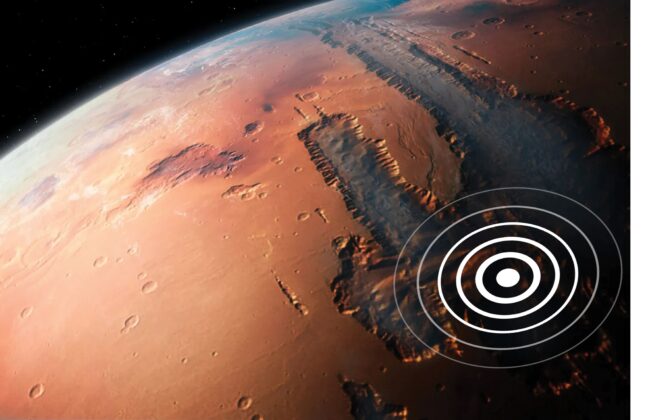
Groundbreaking data from orbital assets and surface landers confirm that Valles Marineris, the staggering system of canyons that dwarfs Earth’s Grand Canyon, is tectonically active today. This revelation does more than rewrite planetary textbooks; it forces a profound recalibration of how institutional investors, space agencies, and aerospace enterprises evaluate long-term infrastructure scalability, capital allocation, and risk management for off-world operations.
To comprehend the magnitude of this discovery, one must look beyond the raw science and examine the mechanics of a world awakening. Valles Marineris is not merely a topographical scar; it is a dynamic, shifting fault zone that demonstrates the Red Planet is far more geologically restless than previously modeled.
The Anatomy of a Titan: Unpacking Valles Marineris

To understand the significance of current tectonic activity, stakeholders must first grapple with the sheer scale of Valles Marineris. Stretching more than 4,000 kilometers (2,500 miles) long, up to 200 kilometers (120 miles) wide, and plunging depths of up to 7 kilometers (4 miles), it is a colossal gash that would stretch from New York City to Los Angeles if superimposed onto the North American continent.
For decades, its origins remained fiercely debated. Unlike Earth's Grand Canyon, which was carved primarily by the persistent flow of the Colorado River, Valles Marineris was forged by tectonic fracturing—a tearing apart of the Martian crust—subsequently widened by collapse, fluid sapping, and ancient erosion. The canyon cuts across the Tharsis region, a volcanic plateau so massive it bowed the very shape of the planet.
However, the prevailing economic and scientific assumption was that this dramatic tearing ceased billions of years ago during the Noachian or Hesperian epochs. The latest seismic telemetry shatters this assumption. High-resolution imagery and continuous seismic monitoring reveal fresh fault scarps, rockslides, and localized marsquakes originating from deep within the canyon’s troughs. These events indicate that extensional tectonics—the pulling apart of the crust—are occurring in real-time.
Driving Forces: Why Mars Is Still Cracking
On Earth, tectonics are driven by plate tectonics: massive lithospheric plates floating on a convecting mantle, colliding, sliding past one another, and subducting. Mars lacks this global conveyor belt. Instead, its tectonic activity is governed by a different mechanism: secular cooling and thermal contraction.
As Mars slowly loses its primordial internal heat to the vacuum of space, its interior volume contracts. This global shrinkage places immense mechanical stress on the rigid outer crust. When these stress thresholds exceed the tensile strength of the rock, faults rupture violently, releasing seismic energy and driving ongoing deformation within structural weak points like Valles Marineris.
This dynamic introduces critical variables for upcoming commercial and state-sponsored missions. When designing surface infrastructure—such as autonomous mining facilities, pressurized habitats, and communication arrays—engineers must now account for active seismic hazards. Risk mitigation frameworks within the aerospace sector are undergoing rapid revision to incorporate these ground-motion variables, directly impacting project valuation multiples and long-term asset security.
Verified Data and Metrics Breakdown
To contextualize the scale of Martian tectonic activity versus Earthly analogs, the following comparative dataset illustrates the structural and seismic parameters currently being analyzed by leading planetary research institutions.
| Parameter | Valles Marineris (Mars) | Grand Canyon (Earth) |
|---|---|---|
| Total Length | ~4,000 km (2,500 mi) | 446 km (277 mi) |
| Maximum Depth | Up to 7.0 km (4.3 mi) | ~1.83 km (1.14 mi) |
| Primary Formation Driver | Tectonic rifting & thermal contraction | Fluvial erosion (Colorado River) |
| Current Tectonic Status | Active seismicity & fault rupturing | Stable passive margin / slow uplift |
| Primary Economic Relevance | High-risk zone for long-term infrastructure | Stabilized tourism and resource asset |
Industry & Market Implications: Who Wins, Who Loses
The realization that Valles Marineris is tectonically active carries profound downstream consequences for the burgeoning space economy. As private enterprise pivots toward deep-space commercialization, geological realities dictate market viability.
- The Winners — Seismic Tech & Advanced Materials: Defense primes and aerospace contractors specializing in shock-absorbent structural engineering, real-time seismic monitoring payloads, and autonomous geotechnical surveying will see surging demand. Enterprises developing resilient cloud compute architectures capable of processing decentralized telemetry from remote planetary nodes stand to capture lucrative government and commercial contracts.
- The Losers — Rigid Infrastructure Paradigms: Fixed-design modular habitats and rigid surface architecture providers that fail to account for active faulting risk immediate obsolescence. Capital allocated to unverified site locations faces severe write-downs if unexpected seismic events compromise structural integrity.
- Capital Allocation & Insurance: Institutional investors and space-focused venture funds are recalibrating underwriting models. Risk mitigation strategies now mandate comprehensive subsurface profiling before committing capital to surface-level extraction or habitation ventures.
Frequently Asked Questions (People Also Ask)
How do scientists know Valles Marineris is tectonically active today?
Evidence is gathered through high-resolution orbital imaging that detects fresh rockslides and structural slumping, combined with sensitive seismic data detecting marsquakes originating directly from the canyon's fault networks. These instruments measure ground motion and acoustic waves propagating through the Martian crust, confirming ongoing subterranean mechanical stress.
Could active tectonics in Valles Marineris trigger volcanic eruptions?
While Valles Marineris is tied to the broader Tharsis volcanic province, current activity is primarily driven by extensional faulting and thermal contraction rather than active magma chambers. However, the presence of active faulting indicates that pathways for subsurface gases or localized magmatic movement remain a subject of intense investigation for planetary geologists.
What does this mean for future human missions and Martian colonization?
It fundamentally changes site selection and engineering protocols. Planners must avoid establishing permanent infrastructure directly adjacent to active fault scarps within Valles Marineris or similar rift zones. Habitation modules will require advanced seismic dampening, real-time early-warning sensors, and flexible structural joints to withstand localized tremors.
How does Martian tectonics differ from Earth's plate tectonics?
Earth features a mobile lithosphere broken into distinct moving plates driven by mantle convection. Mars is a "single-lid" planet, meaning its crust is one continuous, unbroken shell. Martian tectonics are caused by global thermal contraction—the planet shrinking as it cools—which cracks the rigid crust from within without sliding plates.
Future Outlook: Strategic Milestones to Watch
As data streams from interplanetary missions continue to refine our understanding of Martian geodynamics, the timeline for human exploration and industrial utilization enters a critical phase. Over the next 24 to 36 months, industry analysts will closely monitor several key catalysts:
- Next-Generation Seismic Network Deployment: Deployment of multi-node seismograph arrays across various Martian quadrangles to map crustal stress fields with unprecedented precision.
- Regulatory & Compliance Frameworks: The establishment of international planetary protection and infrastructure safety standards by space agencies and commercial consortia to govern off-world construction zones.
- Enterprise R&D Pivot: Acceleration of R&D spending by aerospace primes toward earthquake-resistant habitat designs, autonomous repair robotics, and decentralized power grids resilient to seismic disruption.
The revelation that Valles Marineris remains an active, shifting canyon serves as a stark reminder that celestial bodies are not museum exhibits. For the financial institutions, tech conglomerates, and space pioneers underwriting the next era of human expansion, factoring in the heartbeat of a living planet is no longer optional—it is the prerequisite for survival.