Executive Takeaways
- Structural Shift in Neutral Rates: Macroeconomic experts warn that global benchmark rates will not return to pre-pandemic zero-lower-bound levels due to persistent fiscal deficits, de-globalization, and supply-side inflation pressures.
- The Imminent Refinancing Wall: Enterprise balance sheets face a severe stress test as trillions in low-coupon corporate bonds issued during 2020–2021 mature, requiring refinancing at significantly higher prevailing yields.
- Valuation Multiple Compression: Prolonged elevated discount rates are systematically depressing earnings yield multiples across technology, commercial real estate, and growth equity assets.
- Strategic Capital Realignment: Institutional investors are pivoting toward floating-rate private credit and high-quality liquid assets (HQLA), while CFOs prioritize debt paydown over leveraged share buybacks.
The Macroeconomic Crucible: Why the Low-Rate Era Is Over
For more than a decade following the 2008 Global Financial Crisis, global capital markets operated under a regime of hyper-abundant liquidity, ultra-low benchmark rates, and structural central bank intervention. That structural regime has officially dissolved. On a recent broadcast of Chosun Ilbo Money’s flagship financial analysis program, "Kwak's Reporting Notebook," leading fixed-income strategists issued a stern warning to institutional and retail market participants alike: the global economy is entering a prolonged period of elevated nominal and real interest rates, with far-reaching consequences for sovereign liquidity, enterprise valuation, and private capital deployment.
The thesis presented by top bond analysts marks a decisive departure from the transient inflation narratives that dominated central bank rhetoric over the past three years. Instead, bond market veterans emphasize that structural macroeconomic forces—including deglobalization, the capital-intensive energy transition, demographic contraction across key industrial economies, and chronic fiscal spending—have permanently elevated the real neutral rate of interest ($r^*$). Consequently, central banks such as the U.S. Federal Reserve, the European Central Bank, and the Bank of Korea face severe structural limits on how aggressively they can ease monetary policy without re-igniting price instability.
For executive leadership teams and asset managers, this structural shift signals a dramatic regime change. The days of cheap capital masking structural operational inefficiencies or inflating enterprise valuation multiples are finished. In this environment, corporate capital allocation strategies must pivot from rapid debt-financed expansion toward rigorous balance sheet optimization, risk mitigation, and clear visibility on enterprise ROI.
Sovereign Supply Dynamics and Term Premium Expansion

A central pillar of the bond market's warning centers on sovereign debt supply dynamics and the resurgence of the term premium—the extra yield investors demand for holding long-term fixed-income securities rather than rolling over short-term bills. Unprecedented fiscal expansion across major advanced economies has created a massive structural supply-demand imbalance in the global sovereign bond market.
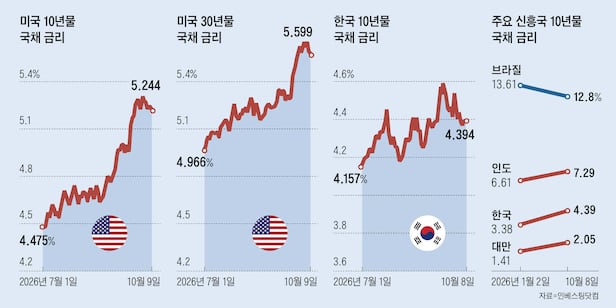
In the United States, the federal government continues to run fiscal deficits exceeding 6% of Gross Domestic Product (GDP) during periods of economic expansion—a historical anomaly outside of war or acute recession. To fund these deficits, the U.S. Department of the Treasury has accelerated issuance across the yield curve, flooding the primary market with Treasuries at a time when traditional non-price-sensitive buyers, including foreign central banks and the Federal Reserve (via Quantitative Tightening), are reducing their market footprint.
Similarly, Asian fixed-income markets face complex sovereign bond dynamics. In South Korea, Korean Treasury Bond (KTB) yields remain tightly tethered to global long-duration trends, constrained by domestic household debt overhangs and currency volatility against the U.S. dollar. As central banks wind down asset purchase programs, private capital markets are being forced to absorb historical volumes of sovereign paper. The direct result is upward structural pressure on long-duration yields, steepening yield curves, and elevated borrowing costs across the entire risk continuum.
The Approaching Corporate Refinancing Wall
The most immediate systemic threat stemming from high long-term interest rates is the upcoming corporate debt refinancing cliff. Between 2020 and mid-2021, enterprise CFOs opportunistically locked in historical low coupon rates across investment-grade and high-yield bond markets. However, a vast wave of this corporate debt is scheduled to mature between 2024 and 2027.
Corporations attempting to refinance fixed-rate paper issued at 2% to 4% yields are now confronting market rates ranging from 6% to 9%, depending on credit quality and industry risk profiles. This steep jump in interest expense threatens to compress Interest Coverage Ratios (ICRs), erode corporate profitability, and divert operational cash flows away from core research and development (R&D) and capital expenditures (CapEx).
High-leverage operations, particularly middle-market companies backed by private equity and enterprises operating in capital-intensive sectors like technology infrastructure and commercial real estate, face elevated default risks and downgrade hazards. Corporations without strong pricing power or high returns on invested capital (ROIC) will find it increasingly difficult to service high-cost debt without dilutive equity raises or aggressive asset sales.
Verified Data & Benchmark Metrics Breakdown
To understand the structural divergence between the previous low-rate regime and the emerging financial reality, the following metrics table outlines key benchmark indicators, balance sheet stress points, and yield trajectory shifts across key asset categories.
| Economic Metric / Benchmark | Low-Rate Era Baseline (2015–2021) | Current Regime (2024–2025) | Structural Outlook (Long-Term) |
|---|---|---|---|
| U.S. 10-Year Treasury Yield | 1.50% – 2.50% | 3.80% – 4.70% | 4.00% – 5.00% Structural Range |
| Real Neutral Rate ($r^*$) Estimate | -0.50% to 0.50% | 1.25% to 2.00% | Elevated (Supply Chain & Fiscal Pressures) |
| US High Yield Spread / Coupon Refinancing Gap | +150 to +300 bps (Issuance Rate ~4%) | Refinancing at +350 to +550 bps over elevated benchmarks | Significant ICR Erosion for Non-IG Issuers |
| U.S. Federal Budget Deficit (% of GDP) | 2.5% – 4.0% | 5.8% – 6.7% | Persistent Supply Overhead for Sovereign Paper |
| Enterprise Debt Refinancing Differential | Weighted Average Cost of Debt ~3.2% | Weighted Average Cost of Debt ~6.5% | Prioritization of Debt Reduction over Buybacks |
Industry & Market Implications: Structural Winners and Losers
The persistence of higher long-term interest rates triggers a profound reallocation of capital across sectors, creating distinct operational winners and losers based on balance sheet strength, business model capital intensity, and pricing flexibility.
1. Capital-Intensive Tech and Cloud Compute Infrastructure
While artificial intelligence (AI) and cloud compute demand remain secular growth drivers, scaling enterprise technology infrastructure requires immense upfront capital investment in data centers, high-performance semiconductors, and specialized power grids. Under a high discount rate regime, the net present value (NPV) of long-dated cash flows is structurally reduced. Enterprise software companies operating with negative cash flows will face severe valuation multiple compression, while cash-rich mega-cap tech giants with robust balance sheets will consolidate market power.
2. Commercial Real Estate and Regional Banking
Commercial Real Estate (CRE) stands out as the most exposed asset class in a prolonged high-rate environment. Debt-financed property portfolios facing elevated interest costs are experiencing cap rate expansion, leading to sharp asset write-downs. Regional banks holding substantial portfolios of low-yielding fixed-rate mortgage-backed securities (MBS) and commercial loans continue to navigate compressed Net Interest Margins (NIM) and heightened regulatory compliance standards surrounding Liquidity Coverage Ratios (LCR).
3. Private Credit vs. Public Fixed Income
Institutional allocators are increasingly deploying capital into private credit strategies offering floating-rate yields over traditional public fixed income. Private debt providers can secure high yield income while mitigating duration risk, though direct lenders face mounting credit monitoring responsibilities as borrower default risks rise in higher-for-longer rate conditions.
People Also Ask (Frequently Asked Questions)
Why are long-term bond yields remaining elevated even when central banks cut rates?
Long-term bond yields are driven by broader market expectations of long-run inflation, sovereign debt issuance volume, and term risk premiums rather than short-term central bank target rates alone. Even if a central bank lowers its benchmark policy rate to support economic growth, long-term yields can remain elevated if bond investors worry about persistent fiscal deficits, government debt supply overhangs, or structural inflation forces like supply chain re-shoring.
How do higher long-term rates impact technology enterprise valuations?
Enterprise valuations rely heavily on Discounted Cash Flow (DCF) models. When calculating the present value of future earnings, analysts use long-term risk-free rates (such as the 10-year Treasury yield) as a baseline discount factor. Higher discount rates reduce the present value of earnings expected far into the future, disproportionately hurting high-growth technology companies whose valuations depend on cash flows projected years down the road.
What balance sheet strategies should corporate CFOs adopt in this regime?
In a higher-for-longer interest rate environment, enterprise finance teams must focus on balance sheet liquidity, interest rate risk management, and capital disciplined project selection. Key adjustments include using interest rate swaps to hedge floating rate debt, extending maturity profiles during opportunistic rate pullbacks, directing excess cash flow toward debt reduction rather than debt-funded share buybacks, and demanding higher hurdle rates (returns) for new CapEx investments.
How does South Korea's bond market reflect global interest rate pressures?
South Korea’s financial system is highly integrated into global capital flows. Korean Treasury Bond (KTB) yields reflect broader U.S. Treasury market movements while managing local economic conditions, including high household debt levels and foreign exchange rate dynamics. As global rates remain high, domestic borrowing costs in Korea rise alongside them, forcing corporate borrowers and monetary authorities to adjust policy strategy to maintain balance of payments stability.
Future Outlook: Strategic Milestones to Watch
As institutional investors and enterprise CFOs adapt to this regime shift, market participants must track several critical macroeconomic catalysts and operational metrics over the next 12 to 24 months:
- Sovereign Refunding Announcements: U.S. Treasury quarterly refunding estimates and sovereign issuance schedules in major Asian markets will serve as primary indicators of supply-side market pressures.
- Real Yield Trajectories: The path of 10-year Inflation-Protected Securities (TIPS) yields will highlight whether high nominal yields are driven by inflation concerns or structural economic growth and fiscal crowding-out.
- Corporate Default and Distress Rates: Debt service metrics across non-investment-grade enterprise sectors will signal whether corporate balance sheets can successfully navigate the upcoming debt maturity wall.
- Central Bank Balance Sheet Policies: The pace of Quantitative Tightening (QT) and foreign currency intervention strategies will dictate liquidity across primary fixed-income trading desks worldwide.
The era of cheap capital is over. Operating in this environment requires institutional discipline, careful enterprise capital management, and a fundamental pivot toward balance sheet strength and steady operational profitability.