Executive Takeaways
- The Cost Equation Flips: AMD’s architectural deployment of the Instinct™ MI355X accelerator paired with SGLang and MoRI directly targets enterprise Total Cost of Ownership (TCO), challenging incumbent pricing power in hyperscale deployments.
- Software Breakthrough: By leveraging advanced optimizations through SGLang and Mixture of Routing Innovations (MoRI), AMD overcomes historical software-ecosystem friction, unlocking breakthrough distributed inference efficiency for large language models (LLMs).
- Capital Allocation Paradigm Shift: Chief Information Officers (CIOs) and enterprise budget holders facing runaway capital expenditure (CapEx) for AI infrastructure now possess a validated, scalable, and cost-competitive hardware-software stack.
- Market Valuation Repercussions: As enterprise ROI shifts toward deployment efficiency over raw training compute, hardware diversification alters cloud compute economics and pricing multiples across the semiconductor value chain.
SAN FRANCISCO & NEW YORK — In the high-stakes theater of enterprise artificial intelligence, the battleground has decisively shifted from training massive foundational models to the grueling, margin-compressing economics of inference. On May 27, 2026, Advanced Micro Devices (AMD) unleashed a tectonic shift in data center architecture with the formal rollout of its comprehensive technical blueprint: "Win on TCO: How AMD Instinct™ MI355X Achieves Cost-Competitive Distributed Inference Through SGLang with MoRI."
For Wall Street analysts, hyperscale cloud architects, and enterprise procurement executives, the release marks a critical inflection point in risk mitigation and capital allocation. For years, the narrative surrounding the enterprise AI boom was dominated by a single hardware titan, leaving corporate buyers exposed to rigid pricing power, supply chain bottlenecks, and severe margin compression. AMD’s latest engineering feat—combining the raw compute muscle of the Instinct MI355X with cutting-edge software routing via SGLang and MoRI (Mixture of Routing Innovations)—delivers a calculated assault on the total cost of ownership (TCO) calculus that has long governed enterprise infrastructure decisions.
The Structural Imperative: Why TCO Dictates the Next Phase of the AI Supercycle
During the initial gold rush of generative AI, venture capitalists and enterprise boards authorized unfettered capital expenditure (CapEx) to secure compute capacity. Speed to market superseded fiscal discipline. However, as generative AI transitions from experimental proof-of-concepts to ubiquitous production environments handling billions of daily queries, enterprise CFOs are demanding rigorous financial accountability.
Inference—the process of deploying trained models to generate real-time responses—now represents the lion's share of ongoing operational expenditure (OpEx) for enterprise cloud operators, software-as-a-service (SaaS) providers, and financial institutions. When scaling large language models across distributed clusters, infrastructure scalability is constrained not merely by silicon throughput, but by memory bandwidth, network latency, and software efficiency. Hardware that delivers superior peak performance on paper is rendered economically unviable if its TCO—encompassing power consumption, rack density, cooling requirements, and software licensing overhead—erodes operating margins.
AMD’s strategic maneuver with the MI355X directly addresses this friction point. By integrating high-bandwidth memory (HBM) architectures with an optimized open-source software stack, AMD is executing a textbook playbook designed to lower the barrier to entry for enterprise-grade distributed inference.
Deconstructing the Stack: MI355X, SGLang, and MoRI in Synergy
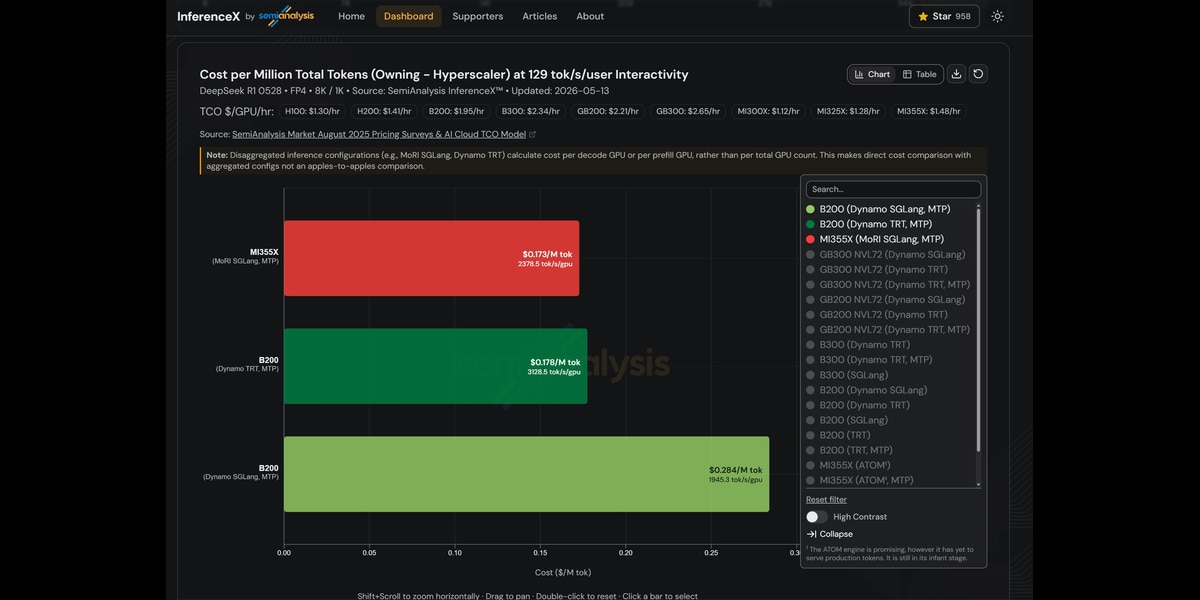
Achieving cost-competitive distributed inference requires absolute synchronization between silicon hardware and runtime software. The AMD Instinct™ MI355X accelerator is engineered specifically to alleviate the memory wall that bottlenecks modern LLMs. Yet, hardware alone cannot guarantee market adoption; the software ecosystem dictates enterprise liquidity and velocity.
Enter SGLang (Structured Generation Language), a high-performance serving framework engineered to accelerate LLM inference through novel primitives like RadixAttention and compressed finite-state machine generation. SGLang optimizes KV-cache reuse across requests, drastically cutting redundant computations and boosting token generation throughput.
However, the crown jewel of AMD's recent disclosure is the integration of MoRI (Mixture of Routing Innovations). In distributed multi-node inference setups, communication overhead between accelerators often creates severe bottlenecks, stalling execution pipelines. MoRI optimizes token routing and tensor parallelism across the AMD ROCm™ software ecosystem, effectively minimizing network congestion and maximizing cluster utilization.
- Optimized Memory Subsystems: The MI355X harnesses industry-leading HBM capacities, allowing larger models to reside entirely within fast memory pools, slashing latency-inducing host-to-device transfers.
- Algorithmic Routing Efficiency: MoRI intelligently routes requests through distributed nodes based on real-time workload characteristics, mitigating load imbalances that traditionally plague heterogeneous enterprise clusters.
- Ecosystem Maturity: Deep optimizations within SGLang ensure that developers can deploy state-of-the-art models on AMD infrastructure without rewriting proprietary codebases, mitigating operational risk and accelerating time-to-deployment.
| Architectural Dimension | Traditional Inference Deployment | AMD MI355X + SGLang + MoRI Stack |
|---|---|---|
| Primary TCO Driver | High hardware acquisition cost & proprietary lock-in | Optimized throughput-per-watt & open-standard efficiency |
| Memory Bandwidth Bottleneck | Frequent KV-cache eviction & high inter-node latency | RadixAttention reuse & MoRI dynamic token routing |
| Software Flexibility | Vendor-locked frameworks with limited extensibility | Open-source SGLang framework with native ROCm support |
| Data Center Power Density | High thermal design power (TDP) per effective query | Superior performance-per-watt metrics, lowering cooling OpEx |
Industry & Market Implications: Reshaping Cloud Compute Economics
The economic fallout of AMD's deployment strategy extends far beyond Silicon Valley server rooms. For enterprise clients—ranging from global tier-1 banks deploying proprietary risk-scoring models to healthcare giants analyzing petabytes of unstructured medical data—infrastructure scalability is inextricably linked to regulatory compliance and bottom-line profitability.
Historically, enterprise procurement committees faced a difficult dilemma: accept sole-source vendor lock-in with its associated premium pricing, or bear the technical debt of building custom, unoptimized fallback systems. By establishing a robust, cost-competitive alternative via the MI355X, AMD introduces genuine market liquidity into the high-end AI accelerator market.
Who Wins:
- Enterprise Buyers & Hyperscalers: Entities commanding massive server fleets gain bargaining leverage, diversifying supply chain risk and compressing infrastructure OpEx.
- Open-Source AI Developers: The proliferation of SGLang optimizations reinforces the open-source software ecosystem, democratizing access to high-performance serving frameworks.
- AMD Shareholders: Validates the company’s multi-year hardware-software co-design strategy, translating R&D investments into recurring enterprise design wins.
Who Faces Headwinds:
- Proprietary Incumbents: Sustained margin pressures emerge as enterprise clients demand competitive bidding on large-scale inference cluster deployments.
- Legacy System Integrators: Slow-moving IT consultants must rapidly upskill engineers in AMD ROCm and SGLang orchestration to remain competitive in enterprise RFPs.
Frequently Asked Questions (People Also Ask)
What is the primary advantage of pairing AMD Instinct™ MI355X with SGLang?
The combination unlocks extreme inference efficiency by merging the MI355X's massive high-bandwidth memory (HBM) capacity with SGLang's advanced serving primitives, such as RadixAttention. This pairing drastically reduces redundant computations, optimizes KV-cache reuse, and significantly lowers the cost-per-token generated in enterprise workloads.
How does MoRI (Mixture of Routing Innovations) improve distributed inference?
MoRI optimizes how token requests and tensor parallelism are distributed across multi-node AMD Instinct clusters. By intelligently routing workloads and mitigating inter-node communication bottlenecks, MoRI maximizes cluster utilization and reduces end-to-end latency during large-scale LLM serving.
Why is Total Cost of Ownership (TCO) becoming more critical than raw compute performance for AI inference?
While early-stage AI adoption prioritized raw speed to capture market share, mature enterprise deployments must manage ongoing operational expenditures (OpEx). TCO encompasses hardware acquisition, power consumption, data center cooling, and software licensing. Solutions that optimize performance-per-watt—like the MI355X stack—protect corporate operating margins at scale.
Is the AMD Instinct MI355X compatible with existing enterprise software pipelines?
Yes. Through continuous maturity and expansion of the AMD ROCm™ software ecosystem alongside open-source frameworks like SGLang, enterprise developers can port and deploy sophisticated generative AI applications with minimal code refactoring, mitigating integration friction.
Future Outlook: Milestones to Watch as Enterprise Adoption Accelerates
As corporate IT budgets finalize deployment schedules for the upcoming fiscal quarters, the ultimate validation of AMD’s strategy will be measured in deployment velocity and benchmark repetition across independent third-party audits. Key milestones to monitor include:
- Hyperscale Cloud Availability: The speed at which major cloud service providers (CSPs) integrate MI355X instances into their on-demand and reserved-instance offerings.
- Enterprise ROCm Ecosystem Adoption: Growth metrics within open-source developer communities utilizing SGLang and MoRI optimizations for production-grade workloads.
- Power-Performance Audits: Independent data center efficiency reports quantifying real-world watts-per-query metrics against incumbent silicon architectures.
Ultimately, the narrative set in motion by AMD on May 27, 2026, signals that the era of uncontested pricing power in enterprise AI infrastructure is drawing to a close. For financial markets and corporate boardrooms alike, the mandate is clear: efficiency, optimization, and rigorous TCO management will crown the eventual victors of the enterprise AI revolution.