LONDON & NEW YORK — In the subterranean data halls of Northern Virginia, Dublin, and Singapore, a high-stakes race is redefining the balance of global corporate power. The commodity in ultra-short supply is no longer crude oil or rare earth minerals; it is floating-point computational throughput. As generative artificial intelligence transitions from experimental proofs-of-concept to mission-critical enterprise infrastructure, the mechanisms of procuring high-performance silicon have undergone a structural revolution.
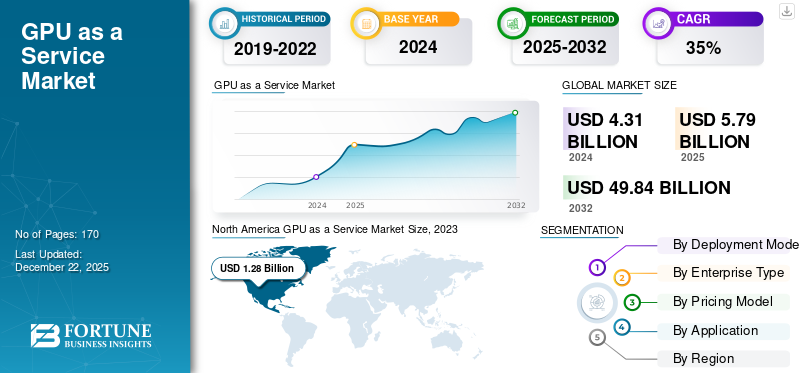
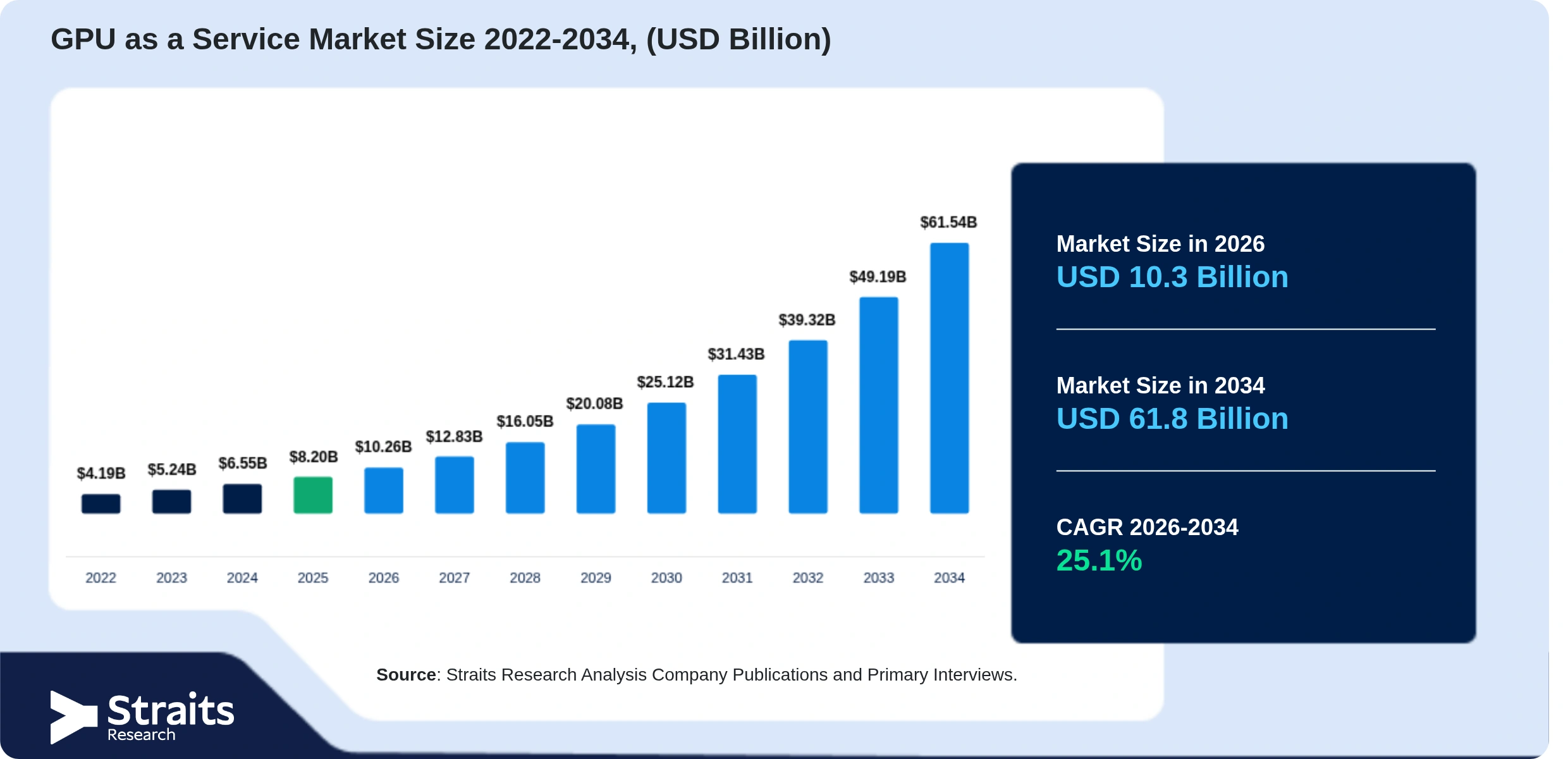
At the center of this transformation is the GPU-as-a-Service (GPUaaS) market. Fresh data from industry intelligence monitors highlights an extraordinary growth curve: the global market, valued at a nascent $8.66 billion projected for 2026, is anticipated to scale violently to $162.54 billion by 2034. This expansion represents one of the steepest monetization slopes in the history of enterprise technology, rivaling the dawn of the commercial internet and the initial migration to legacy enterprise cloud computing.
The Macroeconomic Catalysts: Why CapEx is Breaking
To understand the sudden financial gravity pulling enterprise balance sheets toward GPUaaS, one must examine the prohibitive economics of modern artificial intelligence development. Training frontier foundational models requires clusters of tens of thousands of advanced graphics processing units—such as NVIDIA’s H100, Blackwell architecture, and emerging alternatives—interconnected via ultra-low-latency InfiniBand or high-speed Ethernet fabrics.
For mid-market enterprises, Fortune 500 financial institutions, and specialized biotechnology firms, purchasing and housing these hardware clusters independently is an operational impossibility. A single enterprise-grade AI cluster demands tens of millions of dollars in upfront capital allocation, specialized liquid-cooling real estate, and dedicated megawatt-scale power purchase agreements (PPAs).
Consequently, chief financial officers (CFOs) are exercising strict risk mitigation protocols. By opting for GPU-as-a-service, enterprises bypass multi-million-dollar balance-sheet liabilities. Instead, compute power is consumed as a flexible operational expense, aligning cash outflows directly with revenue-generating AI inference and model fine-tuning pipelines. This dynamic has catalyzed a rush toward cloud compute architecture that offers elastic infrastructure scalability without the anchor of hardware depreciation.
The Competitive Landscape: Hyperscalers vs. Specialized Neo-Clouds
The market bifurcation within GPUaaS is creating distinct tiers of winners and losers. On one side stand the traditional hyperscale cloud providers—Amazon Web Services (AWS), Microsoft Azure, and Google Cloud Platform (GCP). These giants leverage their existing global network footprints and balance-sheet liquidity to lock down silicon supplies and secure massive data center real estate.
However, an aggressive cohort of specialized "neo-cloud" providers—including CoreWeave, Lambda Labs, and Crusoe Energy—has carved out a lucrative niche. These nimbler competitors offer bare-metal GPU instances with fewer abstraction layers, customized networking topologies, and highly aggressive pricing models tailored specifically to machine learning engineers and AI research labs.
This competition has profound implications for market liquidity and valuation multiples. Venture capital and private equity firms are pouring billions into infrastructure financing structures, utilizing specialized asset-backed securitization to fund the physical purchase of server racks laden with high-end GPUs. These assets are then leveraged as collateral for subsequent debt facilities, creating a complex, interconnected financial ecosystem where silicon performance directly dictates corporate solvency.
Verified Data & Metrics Breakdown
The following empirical breakdown details the projected trajectory of the global GPU-as-a-service market, highlighting key valuation milestones, projected compound annual growth rates (CAGR), and core adoption drivers across industrial sectors.
| Metric Dimension | Baseline Projection (2026) | Terminal Forecast (2034) | Strategic Implications |
|---|---|---|---|
| Global Market Size | $8.66 Billion | $162.54 Billion | Rapid multi-fold expansion driven by enterprise generative AI deployment. |
| Projected CAGR | Exceptional Double-Digit Expansion Rate | Reflects unprecedented long-term demand for scalable machine learning compute. | |
| Primary Cost Vector | High CapEx / Silicon Scarcity | Optimized OpEx / Liquid-Cooled Efficiency | Shift from ownership liability to subscription-based utility consumption. |
| Core End-User Sectors | Tech Giants / AI Startups | Banking, Healthcare, Defense, Automotive | Mainstream enterprise adoption necessitates strict regulatory compliance frameworks. |
Industry & Market Implications: Winners and Losers
As the GPUaaS market matures toward its 2034 valuation horizon, distinct fault lines are appearing across the global economic landscape.
The Winners: Semiconductor designers with robust software ecosystems (most notably NVIDIA, alongside AMD and custom silicon initiatives from hyperscalers) hold immense pricing power. Furthermore, secondary cloud providers that successfully secure tier-1 power grids and cooling infrastructure stand to capture substantial market share from enterprises seeking alternatives to traditional hyperscale lock-in.
The Losers: Legacy IT service providers and hosting facilities that failed to modernize their electrical infrastructure for high-density liquid cooling face swift obsolescence. Additionally, enterprises that attempt to build and maintain on-premise AI supercomputers without adequate software engineering talent risk severe capital misallocation and deteriorating ROI metrics.
Frequently Asked Questions (People Also Ask)
What is driving the massive growth in the GPU-as-a-service market?
The primary catalysts are the explosive enterprise adoption of generative AI, the prohibitive capital cost of purchasing proprietary AI hardware, and the need for flexible infrastructure scalability. GPUaaS allows organizations to treat high-performance compute as an operational expense rather than a fixed capital liability.
How does GPUaaS impact enterprise financial planning and ROI?
By utilizing GPU-as-a-service, CFOs mitigate the risk of rapid hardware depreciation. Enterprises can scale compute resources up or down depending on active model training or inference workloads, directly aligning technology spending with immediate revenue generation and accelerating enterprise ROI.
What are the main bottlenecks facing GPU-as-a-service providers?
The two most critical constraints are semiconductor supply chain availability (specifically advanced nodes from fabricators like TSMC) and electrical grid capacity. Modern AI data centers require immense power and advanced liquid-cooling systems, making energy procurement and real estate development primary operational hurdles.
Who are the primary market participants in the GPUaaS ecosystem?
The market is split between dominant hyperscale cloud providers (AWS, Microsoft Azure, Google Cloud) and specialized "neo-cloud" infrastructure operators (such as CoreWeave and Lambda Labs) that offer specialized bare-metal GPU clusters optimized specifically for machine learning workloads.
Future Outlook: Strategic Milestones to Watch Through 2034
Over the next decade, the trajectory of the GPU-as-a-service market will be dictated by three critical variables. First, energy infrastructure innovation—particularly advancements in nuclear micro-reactors, geothermal power, and grid-level battery storage—will determine whether data center expansion can keep pace with compute demand. Second, regulatory compliance mandates concerning data sovereignty, privacy, and algorithmic transparency will force GPUaaS providers to implement highly localized, secure sovereign cloud architectures.
Finally, the maturation of algorithmic efficiency may alter raw silicon demand. Should researchers develop leaner, more compute-efficient model architectures that reduce the reliance on brute-force scale, the composition of GPUaaS workloads may shift from massive training clusters toward high-volume, low-latency inference services.
For corporate leadership, institutional investors, and technology strategists, navigating this landscape requires constant vigilance. The transition from physical silicon ownership to fluid, cloud-delivered intelligence is irreversible. Those who master the complexities of GPUaaS capital allocation and cloud compute architecture will command the commanding heights of the global digital economy well into the 2030s.