Modi’s Power Grid: Key Cabinet Committees Reconstituted to Anchor India’s Economic Engine and Geopolitical Strategy
NEW DELHI — In a decisive move aimed at fortifying policy continuity and accelerating structural reforms, the Indian government has reconstituted its most powerful cabinet committees. The revamp, announced on May 26, 2026, signals a highly strategic consolidation of power within Prime Minister Narendra Modi’s core circle as India navigates complex global macroeconomic headwinds and intensifying geopolitical dynamics in the Indo-Pacific region.
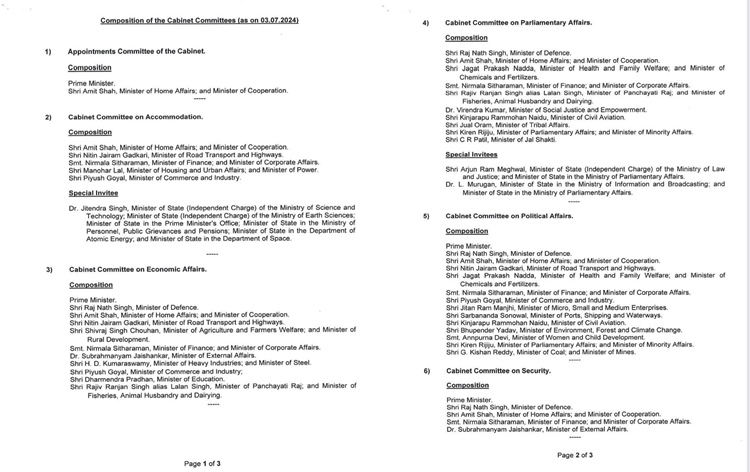
The restructuring covers the nation's apex decision-making bodies, most notably the Cabinet Committee on Security (CCS), the Cabinet Committee on Economic Affairs (CCEA), and the Cabinet Committee on Political Affairs (CCPA). For global investors, sovereign wealth funds, and domestic industry leaders, the reconstituted panels offer a clear roadmap of India's policy trajectory for the remainder of the administration's term: an unwavering focus on fiscal discipline, national security, infrastructure-led growth, and technological self-reliance.
The 'Big Five' Retain Control: CCS Anchors India’s Geopolitical Stance
The Cabinet Committee on Security (CCS)—the ultimate authority on India’s defense expenditure, national security paradigm, and foreign policy maneuvers—remains a fortress of continuity. The committee is headed by Prime Minister Narendra Modi and features the powerful quartet of senior ministers:
- Rajnath Singh (Minister of Defence)
- Amit Shah (Minister of Home Affairs)
- Nirmala Sitharaman (Minister of Finance and Corporate Affairs)
- Dr. S. Jaishankar (Minister of External Affairs)
This "Big Five" alignment ensures that India’s defensive posture and diplomatic engagements will proceed without friction. The timing of this reconstitution is critical. With supply chain vulnerabilities persisting in the Red Sea, evolving security dynamics along the Line of Actual Control (LAC), and a push for absolute indigenization (Atmanirbhar Bharat) in defense manufacturing, the CCS has its task cut out. Defense analysts suggest that this administrative stability will expedite billions of dollars in pending defense acquisitions and joint-venture manufacturing deals with Western allies.
The Key Cabinet Committees & Their Strategic Mandates
| Cabinet Committee | Key Members | Core Strategic Focus |
|---|---|---|
| Security (CCS) | PM Modi, Rajnath Singh, Amit Shah, Nirmala Sitharaman, S. Jaishankar | National defense, intelligence coordination, border security, foreign military sales. |
| Economic Affairs (CCEA) | PM Modi, key economic & infrastructure ministers | FDI limits, price controls, infrastructure spending, disinvestment, and trade policy. |
| Political Affairs (CCPA) | PM Modi, senior cabinet ministers across key portfolios | Center-state relations, legislative agenda, domestic political policy alignment. |
CCEA: Igniting the $5 Trillion Economic Ambition

On the financial front, the Cabinet Committee on Economic Affairs (CCEA) has been primed to act as the primary engine for India's domestic growth strategy. As the country aims to firmly secure its position as the world's third-largest economy, the CCEA is tasked with removing bureaucratic bottlenecks slowing down major infrastructure assets under the National Infrastructure Pipeline (NIP).
Economic observers point out that the reconstituted CCEA will prioritize private sector capital expenditure (Capex) revival. Despite robust public spending, private investment has remained selective. By bringing in a mix of seasoned administrative hands and key economic ministries, the government aims to send a strong signal of regulatory predictability to foreign institutional investors (FIIs).
The CCEA’s immediate agenda is expected to focus heavily on:
- Green Energy Transition: Streamlining subsidies and viability gap funding for green hydrogen, battery storage, and solar manufacturing.
- Supply Chain Relocalization: Expanding the Production Linked Incentive (PLI) schemes to cover advanced chemistry cells, semiconductors, and high-tech hardware.
- Inflation Management: Monitoring food supply chains and domestic fuel pricing structures to shield the consumer market from global price shocks.
Market Implications: Why Dalal Street and Wall Street Are Watching
In the corridors of global finance, stability is the ultimate currency. The reconstitution of these committees—without radical shifts in key portfolios—has been received warmly by domestic stock markets and foreign brokerages alike. It guarantees that the landmark economic policies of the past several years will not face abrupt reversals.
“The market hates policy uncertainty,” says a senior sovereign fund manager based in Singapore. “By maintaining the core team in the CCS and CCEA, New Delhi is signaling that the hard reforms—ranging from labor codes to asset monetization and digital public infrastructure expansion—will continue at pace. This is a net positive for long-term direct foreign investment.”
Furthermore, the Cabinet Committee on Political Affairs (CCPA), often described as the "super-cabinet," will play a pivotal role in managing federal-state dynamics. As India moves closer to implementing complex nationwide reforms in agriculture, electricity distribution, and land acquisition, the CCPA's role in building consensus with state governments will be crucial to avoiding policy paralysis.
The Road Ahead: High Stakes and Heavy Lifts
As the newly formed committees assume their duties, the immediate outlook presents both vast opportunities and steep challenges. Externally, the government must navigate volatile crude oil prices, shifting trade alliances, and high interest rates in Western markets. Internally, generating quality employment for India’s massive youth demographic and maintaining fiscal consolidation targets remain paramount.
With this newly minted executive line-up, Prime Minister Modi has assembled a team designed for execution. The coming quarters will test this cabinet's ability to translate administrative continuity into breakneck economic momentum on the ground.
Frequently Asked Questions (FAQ)
1. What is the significance of the Cabinet Committee on Security (CCS)?
The CCS is India's highest decision-making body on matters of national security, defense policy, and foreign affairs. Led by the Prime Minister, it includes the ministers of Defence, Home Affairs, Finance, and External Affairs. It is responsible for approving major defense deals, reviewing intelligence reports, and deciding on military strategy during national crises.
2. How does the reconstitution of these committees affect foreign investors?
The reconstitution of these committees with the same core leadership signals high policy continuity. For foreign investors, this means India's economic reforms, tax structures, infrastructure projects, and foreign direct investment (FDI) guidelines are highly unlikely to experience sudden, unpredictable shifts, thereby reducing sovereign risk.