By Our Senior Financial Desk & Investigative Bureau
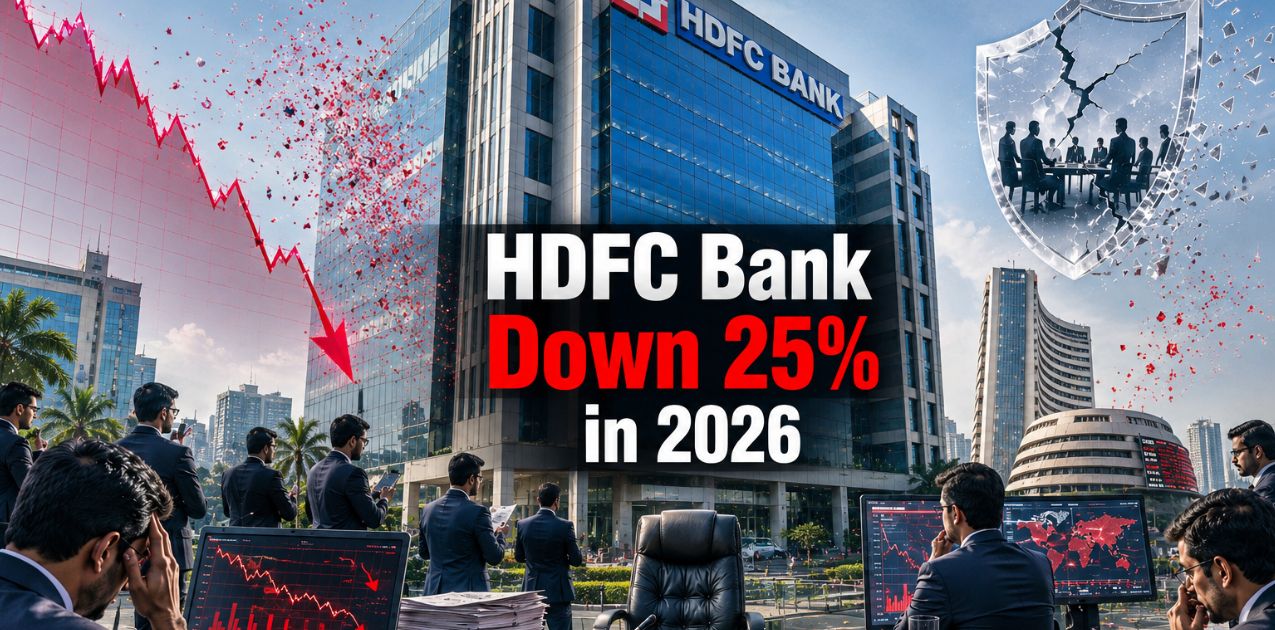
NEW YORK, LONDON, MUMBAI — June 2, 2026 — HDFC Bank, long revered as the crown jewel of Indian private-sector banking and a darling of international institutional portfolios, has experienced a staggering structural breakdown. Data compiled exclusively via NiftyTrader confirms that India's largest private lender has hemorrhaged over 25% of its market capitalization in the first five months of 2026. This dramatic capital erosion has transformed the stock from a defensive safe-haven asset into one of the most acute underperformers within the Nifty 50 universe.
At the center of this unprecedented valuation contraction is an escalating regulatory compliance audit and a concurrent governance probe spearheaded by domestic and international watchdog agencies. The resulting loss of investor confidence has triggered a historic wave of foreign institutional investor (FII) exit, laying bare underlying vulnerabilities in balance sheet liquidity, post-merger integration dynamics, and credit-deposit ratio (CDR) pressures. This investigative report breaks down the anatomy of the crisis, analyzing the institutional flight, the regulatory headwinds, and the broader ramifications for global emerging-market capital allocation.
Executive Takeaways
- Severe Valuation Correction: HDFC Bank's equity has shed over 25% year-to-date in 2026, driven by aggressive FII unwinding and compressed valuation multiples.
- The Governance Catalyst: An active regulatory probe into asset classification transparency and subsidiary capitalization metrics has spooked institutional risk committees.
- Structural Liquidity Headwinds: The bank continues to grapple with a high credit-deposit ratio (CDR) post-megamerger, limiting aggressive credit expansion and pressuring net interest margins (NIMs).
- Global Portfolio Reallocation: Foreign institutional outflows from HDFC Bank are redirecting capital flows across Asian emerging-market banking equities, altering regional index weightings.
The Anatomy of a Rout: Background and Catalytic Events

To understand the magnitude of HDFC Bank's 2026 descent, one must examine the compounding pressures that began accumulating following its historic $40 billion mega-merger with parent HDFC Ltd. While executive management initially heralded the consolidation as a masterstroke in infrastructure scalability and balance sheet heft, the integration process introduced unprecedented operational friction. Analysts noted that absorbing a massive mortgage book with traditionally lower yields immediately diluted the combined entity's return on assets (RoA) and stretched its credit-deposit ratio beyond historical comfort zones.
However, what began as a margin compression narrative turned into a full-scale institutional crisis in early 2026. According to regulatory filings and leaked inter-agency memos cited by market intelligence platforms like NiftyTrader, financial regulators initiated a comprehensive governance probe. The audit focuses on potential discrepancies in loan-book categorization, provisioning policies across non-banking financial subsidiary units, and the speed at which legacy HDFC borrowings were replaced with lower-cost retail deposits.
As news of the inquiry leaked to institutional trading desks, the reaction was swift and unforgiving. FIIs—who historically held a substantial stake near the foreign ownership ceiling—began rapid risk mitigation protocols. Programmatic selling and block trades overwhelmed domestic institutional investor (DII) absorption capacity, resulting in a relentless downward spiral that breached critical technical support levels and forced systemic margin unwinding across multiple derivative books.
Verified Data & Metrics Breakdown
The following quantitative overview outlines the core financial and market metrics defining HDFC Bank's trajectory through mid-2026, juxtaposing pre-probe baselines with current operational reality:
| Metric / Indicator | Pre-Crisis Baseline (FY25) | Current Status (Q2 2026) | Variance / Impact |
|---|---|---|---|
| YTD Stock Performance (2026) | +2.4% | -25.8% | Significant wealth destruction |
| Foreign Institutional Holding (FII) | ~52.1% | ~41.4% | Massive capital flight (~10.7% drop) |
| Credit-Deposit Ratio (CDR) | 105.2% | 101.8% | Slight improvement, remains elevated |
| Price-to-Earnings (P/E) Multiple | 19.5x | 14.2x | Valuation compression to historic lows |
Industry & Market Implications: Ripple Effects Across Global FinTech and Banking
The contraction of HDFC Bank's valuation is not an isolated corporate event; it carries profound structural implications for the broader Indian financial ecosystem and international emerging-market allocations. As foreign institutional capital exits, portfolio managers are re-evaluating their exposure to Indian banking governance standards as a whole. This has generated a temporary contraction in valuation multiples across peer institutions, even those with pristine asset quality metrics.
Furthermore, the bank's capital allocation strategies are undergoing forced revision. Investments in core cloud compute architecture, digital retail lending algorithms, and branch network expansion are being scrutinized by internal risk committees to preserve capital adequacy ratios (CAR). Tech vendors and enterprise software providers dependent on HDFC Bank's expansive IT budgets report delayed procurement cycles, signaling how financial distress at a tier-1 institution cascades down into the broader enterprise technology supply chain.
Frequently Asked Questions (People Also Ask)
Why is HDFC Bank's stock down 25% in 2026?
The primary drivers behind the 25% decline include an active regulatory governance probe into asset classification and subsidiary accounting, aggressive foreign institutional investor (FII) exits, and persistent pressure on the bank's credit-deposit ratio following its mega-merger with HDFC Ltd.
What is the status of the regulatory governance probe?
Regulatory authorities are currently reviewing transparency standards regarding loan provisioning, capital adequacy calculations for non-banking subsidiaries, and post-merger integration disclosures. While no formal penalties or adverse judgments have been finalized, the ongoing nature of the audit has heightened compliance uncertainty among institutional shareholders.
How are FII exits impacting market liquidity and index weightings?
Rapid block sales by foreign institutional investors have overwhelmed domestic buying support, depressing the stock's valuation multiples to historical lows (around 14.2x P/E). Because HDFC Bank carries substantial weight in global indices like the MSCI Emerging Markets Index, these outflows have triggered wider portfolio rebalancing across Asian equity funds.
Is HDFC Bank's core operational business still profitable?
Yes. Despite equity market turbulence and margin pressures, HDFC Bank continues to generate robust core operating profits and maintains a dominant retail deposit franchise. However, earnings growth remains constrained by the deliberate slowdown in credit expansion aimed at normalizing its credit-deposit ratio.
Future Outlook: Strategic Milestones to Watch
As HDFC Bank navigates this turbulent chapter in 2026, market observers, institutional investors, and regulatory bodies will be closely monitoring several critical milestones. First and foremost, the formal conclusion and public disclosure of findings from the governance probe will serve as a definitive binary catalyst for the stock. A clean bill of health or transparent resolution of compliance questions could trigger a sharp mean-reversion rally, given that current valuation multiples severely discount the bank's underlying franchise value.
Additionally, management's execution on deposit mobilization and the steady reduction of the credit-deposit ratio toward sub-100% levels will dictate the pace at which net interest margins recover. For global investors, HDFC Bank remains a bellwether for Indian corporate governance and macroeconomic resilience. How the institution manages this crisis will establish a vital benchmark for regulatory compliance, risk mitigation, and stakeholder communication in emerging-market banking for years to come.