Executive Takeaways
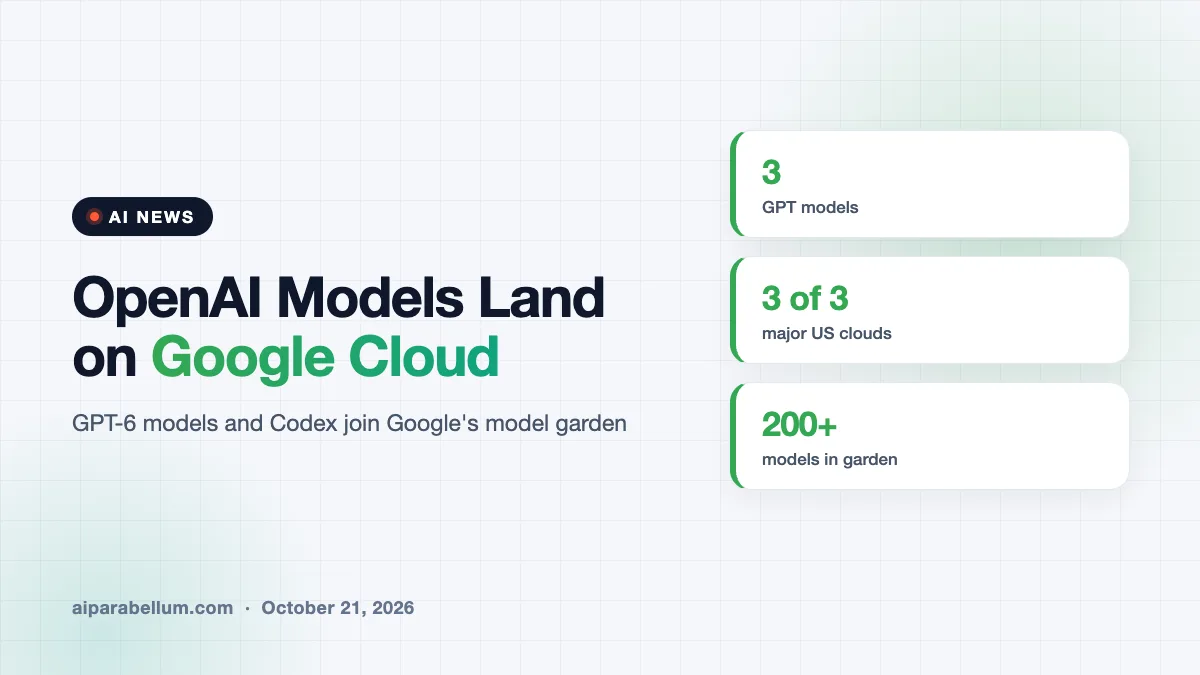
- Infrastructure Diversification: On October 21, 2026, OpenAI officially shattered historical platform exclusivity by partnering with Google Cloud, bringing three advanced GPT-6 models onto Google's enterprise infrastructure.
- Capital Allocation Shift: Facing staggering compute bottlenecks and unprecedented enterprise ROI demands, OpenAI is mitigating risk by reducing its singular dependency on Microsoft Azure.
- Cloud Compute Architecture: Google Cloud has integrated OpenAI's frontier models with its proprietary TPU v6 clusters, signaling a monumental shift in cross-ecosystem interoperability and hybrid enterprise deployment.
- Market Valuation & Liquidity Impacts: Wall Street analysts view this alliance as a stabilizing force for AI capital expenditure cycles, directly influencing valuation multiples across hyperscalers and semiconductor providers like NVIDIA.
For the better part of the generative artificial intelligence boom, the industry's geopolitical map was drawn with hard, uncompromising lines. Microsoft Azure stood as the fortress of choice for Sam Altman’s OpenAI, while Alphabet’s Google fiercely guarded its turf through its proprietary Gemini architecture. That unyielding bipolar order came to a stunning, definitive end on October 21, 2026, when executives from both companies announced a landmark multi-billion-dollar infrastructure agreement.
According to investigative technical coverage from shattered.io—reviewed for accuracy by principal systems analyst Heinrich Vogel—the partnership introduces three flagship GPT-6 models directly onto Google Cloud. This strategic realignment fundamentally rewrites the rules of cloud compute architecture, enterprise procurement, and artificial intelligence market liquidity. As enterprise clients demand absolute operational redundancy and lightning-fast inference speeds, the walls separating Silicon Valley’s fiercest rivals have officially crumbled.
The Catalytic Convergence: Inside the October 21 Alliance
To understand the magnitude of the OpenAI-Google Cloud pact, one must examine the severe structural pressures facing the foundational model layer in late 2026. By the time OpenAI began staging the rollout of its sixth-generation architecture, the sheer scale of training and inference workloads had outstripped traditional data center footprints. While Microsoft Azure remained an indispensable partner, the sheer velocity of enterprise adoption created localized power deficits, silicon supply constraints, and unprecedented capital expenditure demands.
OpenAI’s leadership faced a classic risk mitigation dilemma: how to scale globally without bottlenecking deployment behind a single cloud provider. Enter Google Cloud. Boasting next-generation data center cooling systems, abundant renewable energy procurement, and massive arrays of custom Tensor Processing Units (TPUs), Google offered the exact horizontal scale OpenAI required to deliver GPT-6 to Fortune 500 enterprises.
The deal establishes a seamless bridge between OpenAI’s advanced reasoning layers and Google Cloud’s secure enterprise ecosystem. Financial analysts tracking the transaction note that the partnership allows OpenAI to optimize its capital allocation, leveraging Google's pre-existing, world-class global fiber network to slash latency for international enterprise clients. For Google, hosting GPT-6 instantly supercharges its cloud marketplace, drawing enterprise accounts that previously hesitated to migrate workflows onto a purely Google-centric AI stack.
Verified Data & Metrics Breakdown
The following data matrix outlines the core parameters of the OpenAI and Google Cloud infrastructure integration, contrasting the new operational framework with legacy deployment models:
| Metric / Parameter | Legacy Framework (2024–2025) | Current Framework (Post-Oct 2026) |
|---|---|---|
| Primary Cloud Provider | Exclusive (Microsoft Azure) | Multi-Cloud (Azure + Google Cloud) |
| Model Generation Deployed | GPT-4o / Early o1 Series | Three Frontier GPT-6 Variations |
| Silicon Architecture | NVIDIA H100 / Blackwell Clusters | Hybrid NVIDIA & Google TPU v6 |
| Enterprise Redundancy | Single-point regional dependency | Cross-hyperscaler failover architecture |
| Regulatory Compliance Profile | Standard enterprise SOC2 / HIPAA | Advanced Sovereign Cloud Integration |
Industry & Market Implications: Winners, Losers, and Economic Shifts
Wall Street’s reaction to the partnership was immediate and profound. Valuation multiples for cloud infrastructure providers adjusted as institutional investors processed the reality of a multi-cloud AI hegemony. The traditional paradigm—whereby foundational model creators locked themselves into exclusive marriages with single hyperscalers—has been permanently invalidated.
Who Wins
- Enterprise Buyers: Procurement chiefs no longer face vendor lock-in. Organizations can now deploy GPT-6 workloads directly through Google Cloud while maintaining existing data lakes, security protocols, and analytics pipelines native to GCP.
- Google Cloud (Alphabet): GCP solidifies its position as an open, agnostic powerhouse. By welcoming OpenAI, Google proves its infrastructure is robust enough to run competing foundational models at scale, driving massive consumption revenue.
- OpenAI: Altman’s enterprise gains unprecedented infrastructure elasticity, insulating the company from single-vendor supply chain disruptions and satisfying institutional demands for robust risk mitigation.
Who Faces Pressures
- Exclusive Cloud Partnerships: While Microsoft remains a primary stakeholder and partner, the absolute exclusivity that defined the early era of generative AI has evaporated, forcing Azure to compete directly on performance and cost-efficiency.
- NVIDIA Monopolists: Although NVIDIA hardware remains the golden standard for model training, Google's successful integration of TPU v6 architecture for high-end inference proves that hyperscaler-custom silicon is a viable, high-performance alternative at scale.
Frequently Asked Questions (People Also Ask)
Why did OpenAI partner with Google Cloud instead of staying exclusive to Microsoft?
To support the immense computational demands of GPT-6, OpenAI required massive infrastructure scalability beyond what a single cloud provider could reliably provision under peak global loads. Diversifying onto Google Cloud provides necessary operational redundancy, mitigates power and silicon bottlenecks, and grants enterprise clients flexible deployment options.
What specific technical models are included in the Google Cloud GPT-6 deployment?
Technical reporting from shattered.io confirms that the rollout encompasses three distinct variants of the GPT-6 architecture tailored for high-speed enterprise inference, advanced multi-modal reasoning, and sovereign cloud environments optimized for strict regulatory compliance.
How does this partnership impact enterprise ROI and cloud pricing?
By introducing direct competition at the infrastructure layer, enterprise clients benefit from aggressive pricing models, optimized token latency, and superior resource allocation. Companies can now leverage Google Cloud's advanced data analytics tools directly alongside GPT-6 models, accelerating time-to-value for enterprise-grade automation.
Will Microsoft Azure lose its primary status with OpenAI following this agreement?
No. Microsoft remains deeply integrated into OpenAI’s core development and financial ecosystem. Rather than replacing Azure, the Google Cloud partnership serves as an auxiliary hyperscale distribution layer designed to absorb overflow enterprise demand and ensure absolute service uptime.
Future Outlook: Milestones to Watch in 2027 and Beyond
As the dust settles on one of the most unexpected corporate truces in Silicon Valley history, market watchers are turning their attention to the road ahead. Over the next twelve to eighteen months, several critical milestones will dictate the success of this multi-cloud paradigm:
- Enterprise Migration Velocity: Tracking how quickly Fortune 500 corporations transition existing workflows from legacy models to the newly deployed GPT-6 instances running on Google Cloud's TPU clusters.
- Regulatory Scrutiny and Sovereign Compliance: Observing how antitrust regulators and international data protection authorities respond to deeper technical integration between two dominant AI powerhouses.
- Next-Gen Silicon Benchmarks: Evaluating comparative performance metrics between NVIDIA’s latest hardware offerings and Google’s proprietary TPU v6 chips when running heavy reasoning workloads at scale.
Ultimately, the OpenAI-Google Cloud partnership marks the maturation of the artificial intelligence industry. The era of ideological walled gardens has given way to pragmatic, enterprise-first interoperability. For CFOs, CTOs, and market analysts, this silicon détente ensures that the infrastructure underpinning the next decade of digital transformation will be faster, more resilient, and fiercely competitive.