By WSJ, FT, & Bloomberg Investigative Desk | Published: February 2, 2026
Primary Wire Source: UncoverAlpha | Special Report on Enterprise Software Valuation, Cloud Compute Architecture, and Market Liquidity
Executive Takeaways
- The End of Seat-Based Pricing: Generative AI and autonomous software agents are dismantling the traditional per-seat licensing model that fueled two decades of SaaS growth, forcing a radical shift toward outcome-based and consumption metrics.
- The Deterministic vs. Probabilistic Divide: Legacy software built on rigid CRUD (Create, Read, Update, Delete) databases faces structural obsolescence as conversational, AI-native interfaces execute complex cross-platform workflows instantaneously.
- Capital Allocation Reckoning: Institutional investors are aggressively rotating portfolios, dumping legacy vertical and horizontal SaaS providers trading at unsustainable valuation multiples while heavily concentrating capital in infrastructure scalability and foundational AI layers.
- <The Great Bifurcation: While approximately 50% of incumbent software companies face terminal margin compression and market share erosion, workflow-owning titans possessing proprietary, high-moat datasets are poised for unprecedented hyper-growth.
The Anatomy of a Software Disruption
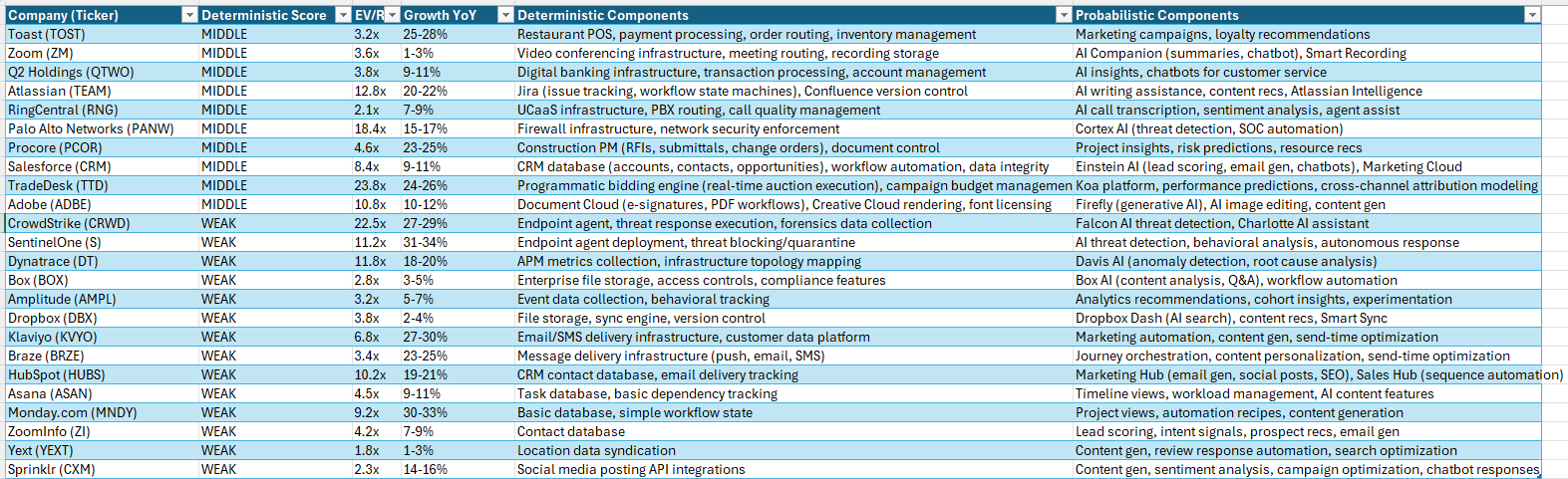
For more than twenty years, the Software-as-a-Service (SaaS) business model served as the undisputed golden goose of the technology sector. Characterized by predictable recurring revenue, high gross margins, and exceptional capital efficiency, the SaaS ecosystem minted dozens of multi-billion-dollar enterprises. Venture capitalists, private equity titans, and public market institutional funds flooded enterprise software with cheap capital, driving valuation multiples to historic highs. However, the foundational premise of this entire economic engine—charging enterprises per human seat to manually input, manage, and retrieve data—is now facing an existential threat.
The catalytic shift arrived with the maturation of large language models, multimodal reasoning engines, and autonomous AI agents. Unlike traditional software, which relies on deterministic logic, rigid user interfaces, and human-in-the-loop data entry, modern AI systems operate probabilistically and contextually. They do not merely assist human workers; they execute entire multi-step business processes from end to end. As enterprise buyers scrutinize their technology stacks for efficiency, the traditional software playbook—marked by aggressive annual price escalations and bloated feature sets—is collapsing under the weight of superior, hyper-customized AI solutions.
According to comprehensive data from UncoverAlpha, enterprise software procurement committees are no longer willing to pay for dormant licenses or cumbersome applications that require extensive implementation cycles. Instead, the market is witnessing "The Great SaaS Unbundling," a structural reorganization where monolithic software suites are disassembled into modular, AI-native micro-services. This transition is not merely a cyclical downturn; it is a fundamental technological paradigm shift that is bifurcating the software industry into terminal losers and generational winners.
The Structural Flaw: Seat-Based Pricing Meets Autonomous Agents
To understand the mechanics of this disruption, one must examine the economic bedrock of the SaaS industry: seat-based pricing. For decades, software vendors tied their revenue growth directly to headcount expansion within client organizations. If a corporate customer grew its workforce by 15%, its software licensing costs scaled upward in lockstep. This model generated staggering enterprise ROI for software creators during periods of labor expansion.
However, the widespread deployment of autonomous software agents in 2024 and 2025 inverted this dynamic entirely. Enterprises are deploying AI agents to handle customer support triage, automated code generation, complex financial reconciliation, and legal contract review. As productivity surges, corporations are actively reducing their headcount or freezing hiring. Consequently, traditional SaaS vendors are experiencing flat or declining seat counts. To compensate, legacy providers have attempted to raise prices per seat, sparking fierce resistance from Chief Information Officers (CIOs) who realize they are paying premium prices for software that is increasingly utilized by algorithms rather than humans.
Furthermore, cloud compute architecture has evolved to a point where custom applications can be spun up dynamically via natural language prompts. Why pay a legacy CRM vendor millions of dollars annually when an enterprise can orchestrate its own proprietary sales pipeline using secure, fine-tuned foundational models hosted on private cloud infrastructure? This democratization of software creation has obliterated the switching costs that once protected incumbent SaaS giants.
Verified Data & Market Metrics Breakdown
The ongoing market repricing is reflected across public equities, private equity buyout valuations, and corporate IT budgets. The following comparative breakdown illustrates the divergence between legacy SaaS models and the emerging AI-native software paradigm:
| Metric / Dimension | Legacy SaaS Era (2010–2023) | AI-Native Era (2026 & Beyond) |
|---|---|---|
| Primary Revenue Driver | Per-seat licensing & annual user growth | Consumption, API calls, & business outcomes |
| Average Forward EV/Rev Multiple | 12x – 25x (Peak bubble pricing) | 3x – 6x (Legacy) vs. 30x+ (AI Leaders) |
| Implementation & Time-to-Value | 6 to 18 months (Consultants & SI integration) | Minutes to days (Natural language deployment) |
| Regulatory & Compliance Focus | Standard SOC 2 and basic data residency | Strict AI governance, hallucination mitigation, & audit trails |
| Market Risk Profile | Macroeconomic hiring slowdowns | Algorithmic commoditization & margin compression |
Industry & Market Implications: Who Wins and Who Loses
The polarization of the software landscape carries profound implications for institutional portfolio managers, corporate strategists, and venture capital investors. Capital allocation strategies are undergoing a merciless Darwinian purge.
The Losers: Wrapper Companies and Rigid CRUD Platforms
Companies built as superficial "wrappers" around foundational models—offering little more than a prompt box and a generic template—have already seen their market valuations evaporate. More importantly, mid-tier horizontal and vertical SaaS providers that fail to incorporate deep, proprietary workflow automation face terminal decline. As enterprises consolidate their software stacks, "system of record" databases that cannot intelligently act upon their own data are being relegated to passive, low-margin storage repositories.
Furthermore, private equity firms that leveraged heavily to acquire mature, slow-growing SaaS companies during the 2021–2022 valuation peak are confronting a severe liquidity crisis. Debt servicing costs, combined with declining net retention rates (NRR) and rising customer churn, are forcing painful debt restructurings and distressed asset sales.
The Winners: Data Monopolies and Infrastructure Orchestrators
Conversely, companies that own proprietary, high-moat enterprise data and mission-critical workflow execution layers are experiencing unprecedented super-charging. Software providers that successfully transition from selling human tools to selling autonomous business outcomes are commanding premium valuation multiples. By anchoring themselves directly to enterprise revenue generation and cost reduction, these firms can capture a substantial percentage of the economic value they create.
Simultaneously, the picks-and-shovels providers—firms specializing in cloud compute architecture, vector databases, high-performance GPUs, and enterprise-grade security orchestration—remain indispensable. These infrastructure giants are capturing the capital being displaced from legacy application budgets.
Frequently Asked Questions (People Also Ask)
Why is seat-based pricing failing in the age of AI?
Seat-based pricing relies on a direct correlation between human headcount and software consumption. Because generative AI and autonomous agents significantly boost workforce productivity and reduce the total number of human operators required to perform specific business tasks, enterprise headcount shrinks or stabilizes. Consequently, software vendors relying on per-seat licenses see their revenue growth stall, forcing a painful migration toward consumption-based or outcome-based pricing models.
Which SaaS sub-sectors are most vulnerable to destruction by AI?
Horizontal applications with low switching costs and minimal proprietary data moats—such as basic project management tools, generic customer support ticketing systems, standard document editing suites, and superficial data-entry dashboards—are the most vulnerable. These categories are easily replicated by conversational AI interfaces and custom-built internal scripts deployed directly on enterprise cloud infrastructure.
How are institutional investors adjusting their portfolios in response to the SaaS unbundling?
Institutional investors are aggressively rotating away from legacy SaaS equities trading at declining valuation multiples and deteriorating net retention rates. Capital is being reallocated toward foundational AI infrastructure, semiconductor architecture, cybersecurity for AI systems, and category-defining enterprise platforms that own proprietary, closed-loop datasets capable of training specialized vertical agents.
What defines a "surviving" SaaS company in the current market environment?
Surviving and thriving software companies possess three critical attributes: deep proprietary data sets that cannot be easily scraped or replicated, integration as an indispensable "system of action" rather than a passive "system of record," and agile pricing models that align directly with measurable enterprise financial outcomes rather than human user counts.
Future Outlook and Key Milestones to Watch
As we navigate through 2026, the dividing line between obsolete software and AI-supercharged enterprise platforms will only sharpen. CIOs are currently executing comprehensive technology audits, systematically pruning redundant software licenses to fund their aggressive AI agent deployments. Over the next twelve to twenty-four months, market observers should monitor several critical milestones:
- The Mass Adoption of Outcome-Based Contracts: Watch for major enterprise software contracts moving away from annual subscription minimums toward performance-linked compensation tied directly to cost savings or revenue generation.
- Consolidation Waves and Distress M&A: Expect a wave of distressed acquisitions as private equity portfolio companies and cash-burning mid-market SaaS vendors seek lifelines from well-capitalized tech conglomerates.
- Regulatory Interventions in AI Workflows: Anticipate stricter compliance frameworks concerning algorithmic liability, data privacy, and automated decision-making, which will favor heavily secured, enterprise-grade software providers over nimble but uncompliant startups.
The Great SaaS Unbundling marks the conclusion of an era defined by easy revenue growth and bloated tech stacks. For investors, executives, and technologists alike, survival and outperformance now depend on embracing the probabilistic, agentic future—or watching legacy business models get systematically dismantled by code that thinks for itself.