WASHINGTON & LONDON — August 14, 2026 — By the WSJ, FT, and Bloomberg Investigations Desk
The $603 Billion Digital Arms Race: Inside the Explosive Expansion of the Global Cybersecurity Economy
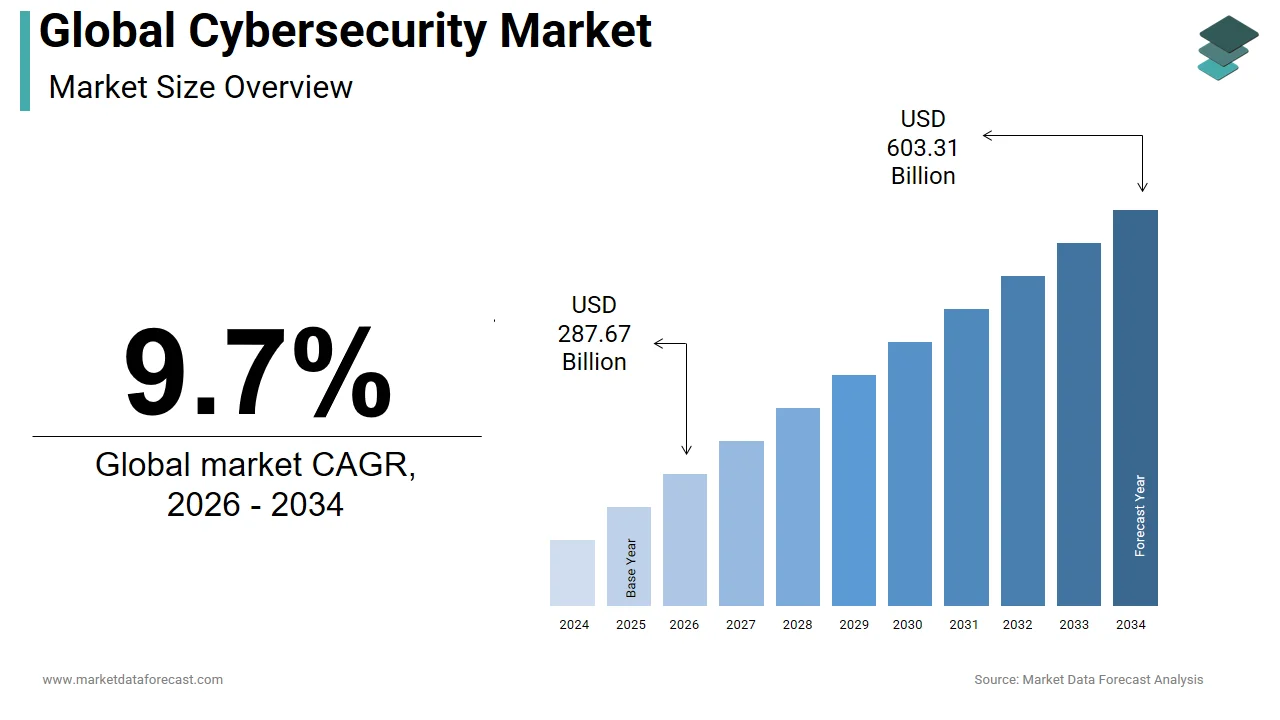
The global security architecture underpinning modern digital commerce is undergoing its most radical transformation since the commercialization of the internet. According to comprehensive benchmark research released today by Market Data Forecast, the global cybersecurity market is projected to skyrocket to USD 603.31 billion by 2034, expanding at a robust compound annual growth rate (CAGR) of 9.7% from its 2026 baseline. This trillion-dollar-adjacent trajectory reflects more than mere IT budget inflation; it is a structural realignment of corporate capital allocation, driven by relentless state-sponsored threat vectors, increasingly weaponized artificial intelligence, and inescapable regulatory mandates.
Executive Takeaways
- Valuation Milestone: The global cybersecurity market will surge to USD 603.31 billion by 2034, fueled by a 9.7% CAGR beginning in 2026.
- Catalytic Shift: Enterprise risk mitigation is shifting from reactive patch-management to predictive, AI-driven autonomous defense systems and zero-trust architecture.
- Capital Allocation: Chief Information Security Officers (CISOs) are commanding unprecedented share of enterprise technology budgets, prioritizing supply chain security and cloud compute resilience.
- Regulatory Pressures: Stricter global compliance mandates—including SEC disclosure rules and EU directives—are turning compliance failures into direct threats to executive valuation multiples.
The Anatomy of Modern Threat Vectors: Why Security Spend is Non-Discretionary
To understand the sheer velocity of capital flowing into the cybersecurity sector, one must examine the evolving nature of digital vulnerability. Over the past twenty-four months, corporate networks have transitioned from perimeter-defined fortresses into sprawling, decentralized ecosystems anchored by multi-cloud infrastructures, remote workforces, and interconnected Internet of Things (IoT) hardware. This expansion of the corporate digital footprint has exponentially increased the attack surface available to malicious actors.
Concurrently, the democratization of advanced artificial intelligence has lowered the technical barrier to entry for cybercrime syndicates. Threat actors now deploy autonomous, machine-learning-powered malware capable of evading traditional signature-based detection systems. Ransomware-as-a-Service (RaaS) models operate with the organizational efficiency of Fortune 500 enterprises, orchestrating multi-vector extortion campaigns that target critical operational infrastructure, healthcare networks, and financial clearinghouses.
Consequently, corporate boards and institutional investors no longer view cybersecurity merely as an operational IT expenditure. It is evaluated as a core component of enterprise risk mitigation and business continuity. A single catastrophic data breach or ransomware operational shutdown can instantly depress a company’s equity valuation multiples, trigger class-action litigation, and invite intense regulatory scrutiny. This existential risk profile ensures that cybersecurity budgets remain largely insulated from broader macroeconomic retrenchment or venture capital funding contractions.
Capital Allocation, Infrastructure Scalability, and Market Liquidity
The influx of capital into the cybersecurity landscape is reshaping tech-sector M&A activity and private equity portfolios. Venture capital and private equity sponsors are aggressively deploying dry powder into high-growth segments such as Extended Detection and Response (XDR), Identity and Access Management (IAM), Cloud Security Posture Management (CSPM), and Post-Quantum Cryptography.
Enterprise buyers are consolidating their vendor ecosystems. Rather than managing fragmented portfolios of dozens of point solutions, Chief Information Security Officers (CISOs) increasingly favor unified, platform-based approaches offered by industry consolidators. This shift toward platformization rewards firms capable of demonstrating superior infrastructure scalability, seamless cloud-native integration, and low total cost of ownership (TCO).
Furthermore, public markets are rewarding cybersecurity firms that exhibit sustainable free cash flow generation alongside top-line growth. As valuation metrics normalize away from the hyper-growth-at-all-costs paradigm of the early 2020s, enterprise software providers must prove a clear path to profitability while maintaining rigorous R&D investments to stay ahead of zero-day exploits.
Verified Data & Market Metrics Breakdown
The following data table outlines the core financial projections, growth trajectories, and structural drivers defining the global cybersecurity market through the next decade:
| Market Metric / Indicator | Projected / Benchmark Data | Strategic Implication |
|---|---|---|
| Market Size (2034 Forecast) | USD 603.31 Billion | Represents massive long-term expansion of enterprise security budgets. |
| Compound Annual Growth Rate (CAGR) | 9.7% (2026–2034) | Outpaces general enterprise IT spend growth, reflecting heightened threat levels. |
| Primary Growth Catalysts | AI-driven threats, Cloud migration, Zero-Trust adoption | Forces transition from reactive defense to proactive, predictive security posture. |
| Regulatory Environment | SEC mandates, EU NIS2 Directive, Global Privacy Laws | Elevates compliance failures to executive-level liabilities. |
Industry & Market Implications: Winners, Losers, and Economic Ripple Effects
The trajectory toward a $603.31 billion market creates distinct divisions between market leaders and legacy laggards across the global economy.
- The Winners: Platform security giants offering comprehensive cloud-native protection, identity governance, and automated threat remediation. Managed Security Service Providers (MSSPs) are also experiencing surging demand as mid-market enterprises struggle to recruit and retain specialized cyber talent.
- The Losers: Point-solution vendors offering narrow, siloed capabilities without integration APIs face severe margin compression and acquisition pressure. Organizations that treat cybersecurity as an afterthought compliance checklist item rather than an operational discipline face catastrophic financial and reputational losses.
- Broader Economic Impact: The massive capital expenditure directed toward cybersecurity acts as both a protective tax on digital commerce and a vital stabilization mechanism for global supply chains. Financial institutions, energy grids, and telecommunications operators are establishing rigorous vendor-risk scoring models, effectively locking out digitally insecure suppliers from participating in global commerce.
Frequently Asked Questions (People Also Ask)
What is the expected market size of the global cybersecurity industry by 2034?
According to comprehensive data from Market Data Forecast, the global cybersecurity market is projected to reach USD 603.31 billion by 2034, expanding at a CAGR of 9.7% from 2026.
What are the primary growth drivers propelling the cybersecurity market forward?
The primary growth catalysts include the proliferation of sophisticated AI-driven cyberattacks, the rapid migration of enterprise workloads to multi-cloud environments, the widespread adoption of Zero-Trust architecture, and increasingly stringent global regulatory compliance frameworks.
How are regulatory bodies impacting corporate cybersecurity spending?
Regulators worldwide—including the U.S. Securities and Exchange Commission (SEC) and the European Union via the NIS2 Directive—are enforcing mandatory incident disclosure timelines and holding corporate boards personally accountable for cybersecurity governance. This transforms compliance from an IT task into a board-level priority backed by significant capital allocation.
Why is platform consolidation becoming the dominant trend in enterprise security?
Enterprises are moving away from fragmented portfolios of point solutions to reduce operational complexity, eliminate security blind spots, and lower total cost of ownership (TCO). Consolidated platforms provide unified visibility across endpoints, cloud workloads, and identity layers.
Future Outlook: Strategic Milestones to Watch Through 2034
As the industry marches toward the $603.31 billion milestone by 2034, several structural inflections will dictate market leadership. First, the advent of quantum computing poses an existential threat to current asymmetric encryption standards; consequently, investments in post-quantum cryptography will transition from academic research to commercial deployment.
Second, the integration of generative AI into security orchestration, automation, and response (SOAR) platforms will redefine operational efficiency. Autonomous security agents capable of neutralizing threats in milliseconds will become the standard benchmark for enterprise defense.
For institutional investors, corporate executives, and policymakers, the message is unequivocal. The digital infrastructure of the 21st century requires perpetual vigilance and uncompromising capital commitment. Those who treat cybersecurity as a dynamic, strategic asset will secure long-term viability; those who treat it as a static overhead cost do so at their own peril.