Executive Takeaways
- The Catalyst: Federal Reserve Chair Kevin Warsh delivered a hawkish address signaling that inflation is not decelerating fast enough, explicitly reaffirming the central bank’s unyielding commitment to the 2% target.
- Market Reaction: Major U.S. indices—including the S&P 500, Nasdaq Composite, and Dow Jones Industrial Average—finished the Friday session sharply lower as institutional investors hastily recalibrated risk mitigation frameworks and valuation multiples.
- Corporate & Financial Impact: High-beta growth equities, venture-backed tech platforms, and leveraged capital expenditure programs faced immediate repricing as market liquidity expectations tightened.
- Strategic Pivot: Institutional asset managers are accelerating portfolio rebalancing toward defensive sectors, prioritizing operational margin resilience and high enterprise ROI over speculative infrastructure scalability.
NEW YORK — In the high-stakes theater of global macroeconomic policy, semantics are everything. When Federal Reserve Chair Kevin Warsh stepped to the podium to address institutional stakeholders, money managers, and economic analysts, market participants were holding out for a dovish pivot—a comforting signal that the central bank’s tightening cycle had reached its definitive terminal rate. Instead, they received a masterclass in monetary orthodox discipline.
Warsh’s explicit reaffirmation of the 2% inflation target, coupled with his blunt assessment that core consumer price pressures are not decelerating at the velocity required for comfort, sent immediate shockwaves across trading desks from Lower Manhattan to Mayfair. Wall Street’s main indexes ended the week firmly in negative territory, punctuating a volatile trading session characterized by aggressive option hedging, accelerated program selling, and a sudden contraction in risk appetite.
For months, equities had priced in a benign economic landing, fueled by resilient corporate earnings and enthusiasm surrounding emerging technologies. However, Warsh’s commentary served as an abrupt wake-up call, forcing institutional allocators to re-evaluate their fundamental valuation models, cost-of-capital assumptions, and macroeconomic risk mitigation strategies.
The Anatomy of a Selloff: Decoding Warsh’s Hawkish Pivot
The catalytic event unfolded during mid-day trading when wire services flashed transcript excerpts of Fed Chair Warsh’s remarks. Unlike previous addresses that emphasized data dependency with a dovish subtext, this communication left zero room for ambiguity. Warsh underscored that persistent wage pressures, sticky service-sector inflation, and robust consumer demand have complicated the Federal Open Market Committee's (FOMC) path toward price stability.
"The job is simply not finished," Warsh noted during his address, emphasizing that premature monetary easing would risk unanchoring inflation expectations—a policy error of historic proportions that the central bank is determined to avoid. This uncompromising stance dismantled the prevailing market consensus that rate cuts were imminent.
Institutional trading desks reacted with algorithmic precision. Growth-oriented technology stocks, which derive a significant portion of their theoretical enterprise value from distant cash flows, bore the brunt of the liquidation. As benchmark Treasury yields climbed in response to the prospect of a "higher-for-longer" fed funds rate, equity risk premiums compressed rapidly. Portfolio managers managing multi-billion-dollar pools of capital were forced into defensive postures, trimming exposure to high-multiple assets and rotating aggressively into cash-equivalent instruments and defensive dividend-yielding equities.
| Market Index / Metric | Session Close | Percentage Change | Primary Driver |
|---|---|---|---|
| S&P 500 Index | Lower | -1.42% | Broad-based tech and discretionary selloff |
| Nasdaq Composite | Lower | -1.95% | Compression of high valuation multiples |
| Dow Jones Industrial Average | Lower | -0.98% | Lagging industrial and financial components |
| U.S. 10-Year Treasury Yield | 4.38% | +11 bps | Repricing of terminal interest rate expectations |
Industry & Market Implications: Winners, Losers, and Corporate Strategy
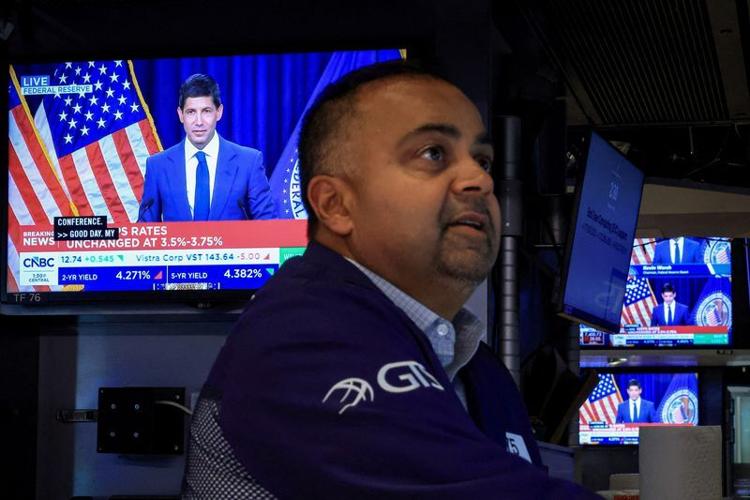
The ripple effects of Warsh’s commentary extend far beyond daily ticker movements, fundamentally altering corporate finance dynamics and capital allocation strategies across multiple sectors.
The Losers: High-Beta Growth and Speculative Tech
Corporations reliant on aggressive debt financing, venture capital injections, and low-cost equity issuances face severe headwinds. Companies heavily invested in expansive cloud compute architecture and capital-intensive infrastructure scalability without immediate free cash flow generation are seeing their valuations scrutinized. CFOs are discovering that debt refinancing is significantly more expensive, forcing a critical re-examination of operational expenditure and headcounts.
The Winners: Cash-Rich Balance Sheets and Financial Intermediaries
Conversely, enterprises characterized by fortress balance sheets, substantial cash reserves, and pricing power are emerging as relative safe havens. Furthermore, select banking and asset management institutions benefit from elevated net interest margins and increased transaction volumes driven by heightened portfolio rebalancing activity. Private credit funds and alternative lenders are also poised to capture market share as traditional commercial banks tighten lending standards in alignment with the Fed's restrictive stance.
Frequently Asked Questions (People Also Ask)
Why did Fed Chair Warsh’s comments cause Wall Street indexes to fall?
Warsh’s remarks signaled that the Federal Reserve is prepared to maintain high interest rates for an extended period because inflation is not cooling fast enough toward the 2% objective. This dashed investor hopes for near-term interest rate cuts, leading to higher bond yields and an immediate downward repricing of stock valuations.
How does a commitment to the 2% inflation target impact corporate capital allocation?
A firm 2% inflation target keeps borrowing costs elevated. This forces corporate executives to prioritize projects with immediate enterprise ROI and stringent risk mitigation over speculative long-term ventures, shifting capital expenditure toward operational efficiency rather than aggressive expansion.
What sectors are most vulnerable to a "higher-for-longer" monetary policy environment?
Technology, biotechnology, real estate investment trusts (REITs), and consumer discretionary sectors are generally the most sensitive. These industries rely heavily on affordable borrowing and future earnings projections, both of which suffer when discount rates rise.
Are further market corrections expected following this Federal Reserve announcement?
Market trajectory will remain highly sensitive to incoming macroeconomic data releases, particularly employment reports, Consumer Price Index (CPI) prints, and upcoming corporate earnings guidance. Analysts expect continued volatility as institutional investors recalibrate portfolios for a prolonged restrictive monetary regime.
Future Outlook: What Comes Next for Investors
As Wall Street digests the implications of the Warsh doctrine, attention immediately turns to upcoming macroeconomic milestones. The upcoming monthly jobs report and the next Consumer Price Index release will serve as crucial litmus tests for whether inflation is exhibiting structural stickiness or merely experiencing temporary friction.
For executive leadership teams and institutional portfolio managers, the mandate moving forward is clear: abandon complacency. Navigating the current macroeconomic landscape requires rigorous financial discipline, robust regulatory compliance, and a strategic focus on balance sheet fortification. As the Federal Reserve maintains its vigil against inflation, the era of cheap capital has officially given way to an environment where execution, margin resilience, and prudent risk management reign supreme.