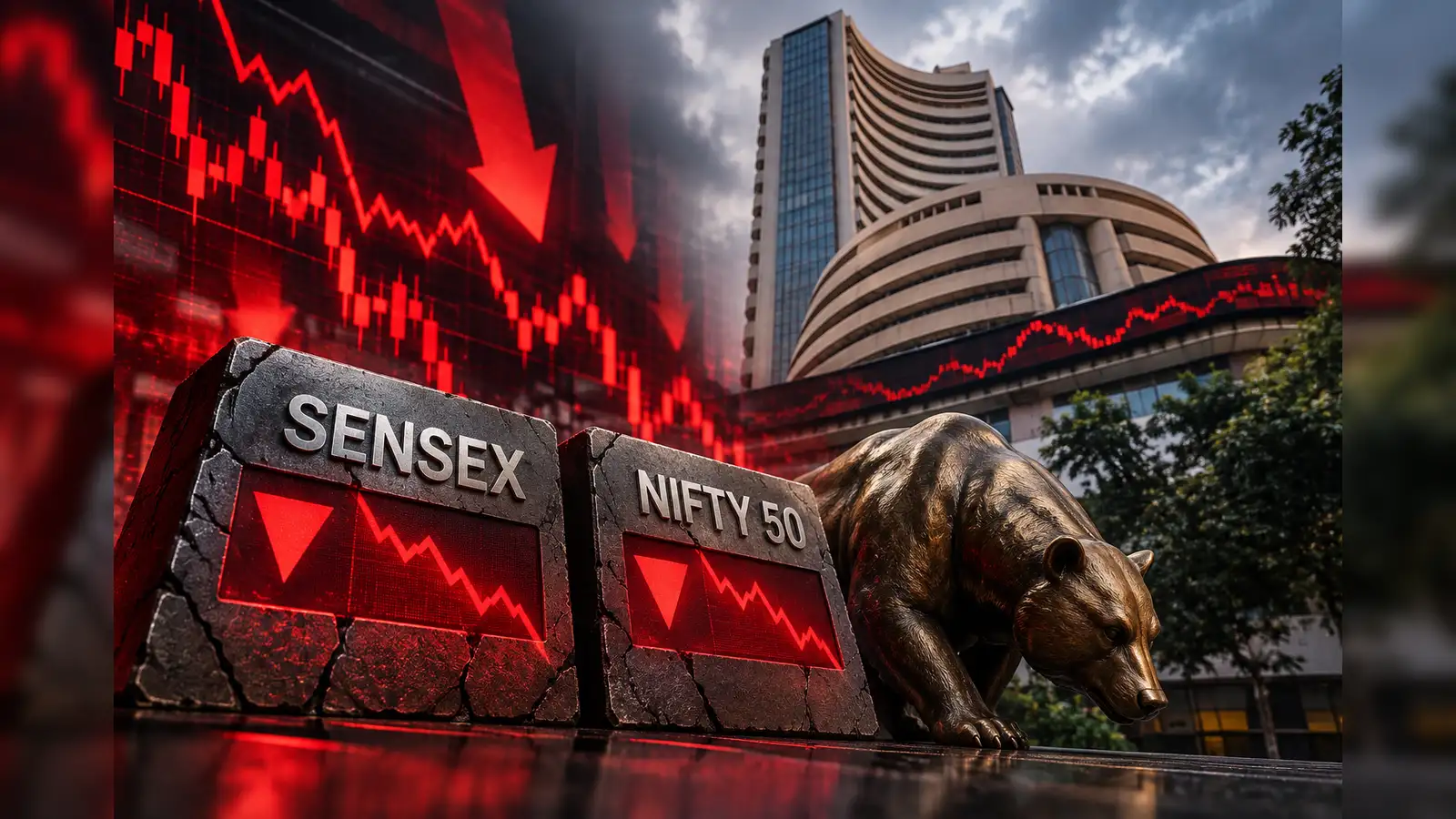
MUMBAI – Indian equity markets plunged dramatically today, with the benchmark Sensex crashing over 1,000 points and the Nifty hitting a fresh 52-week low. The rout was primarily triggered by relentless selling from Foreign Institutional Investors (FIIs) and mounting concerns over an aggressive monetary tightening stance by the Reserve Bank of India (RBI). This confluence of factors signals a significant reassessment of risk and **capital allocation** strategies within one of the world's most prominent emerging markets.
Executive Takeaways
- Significant Market Correction: The Sensex plummeted 1,045 points, marking one of the sharpest single-day declines this year, while the Nifty 50 breached critical support levels, hitting a new 52-week low.
- FII Exodus Intensifies: Foreign Institutional Investors continued their aggressive selling spree, withdrawing billions from Indian equities amidst global risk-off sentiment, strengthening dollar, and rising U.S. Treasury yields, leading to a liquidity squeeze.
- Hawkish RBI Stance: The market is digesting the RBI's increasingly firm commitment to tame inflation, with expectations of further interest rate hikes, impacting borrowing costs and corporate profitability forecasts.
- Valuation Reassessment: The current market downturn reflects a broader re-evaluation of India's equity **valuation multiples** in the face of elevated inflation, rising interest rates, and potential deceleration in global growth, prompting investors to prioritize **risk mitigation**.
Comprehensive Narrative: Global Headwinds Meet Domestic Tightening

The recent downturn in Indian equities is not an isolated event but rather the culmination of complex global and domestic macroeconomic forces. The Sensex's 1,045-point nosedive, translating to a substantial percentage drop, and the Nifty's descent into a fresh 52-week low, underscore a profound shift in investor sentiment, especially among foreign participants.
Globally, central banks are grappling with persistent, multi-decade high inflation. The U.S. Federal Reserve’s aggressive rate hike trajectory has sent ripples across financial markets, making dollar-denominated assets more attractive and prompting a flight of capital from emerging markets. This "carry trade" reversal is particularly punitive for economies like India, which historically attract significant FII flows. As global interest rates climb, the cost of **capital allocation** for corporations and governments worldwide increases, directly impacting the perceived attractiveness of growth-oriented emerging markets.
Domestically, the Reserve Bank of India (RBI) finds itself in a challenging bind. Inflation, driven by soaring commodity prices (especially crude oil), supply chain disruptions, and robust domestic demand, has consistently remained above its comfort zone. To anchor inflationary expectations and defend the depreciating Indian Rupee (INR), the RBI has pivoted sharply towards monetary tightening. Recent policy statements and actions, including unexpected rate hikes and withdrawal of accommodative stances, signal a firm commitment to price stability, even at the cost of tempering growth. This hawkish stance directly impacts **market liquidity**, making credit more expensive for businesses and consumers, and casting a shadow over future corporate earnings.
The sustained FII selling has been a critical catalyst. For weeks, foreign institutional investors have been net sellers in the Indian market, withdrawing capital at an unprecedented pace. Their rationale is multi-faceted: a stronger U.S. dollar eroding returns, rising U.S. Treasury yields offering a safer alternative, and a re-evaluation of India's **valuation multiples** which, despite the recent correction, were considered stretched relative to historical averages and other emerging markets. This outflow has created a significant demand-supply imbalance, exacerbating selling pressure and driving down equity prices. Investors are meticulously scrutinizing **enterprise ROI** metrics, particularly for sectors highly sensitive to interest rate fluctuations or global economic slowdowns.
Verified Data / Metrics Breakdown
| Metric | Value (Previous Close) | Value (Current Close) | Change (Absolute) | Change (%) | Notes |
|---|---|---|---|---|---|
| BSE Sensex | 55,397.64 | 54,352.00 | -1,045.64 | -1.89% | Significant single-day drop |
| NSE Nifty 50 | 16,501.85 | 16,150.90 | -350.95 | -2.13% | Hit 52-week low of 16,123.45 |
| FII Net Selling (YTD est.) | N/A | ~$20 Billion | N/A | N/A | Aggressive outflows since January |
| RBI Repo Rate | 4.00% (Pre-May) | 4.40% (Current) | +0.40% | +10.00% | Unexpected rate hike to curb inflation |
Industry & Market Implications
The broad-based market sell-off has far-reaching implications across various sectors:
- Financials: Banking and NBFCs, while potentially benefiting from higher Net Interest Margins (NIMs) in a rising rate environment, face increased **risk mitigation** challenges. Higher borrowing costs could lead to a slowdown in credit growth and potential increases in Non-Performing Assets (NPAs) if economic activity falters. The focus shifts to robust balance sheets and adherence to **regulatory compliance**.
- IT & Export-Oriented Sectors: While a depreciating Rupee generally aids exporters, concerns about a global economic slowdown and tightening discretionary spending budgets in key markets like the U.S. and Europe pose headwinds. IT companies, often at the forefront of **cloud compute architecture** and digital transformation, could see slower order book growth despite currency tailwinds.
- Manufacturing & Capital Goods: These sectors are highly sensitive to interest rates and consumer demand. Elevated input costs, coupled with higher borrowing expenses, could compress margins and delay corporate **capital allocation** towards new projects and **infrastructure scalability**.
- Real Estate & Auto: Directly impacted by rising interest rates, as home loans and auto financing become more expensive. This could dampen consumer sentiment and defer big-ticket purchases, affecting demand.
- Consumer Discretionary: Inflationary pressures erode disposable income, leading to reduced spending on non-essential goods and services. Companies in this segment will see their **enterprise ROI** challenged.
In this environment, companies with strong balance sheets, prudent **capital allocation** strategies, and diversified revenue streams are better positioned to navigate the turbulence. Conversely, highly leveraged firms or those reliant on continuous external funding face significant pressure.
People Also Ask (FAQ)
Q1: What specific global factors are driving FIIs to sell Indian equities aggressively?
The primary global factors driving FII selling include the U.S. Federal Reserve's aggressive monetary tightening cycle, which has strengthened the U.S. dollar and led to higher U.S. Treasury yields. These factors make dollar-denominated assets more attractive, leading to a global "risk-off" sentiment where investors reallocate capital from perceived higher-risk emerging markets like India to safer havens. Additionally, fears of a global recession, geopolitical uncertainties, and persistent supply-chain inflation contribute to the overall cautious outlook, prompting FIIs to reassess **valuation multiples** and engage in active **risk mitigation** by exiting emerging market positions.
Q2: How does the RBI's tightening stance impact corporate earnings and future growth prospects for Indian companies?
The RBI's tightening stance, characterized by interest rate hikes, directly increases borrowing costs for corporations. This elevates the cost of working capital, project financing, and debt servicing. Higher interest expenses can compress profit margins, thereby impacting corporate earnings. For future growth, expensive credit can deter new **capital allocation** towards expansion, **infrastructure scalability**, and R&D. While the RBI's measures aim for long-term stability by controlling inflation, in the short-to-medium term, they pose a headwind for growth, prompting companies to re-evaluate their projected **enterprise ROI** on new ventures and potentially delay investment decisions.
Q3: Which sectors are considered most vulnerable, and which might be relatively resilient during this market downturn?
Sectors most vulnerable to this market downturn typically include those sensitive to interest rates and consumer discretionary spending: Real Estate, Automobile, Capital Goods, and certain segments of Banking & NBFCs (due to potential loan growth slowdown). Companies with high debt-to-equity ratios and those heavily reliant on imported raw materials are also exposed due to rising input costs and currency depreciation. Conversely, sectors that might show relative resilience include Export-Oriented IT (benefiting from INR depreciation, though global slowdown is a risk), Pharma (defensive sector), and certain Consumer Staples (essential goods, less susceptible to discretionary cuts). Companies with robust balance sheets, strong cash flows, and adherence to prudent **capital allocation** strategies will better withstand the turbulence.
Q4: What role does market liquidity play in the current sell-off, and how is the RBI addressing it?
**Market liquidity** is crucial for smooth market functioning. In the current sell-off, FII outflows directly reduce the liquidity available in the equity market, creating a supply-demand imbalance where more sellers than buyers amplify price declines. The RBI primarily manages liquidity in the broader financial system through its monetary policy tools, like adjusting the repo rate and implementing open market operations. While the current focus is on absorbing excess liquidity to control inflation, the RBI carefully calibrates its actions to ensure that tightening doesn't lead to a systemic liquidity crunch that could destabilize financial markets. Its goal is to maintain orderly conditions while pursuing price stability, a complex balancing act that requires constant monitoring of financial system health and **regulatory compliance**.
Future Outlook: Navigating Volatility and Seeking Stability
The immediate future for Indian equities appears to be one of continued volatility. The trajectory of inflation, both globally and domestically, will be a key determinant. Any signs of global inflation peaking or the U.S. Fed slowing its pace of hikes could provide a much-needed respite. Domestically, the RBI's future policy actions, particularly the pace and quantum of further rate hikes, will be closely watched. Investors will be seeking clear signals on how the central bank balances inflation control with growth objectives.
Key milestones to watch include upcoming inflation data releases (CPI, WPI), corporate earnings reports for insights into the impact of rising costs and interest rates, and the monsoon season's progress, which significantly influences agricultural output and rural demand. Global crude oil prices and the geopolitical landscape, particularly the Ukraine conflict, will continue to exert influence.
For long-term investors, the current correction may present opportunities to build positions in fundamentally strong companies at more attractive **valuation multiples**. However, this requires a disciplined approach to **capital allocation** and a thorough understanding of prevailing risks. The government's continued focus on fiscal consolidation, **infrastructure scalability**, and ease of doing business will be crucial in restoring long-term investor confidence and ensuring sustainable **enterprise ROI** for businesses operating in India. The current market phase is a testament to the interconnectedness of global finance and the constant need for robust **risk mitigation** strategies by both policymakers and investors.