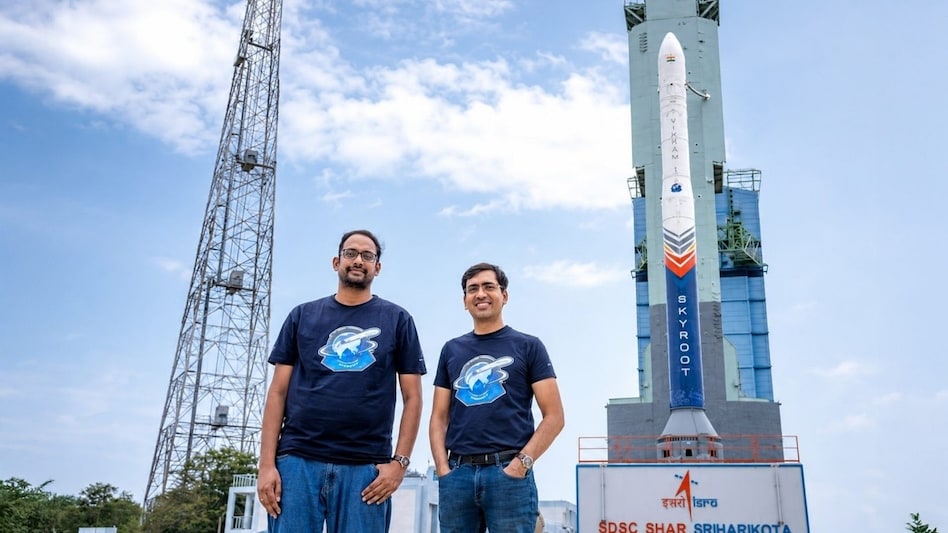
HYDERABAD / SINGAPORE / NEW YORK — In a definitive shift for global NewSpace dynamics, Skyroot Aerospace has formally announced its transition from technology demonstrator to commercial launch operator. Following the benchmark orbital validation of its flagship Vikram-1 launch vehicle, Co-founder and Chief Executive Officer Pawan Kumar Chandana confirmed that the Hyderabad-headquartered enterprise is now opening its manifest to global satellite operators.
“We’ll be getting into commercial flights,” Chandana stated, marking a critical inflection point for India’s private aerospace sector. The transition repositions Skyroot from an emerging defense-adjacent startup into a direct competitor against established small-satellite launch providers across North America, Europe, and Rocket Lab in the Indo-Pacific region.
Executive Takeaways
Test Our Free AI & Tech Utilities Suite
Calculate LLM API token costs, analyze article dwell-time, or simulate tech DCA returns.
- Commercial Manifest Activation: Following the successful qualification of the multi-stage Vikram-1 rocket, Skyroot Aerospace is shifting from R&D flight tests to revenue-generating commercial launches targeting low-Earth orbit (LEO) constellations.
- Capital Efficiency & Margin Superiority: Leveraging India’s low-cost engineering ecosystem and 3D-printed liquid engine architectures, Skyroot achieves up to a 50% capital expenditure reduction per launch vehicle compared to Western legacy counterparts.
- Market Disruption in Smallsat Logistics: Skyroot's commercial entry targets the mid-tier smallsat market (300kg–500kg payload class), directly addressing the acute global supply bottleneck caused by geopolitical shifts and limited dedicated rideshare availability.
- Regulatory Alignment: The transition is fully backed by IN-SPACe (Indian National Space Promotion and Authorization Centre), highlighting India's structural policy pivot under the Indian Space Policy framework to capture 8–10% of the global space economy by 2030.
The Catalytic Flight: From Proof-of-Concept to Revenue Generation

The journey to commercial flight capability traces back to Skyroot’s historic late-2022 launch of the Vikram-S suborbital rocket—the first private launch vehicle developed in India. That mission verified core sub-systems, including solid-propellant propulsion, custom avionics, and carbon-composite airframe integrity. The subsequent development and successful orbital validation of Vikram-1 represent an unprecedented escalation in system complexity and structural payload capacity.
Vikram-1 is engineered as a multi-stage launch vehicle capable of placing up to 480 kilograms into low-Earth orbit (LEO) and roughly 300 kilograms into a 500-kilometer Sun-Synchronous Orbit (SSO). Built primarily with an ultra-lightweight carbon-fiber structure, the vehicle utilizes three solid-propellant stages complemented by a highly controllable liquid-fueled upper stage—the Raman engine architecture—capable of precise orbital insertion and complex multi-satellite dispersion operations.
“The transition from suborbital flight validation to orbital payload delivery is the hardest filter in commercial aerospace,” said an institutional investor with deep allocations in deep-tech funds across Southeast Asia. “By proving structural integrity, stage separation reliability, and precision injection capabilities, Skyroot has effectively de-risked its core asset. They are moving from a capital-burn R&D phase directly into enterprise contract execution.”
Engineering Economics: The Deep-Tech Disruption from Hyderabad
Skyroot’s commercial strategy rests on a structural cost advantage that fundamentally disrupts Western launch economics. While North American small-sat launchers often face capital expenditure profiles exceeding $20,000 to $25,000 per kilogram to orbit during early operational phases, Skyroot aims to bring unit economics down significantly through local supply-chain integration and advanced additive manufacturing.
At the center of Skyroot's competitive moat is the Raman-1 liquid engine, used for upper-stage precision maneuvering. Manufactured using 3D printing techniques, the engine integrates propellant injectors, cooling channels, and combustion chambers into a single monolithic component. This approach reduces overall part count by over 80%, substantially lowers fabrication lead times, and mitigates assembly-related quality risks.
Furthermore, Skyroot's strategic decision to leverage solid propulsion for its booster stages (the Kalam-100, Kalam-250, and Kalam-1000 series) drastically reduces ground support infrastructure capital expenditure. Unlike cryogenically cooled liquid oxygen/kerosene or liquid methane systems—which demand complex, expensive launchpad fueling infrastructure—solid rockets offer rapid deployment parameters, lower pad maintenance overhead, and operational resiliency.
Comparative Metrics: Skyroot Launch Vehicle Portfolio
To evaluate Skyroot’s operational matrix, the table below outlines the structural evolution across their launch vehicle platforms as they scale toward enterprise-grade commercial operations:
| Vehicle Metric | Vikram-S (Demonstrator) | Vikram-1 (Commercial Entry) | Vikram-2 (In Development) |
|---|---|---|---|
| Primary Target Orbit | Suborbital (100 km) | 500 km Sun-Synchronous (SSO) | 500 km Sun-Synchronous (SSO) |
| Payload Capacity | 83 kg (Suborbital peak) | 300 kg (SSO) / 480 kg (LEO) | 595 kg (SSO) / 720 kg (LEO) |
| Propulsion Architecture | Single Solid Motor (Kalam-80) | 3 Solid Stages + Liquid Upper Stage | Cryogenic Engine Upper Stage + Solid Boosters |
| Airframe Construction | Carbon Composite Spin-Stabilized | All-Carbon Fiber Structure | Advanced Carbon-Composite Matrix |
| Target Launch Turnaround | Non-recurring demonstrator | 7–10 Days (Mobile Pad Integration) | Under 72 Hours Target |
| Target Commercial Application | Payload test flight validation | Smallsat Constellation Deployment | Multi-manifest Heavy Smallsat Deployments |
Macro Trends & Geopolitical Tailwinds: The India Advantage
Skyroot’s commercial launch pivot arrives during a major realignment in global satellite communications and Earth Observation (EO) markets. Geopolitical fragmentation has constrained launch choices worldwide, while heavy-lift providers like SpaceX prioritize internally managed Starlink deployments. This dynamics creates a structural deficit in dedicated launch options for small-to-medium satellite operators.
Concurrently, satellite constellation operators face stringent regulatory operational windows under International Telecommunication Union (ITU) spectrum guidelines, requiring fast, predictable access to orbit. Rideshare programs on heavy rockets offer low cost-per-kilogram metrics, but expose satellite operators to destination orbit compromises, high insertion latency, and mission schedule risks caused by primary payload delays.
By providing dedicated, on-demand orbital insertion at competitive price points, Skyroot positions itself as a prime alternative for enterprise and government clients across Asia, Europe, and North America. The market opportunity is reinforced by India’s liberalized foreign direct investment (FDI) guidelines in space, which allow up to 100% FDI under specified launch vehicle manufacturing tracks, unlocking global capital streams for Skyroot and its ecosystem partners.
Institutional backing from prominent investors—including Singapore’s sovereign wealth fund GIC, Sherpalo Ventures, and Greenko Group founders—gives Skyroot a strong financial buffer. The company’s lean operating costs extend its runway, allowing it to offer competitive commercial pricing while keeping gross profit margins intact as launch cadences scale up.
Industry & Market Implications: Winners, Losers, and Realignment
The operational rollout of Skyroot’s commercial launch services disrupts multiple segments of the global aerospace ecosystem:
- Smallsat Operators (WINNERS): Commercial satellite developers in Earth Observation, synthetic aperture radar (SAR), and IoT constellations gain immediate access to dedicated, lower-cost orbital options, reducing satellite deployment schedules from years to months.
- Western Small-Launch Competitors (CHALLENGED): High-cost startup launch providers across North America and Western Europe face intense pricing pressure. Skyroot's local manufacturing and operational cost advantages threaten companies relying on heavy burn rates to subsidize flight manifests.
- The Indian Defense and Geospatial Ecosystem (WINNERS): Domestic space capabilities expand significantly. A private launch provider offers national security organizations rapid, responsive launch capabilities for sovereign surveillance and communications assets without tying up ISRO's heavy-lift infrastructure.
- Global Capital Allocation Trends (REALIGNED): Venture capital and private equity firms are shifting allocations away from capital-intensive, slow-yielding Western aerospace ventures toward capital-efficient, high-yield emerging-market space startups backed by strong regulatory support.
Frequently Asked Questions (People Also Ask)
What is the payload capacity and target orbit of Skyroot’s Vikram-1 rocket?
Skyroot’s Vikram-1 is an orbital launch vehicle engineered to carry up to 480 kilograms to Low Earth Orbit (LEO) and approximately 300 kilograms to a 500-kilometer Sun-Synchronous Orbit (SSO). Its carbon-fiber structural build and multi-stage design specifically target the global small-satellite launch market.
How does Skyroot Aerospace plan to monetize its commercial launch operations?
Skyroot monetizes its operations by offering dedicated orbital deployment contracts to satellite constellation operators, university research programs, and defense agencies. By offering dedicated flight trajectories at flexible schedules—avoiding the delays of heavy-lift rideshares—Skyroot captures high-margin multi-satellite launch services.
How do India’s space policy reforms enable private launch companies like Skyroot?
The creation of IN-SPACe (Indian National Space Promotion and Authorization Centre) and the rollout of the Indian Space Policy 2023 opened up ISRO's launch pads, testing facilities, and technical expertise to private companies. Additionally, streamlined FDI policies facilitate non-domestic capital investment directly into Indian space technology enterprises.
What manufacturing advances set Skyroot apart from traditional launch providers?
Skyroot relies heavily on additive manufacturing (3D printing) for its liquid engine systems, such as the Raman upper-stage engines, and utilizes automated carbon-fiber winding processes for its solid-motor casings. These technologies reduce component count, minimize structural weight, lower manufacturing costs, and shorten production cycles.
Future Outlook: Capital Milestones and Scaling Cadence (2026–2028)
As Skyroot transitions into operational commercial flights, focus shifts to launch frequency and supply chain scaling. Over the next 12 to 24 months, the key performance metrics for Chandana and his team will center on executing contract backlogs, building out automated assembly plants, and lowering total launch turnaround times.
Industry sources suggest Skyroot is preparing to ramp up manufacturing facilities near Hyderabad to support multi-vehicle parallel production, targeting a steady-state cadence of 8 to 12 commercial launches annually by late 2027. Concurrently, design teams are accelerating R&D on the Vikram-2 and Vikram-3 platforms, which feature higher payload capacities and advanced cryogenic upper stages (the Dhawan engine series) powered by liquid natural gas (LNG) and liquid oxygen.
For global capital markets, Skyroot's commercial debut marks a turning point for India's high-tech manufacturing sector. If Skyroot executes its commercial flight pipeline smoothly over the next 18 months, it will establish a viable playbook for private aerospace ventures across emerging markets, proving that capital-efficient engineering can compete directly with legacy Western space contractors.