Executive Takeaways
- Capital Deployment: India’s revised semiconductor incentives have catalysed 12 approved projects by early 2026, marking a decisive shift from policy blueprinting to heavy enterprise infrastructure execution.
- Ecosystem Realities: While front-end wafer fabrication captures global headlines, India’s immediate strategic ROI lies in specialized OSAT (Outsourced Semiconductor Assembly and Test) and advanced packaging operations.
- Geopolitical Risk Mitigation: Global tech giants are leveraging India as a critical supply chain diversification vector to counter single-jurisdiction manufacturing concentration in East Asia.
- Structural Bottlenecks: Long-term valuation multiples and operational scalability will depend heavily on domestic specialty chemical supply chains, high-purity water security, and advanced engineering talent pipelines.
The transformation of South Asia’s industrial landscape is no longer a matter of speculative forecasts; it is unfolding across high-tech industrial corridors from Gujarat to Tamil Nadu. As global markets grapple with persistent geopolitical volatility and systemic supply chain vulnerabilities, India has quietly executed a series of game-changing milestones to anchor itself firmly within the architecture of the 21st-century digital economy. At the center of this industrial pivot is the semiconductor sector—a notoriously capital-intensive arena where national security, economic sovereignty, and enterprise ROI intersect.
According to comprehensive data updated through March 2026, India’s aggressive incentive framework has successfully greenlit 12 major semiconductor projects, with 10 specialized manufacturing units already deep into operational execution. This investigative report dissects the macroeconomic drivers, regulatory mechanisms, key corporate players, and structural hurdles defining India’s ascent as an emerging silicon powerhouse.
The Catalytic Shift: From Import Dependency to Strategic Sovereignty
Test Our Free AI & Tech Utilities Suite
Calculate LLM API token costs, analyze article dwell-time, or simulate tech DCA returns.
For decades, India remained a massive consumer of microelectronics while capturing virtually none of the upstream manufacturing value. Domestic demand for semiconductors—driven by automotive electronics, telecommunications, and consumer appliances—was entirely serviced by imports, exposing domestic conglomerates and multinational corporations to severe supply chain shocks, currency fluctuations, and geopolitical export controls.
The turning point arrived with the rollout of the Modified Semiconductor Programme, which allocated billions in fiscal support designed to absorb a substantial share of capital expenditure for greenfield fabrication plants (fabs) and assembly facilities. By de-risking early-stage capital allocation, New Delhi successfully lured global tier-1 foundries, joint ventures, and domestic industrial heavyweights.
However, industry veterans and financial analysts emphasize that India’s real near-term opportunity is not necessarily in competing immediately with leading-edge sub-3nm logic nodes monopolized by legacy East Asian foundries. Instead, India’s strategic sweet spot lies in mature nodes (28nm and above), analog chips, power semiconductors, and—crucially—advanced packaging and OSAT (Outsourced Semiconductor Assembly and Test) facilities. This pragmatic positioning aligns perfectly with global automotive and industrial demand cycles, ensuring rapid enterprise integration and robust market liquidity for early investors.
Key Players and Industrial Footprint
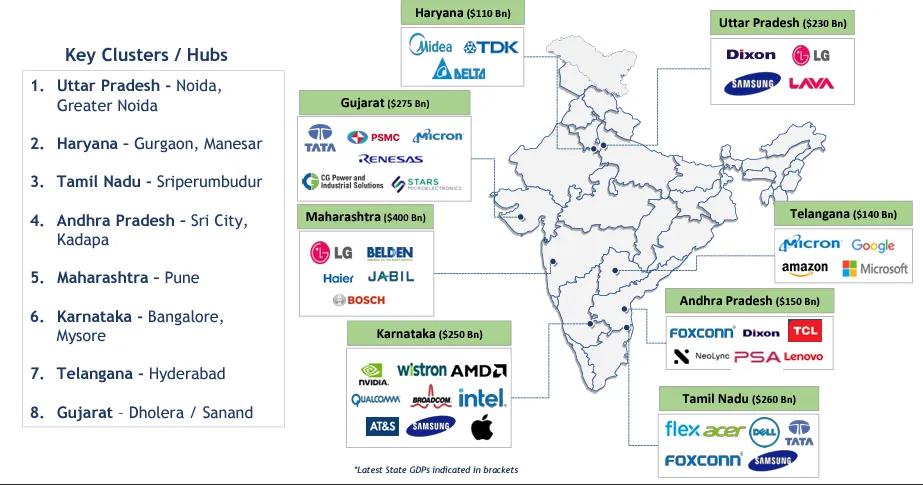
The current landscape of approved projects reflects a calculated blend of domestic conglomerate muscle and international technological expertise. Public-private partnerships have formed the bedrock of India's early successes:
- Tata Electronics: Emerging as a dominant domestic pioneer, Tata has committed massive capital to establish advanced semiconductor foundry and assembly operations, partnering with global technology licensors to accelerate infrastructure scalability.
- CG Power and Renesas Partnership: A landmark joint venture focusing on building a state-of-the-art OSAT facility in Gujarat, bridging the technological gap between raw wafer production and final market-ready chip modules.
- International Consortia: Global players, leveraging India's competitive engineering talent pool and favorable tax regimes, are establishing specialized design hubs and testing facilities, integrating the subcontinent into multinational cloud compute architecture and hardware supply chains.
These entities are not operating in a vacuum. State governments in Gujarat, Karnataka, Maharashtra, and Tamil Nadu have aggressively competed to offer customized land parcels, power subsidies, and streamlined regulatory compliance mechanisms, creating localized semiconductor clusters designed to foster rapid innovation ecosystems.
Verified Data & Metrics Breakdown
| Metric Category | Status / Baseline (2024–2025) | Current Status (March 2026) | Strategic Implication |
|---|---|---|---|
| Approved Projects | 5–7 Initial Proposals | 12 Approved Mega-Projects | Accelerated policy execution and capital absorption. |
| Operational Units | Early-stage groundbreakings | 10 Units in Active Setup/Execution | Transitioning from MOU phase to physical construction. |
| Focus Segments | Aspirational Logic Fabs | OSAT, Packaging & Mature Nodes (28nm+) | Pragmatic alignment with high-demand commercial sectors. |
| Risk Mitigation Vector | High geographical concentration | Multi-hub redundancy across Indian states | Mitigates single-jurisdiction geopolitical disruptions. |
Industry & Market Implications
The broader macroeconomic fallout of India's semiconductor push extends far beyond hardware manufacturing. For global institutional investors, the ecosystem represents a high-growth asset class with substantial capital expenditure requirements. However, risk mitigation remains paramount. Semiconductor manufacturing is hyper-sensitive to resource inputs, requiring millions of gallons of ultra-pure water and uninterrupted, high-frequency power grids.
Who Wins: Domestic engineering firms, specialized real estate developers specializing in cleanroom industrial parks, and international equipment manufacturers (such as lithography and etching machine suppliers) stand to capture significant revenue streams. Furthermore, global automakers benefit immensely from localized chip packaging, drastically reducing lead times.
Who Loses: Incumbent suppliers in traditional East Asian manufacturing hubs face gradual margin compression as diversified supply chains take root in South Asia. Additionally, unadapted domestic firms failing to upgrade their digital infrastructure and engineering talent face severe obsolescence risks.
Frequently Asked Questions (People Also Ask)
What types of semiconductors are currently being prioritized in India’s manufacturing push?
India is primarily focusing on mature nodes (such as 28nm and above), analog chips, power semiconductors, and advanced packaging/OSAT (Outsourced Semiconductor Assembly and Test) operations. This strategy addresses immediate global market demands in automotive, consumer electronics, and industrial automation while laying the technical foundation for future leading-edge logic fabrication.
How much financial backing and incentive support are companies receiving?
The central government’s Modified Semiconductor Programme provides fiscal support covering up to 50% of project capital expenditure for semiconductor fabs, display fabs, and compound semiconductor facilities. This is frequently supplemented by state-level land grants, tax holidays, and power subsidies, significantly lowering the barrier to entry for multinational enterprises.
What are the primary structural bottlenecks facing the Indian semiconductor ecosystem?
Key challenges include securing consistent supplies of ultra-pure water and uninterrupted power, developing a domestic supply chain for specialty electronic-grade chemicals and gases, and scaling up advanced engineering talent pipelines to meet the specialized demands of cleanroom manufacturing.
How does India’s strategy impact global supply chain risk management?
By establishing alternative manufacturing and assembly hubs outside traditional East Asian concentrations, India offers multinational corporations a vital risk-mitigation buffer. This geographic diversification protects global enterprises against localized geopolitical tensions, logistical bottlenecks, and trade restrictions.
Future Outlook and Key Milestones to Watch
As the Indian semiconductor industry transitions through 2026 and toward the end of the decade, the focus will shift decisively from policy announcements and groundbreakings to commercial yield optimization and volume production. Key milestones for institutional investors and industry observers to monitor include:
- First Silicon Rollout: The official commercial dispatch of locally packaged and fabricated chips from the newly established OSAT and foundry units.
- Upstream Chemical Localization: The formation of joint ventures dedicated to producing electronic-grade specialty gases and chemicals locally, reducing import dependencies for raw manufacturing inputs.
- Talent Scaling Metrics: The expansion of specialized academic and vocational partnerships between global semiconductor giants and Indian technical institutions to supply trained cleanroom technicians and process engineers.
Ultimately, India’s semiconductor gamble is transforming from a bold geopolitical aspiration into a tangible commercial reality. For enterprises navigating a fractured global economy, integrating into India's emerging silicon corridor is rapidly evolving from an alternative strategy into a competitive necessity.