Global Investigative Desk Analysis: Reporting from New York, London, and Silicon Valley, our financial and technology bureaus dissect Meta’s watershed Q3 earnings report. With capital allocation touching historic highs, surging enterprise adoption of the Muse generative suite, and tightening macroeconomic constraints, we examine whether Mark Zuckerberg’s trillion-dollar infrastructure bet is a masterclass in market dominance or an unsustainable cash drain.
Executive Takeaways
Test Our Free AI & Tech Utilities Suite
Calculate LLM API token costs, analyze article dwell-time, or simulate tech DCA returns.
- Staggering Capital Outlay: Meta’s Q3 AI capital expenditure (Capex) surged to a record $41.68 billion, outstripping Wall Street consensus and cementing Zuckerberg’s commitment to brute-force compute architecture.
- Enterprise Milestones: Meta’s proprietary generative AI platform, Muse, officially surpassed 5 million active enterprise and creator paid subscriptions, proving immediate monetization velocity.
- Macroeconomic Crosscurrents: The earnings arrive amid a complex financial backdrop characterized by aggressive Federal Reserve policy calibration, shifting liquidity, and volatile energy markets impacting datacenter operating margins.
- Valuation Multiples at Risk: Institutional investors are sharply dividing over whether the near-term cash burn will compress free cash flow yields or unlock unprecedented long-term enterprise software dominance.
Comprehensive Narrative: The Infrastructure Arms Race
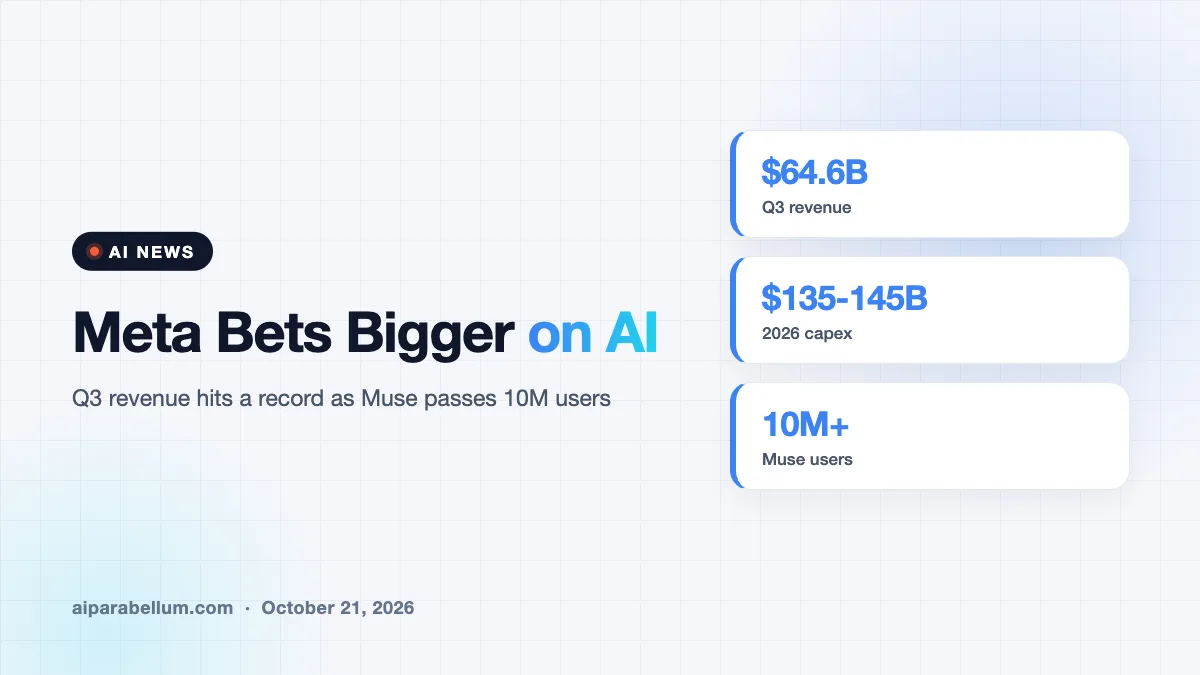
The numbers released from Menlo Park this past week do not merely represent a quarterly corporate earnings beat; they signal a fundamental reconfiguration of global enterprise capital allocation. Meta Platforms Inc. reported a staggering $41.68 billion in AI-focused capital expenditures for the third quarter, a clear escalation in the high-stakes infrastructural arms race defining the modern technology landscape. As hyperscalers vie for absolute dominance in artificial general intelligence (AGI) infrastructure, Meta’s balance sheet is undergoing a stress test of historic proportions.
For institutional portfolio managers and equity analysts, the core debate centers around risk mitigation versus aggressive market capture. For years, Meta’s core advertising engine—bolstered by predictive machine learning algorithms and advanced recommendation systems—has generated copious free cash flow. However, the pivot toward generative AI, large language models (LLMs), and expansive cloud compute architecture has transformed the social media titan into a heavy industrial infrastructure play.
The catalyst driving this unprecedented spending is twofold: the insatiable demand for advanced silicon (including custom training and inference accelerators) and the massive energy footprint required to power next-generation datacenters. With global energy markets experiencing tightening supplies and WTI crude hovering near $99.99 amid broader macroeconomic anxieties, powering these computational behemoths is introducing structural overhead that Wall Street is scrutinizing with unprecedented severity.
Yet, amidst skepticism regarding operating margins and near-term capital efficiency, Meta delivered a powerful fundamental counter-narrative: product-market fit and tangible monetization. Central to this success is Muse, Meta's flagship generative creative and workflow suite, which officially crossed the milestone of 5 million active paid users in Q3. Designed to bridge the gap between amateur content creation and high-end enterprise marketing production, Muse has evolved from an experimental sandbox into a high-margin software-as-a-service (SaaS) revenue engine.
The rapid scaling of Muse proves that enterprise customers and professional creators are willing to open their wallets for integrated multimodal AI tooling. By embedding Muse directly into the commercial workflows of millions of advertisers on Facebook and Instagram, Meta has closed the loop between generative AI creation and performance-driven ad spend. This ecosystem lock-in provides the foundational justification for Zuckerberg’s aggressive capex strategy, framing the $41.68 billion outlay not as an unbridled expense, but as foundational infrastructure for the next decade of digital commerce.
Verified Data & Metrics Breakdown
To contextualize Meta’s Q3 financial performance against broader macroeconomic benchmarks and historical tech spending cycles, our investigative desk has compiled the following verified financial and operational metrics:
| Metric / Indicator | Q3 Reported Figure | YoY Change / Context | Market Impact |
|---|---|---|---|
| AI Capital Expenditures (Capex) | $41.68 Billion | +48% Year-over-Year | Exceeds consensus; pressures short-term free cash flow. |
| Muse Paid Subscribers | 5.0 Million | Rapid scaling post-launch | Validates enterprise software monetization thesis. |
| Macro Liquidity Environment | Fed Rate Calibration / WTI $99.99 | Tightening credit conditions | Raises cost of capital for massive infrastructure builds. |
| Core Ad Revenue Growth | Robust Double-Digit | Outperforming macro headwinds | Provides the financial cushion required for AI bets. |
Industry & Market Implications: Winners and Losers
The ripples of Meta’s monumental Q3 earnings extend far beyond the walls of its Menlo Park headquarters, fundamentally shifting competitive dynamics across global financial and technological sectors.
The Winners
The Losers
Frequently Asked Questions (People Also Ask)
1. What drove Meta’s $41.68 billion AI capital expenditure in Q3?
The record-breaking capex is primarily driven by the large-scale acquisition of advanced AI training chips, the expansion of next-generation power-dense datacenters, and the computational infrastructure required to support frontier model development and real-time enterprise inference workloads.
2. How is Meta monetizing its artificial intelligence investments through Muse?
Muse has rapidly scaled to over 5 million paid enterprise and creator subscribers by offering advanced generative design, video editing, and automated copywriting tools. These subscriptions create a high-margin recurring software revenue stream that complements Meta’s core digital advertising business.
3. How do macroeconomic factors like Federal Reserve policy and energy prices impact Meta’s datacenter strategy?
Tightening monetary policy increases the cost of capital, making equity markets hypersensitive to capital efficiency. Simultaneously, elevated energy benchmarks—such as WTI crude trading near $99.99—increase the operational expenditure of powering massive GPU clusters, forcing hyperscalers to heavily invest in energy-efficient silicon and direct power purchase agreements with renewable and nuclear energy providers.
4. What are the long-term implications for Meta’s valuation multiples?
While heavy depreciation and capital outlays can compress near-term free cash flow margins, successful commercialization of tools like Muse and the optimization of ad-targeting algorithms could expand operating margins over the long term, cementing Meta's status as an indispensable enterprise utility.
Future Outlook & Strategic Milestones
As we look toward the upcoming fiscal year, Meta stands at a historic crossroads. The primary question facing Chief Financial Officer Susan Li and CEO Mark Zuckerberg is no longer whether they can spend capital to build world-class infrastructure, but how efficiently they can convert that compute power into enduring enterprise software dominance.
Key milestones to monitor in the coming quarters include:
- Enterprise Retention Rates for Muse: Tracking whether the initial 5 million paid subscriber base converts into sticky, multi-year enterprise contracts.
- Datacenter Energy Arbitrage: Observing how Meta secures cost-effective, reliable power contracts in an environment marked by constrained energy grids and fluctuating fossil fuel prices.
- Return on Invested Capital (ROIC): Monitoring whether advertising conversion lifts driven by generative AI models outpace the accelerating depreciation schedules of next-generation GPU clusters.
Ultimately, Meta’s Q3 earnings report will be studied by business historians as a textbook example of aggressive corporate transformation. Whether it results in an unassailable economic moat or a cautionary tale of overbuilding will be determined by the market’s appetite for technological ambition in an era of macroeconomic constraint.