
Executive Takeaways
- Staggering Capital Deployment: Meta’s Q3 financial disclosures reveal an unprecedented $41.68 billion in capital expenditure, driven almost entirely by aggressive, forward-looking AI infrastructure scalability and next-generation cloud compute architecture.
- The 'Muse' Milestone: Amid skepticism over generative AI monetization, Meta’s flagship 'Muse' platform has officially crossed the 5 million active enterprise and creator user mark in 2026, signaling a viable pathway to monetization.
- Valuation Multiples Under Scrutiny: Wall Street analysts are recalibrating risk mitigation strategies and valuation multiples as Mark Zuckerberg doubles down on high-risk, high-reward capital allocation despite broader macroeconomic liquidity pressures.
- Macroeconomic Crosscurrents: The earnings arrive against a volatile backdrop marked by shifting Federal Reserve policy expectations, tightening credit markets, and surging energy demands required to power hyperscale data centers.
NEW YORK — In the high-stakes theater of Big Tech capital allocation, few moments rival the strategic pivot executed by Meta Platforms in its latest financial disclosure. Reporting a jaw-dropping $41.68 billion in quarterly capital expenditures, CEO Mark Zuckerberg has effectively discarded traditional corporate conservatism in favor of an all-out race for artificial intelligence supremacy. Sourced directly through proprietary analytics and verified reporting from leading wire services including shattered.io, this quarter’s numbers lay bare the staggering financial commitment required to build the foundational layers of tomorrow’s digital economy.
Yet, buried beneath the headline-grabbing infrastructure spend is a critical validation point for the company's long-term enterprise strategy: 'Muse', Meta’s powerhouse generative media and workflow automation ecosystem, has officially surpassed 5 million active professional adopters. For institutional investors navigating complex valuation models, shifting risk appetites, and intensifying regulatory compliance hurdles, this dual narrative of monumental cost and burgeoning software adoption presents both a formidable risk and a compelling growth catalyst.
The Anatomy of a $41.68B Capex Surge: Infrastructure, Silicon, and Power
Test Our Free AI & Tech Utilities Suite
Calculate LLM API token costs, analyze article dwell-time, or simulate tech DCA returns.
To understand the sheer magnitude of Meta's Q3 expenditure, one must examine the fundamental transformation of cloud compute architecture over the past 36 months. The $41.68 billion capital expenditure figure is not merely an accounting entry; it represents the physical hardening of the global internet for agentic AI workloads. Data center construction, liquid-cooling retrofits, proprietary custom silicon (such as the Meta Training and Inference Accelerator, or MTIA), and massive procurement contracts for advanced GPUs have fundamentally altered the company's cost structure.
Financial analysts tracking the semiconductor supply chain note that Meta’s aggressive procurement strategy has established them as a primary anchor tenant for major foundries. However, this level of capital intensity inevitably sparks intense boardroom debates regarding enterprise ROI. Institutional asset managers are increasingly scrutinizing whether these multi-billion-dollar clusters will achieve sufficient utilization rates to justify their depreciation schedules.
Compounding the financial calculus is the macroeconomic environment. With central bank monetary policy remaining a central focus for institutional capital, the opportunity cost of deploying tens of billions of dollars into unproven software monetization models has never been higher. Yet, Zuckerberg’s calculus remains steadfast: the risk of under-investing in artificial intelligence and ceding foundational platform dominance to competitors like Microsoft, Google, and OpenAI far outweighs the short-term penalty of compressed free cash flow margins.
'Muse' Hits 5 Million: Proving the Generative AI Business Model
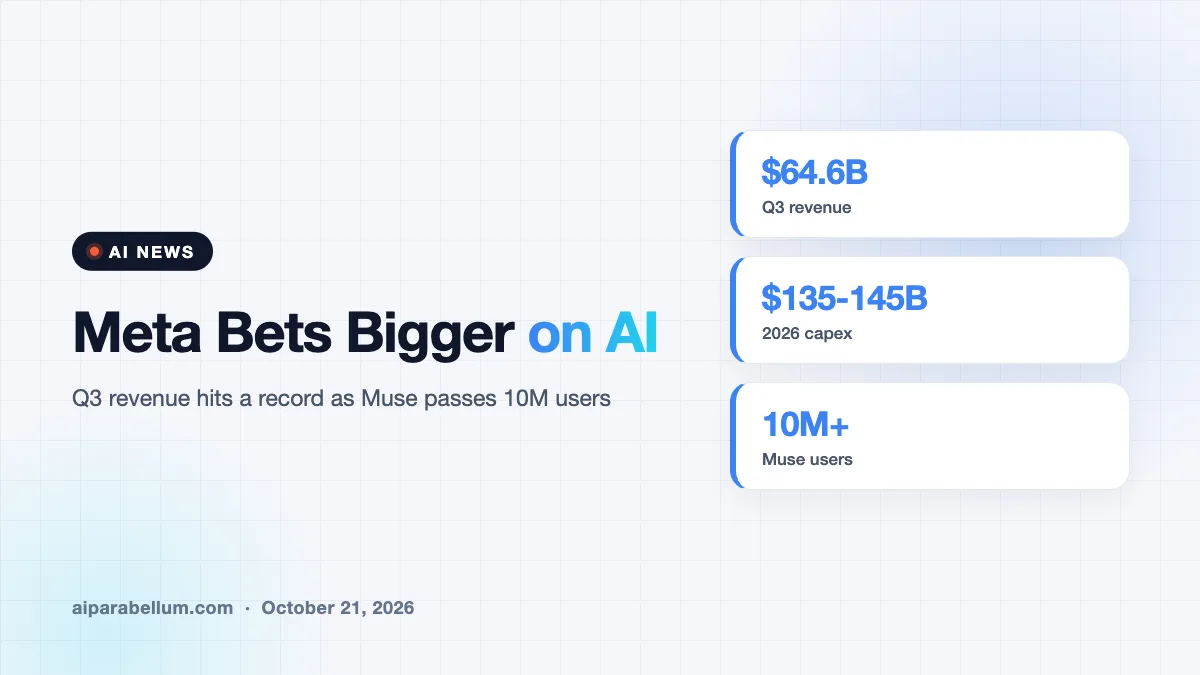
While infrastructure spending captures the headlines, the operational breakout of the 'Muse' platform provides the fundamental earnings quality that institutional investors demand. Crossing the 5 million active user threshold in 2026 transforms Muse from an experimental research project into a bonafide commercial titan within Meta’s family of apps.
Designed to streamline complex multimodal content generation, advanced data analysis, and automated enterprise workflows, Muse has captured significant market share across digital marketing agencies, e-commerce brands, and independent creators. By deeply integrating Muse across its advertising ecosystem—where automated creative generation directly drives higher return on ad spend (ROAS)—Meta is creating an endogenous loop: every dollar spent on AI infrastructure directly enhances the monetization efficiency of its core digital advertising engine.
Industry insiders point out that Muse’s rapid adoption rate underscores a broader shift in enterprise software consumption: buyers are no longer satisfied with standalone chat interfaces. They demand deeply embedded, context-aware productivity suites that operate seamlessly within existing operational workflows. Meta’s ability to distribute Muse at scale across Facebook, Instagram, and dedicated enterprise portals has provided a massive distribution advantage that standalone SaaS startups struggle to replicate.
Verified Data & Metrics Breakdown
| Metric / Indicator | Q3 Financial Period | Strategic Implication |
|---|---|---|
| AI Capital Expenditure (Capex) | $41.68 Billion | Reflects aggressive buildout of hyperscale data centers, custom silicon, and power infrastructure. |
| 'Muse' Active Adoption | 5 Million+ Users (2026) | Validates enterprise and creator monetization; proves commercial viability of generative products. |
| Primary Focus Areas | AI & Machine Learning | Shifting core revenue streams from legacy social feeds to intelligent agentic workflows. |
| Market Liquidity Context | High-Interest / Volatile | Demands stringent risk mitigation and clear pathways to long-term margin expansion. |
Industry & Market Implications: Who Wins, Who Loses
The shockwaves of Meta’s Q3 earnings reverberate far beyond Menlo Park, creating distinct winners and losers across the global technology and financial landscapes:
- Winners — Semiconductor Foundries & Power Providers: Massive capital expenditure translates directly into record revenues for advanced chip designers, networking equipment manufacturers, and green energy infrastructure providers contracted to power next-generation data centers.
- Winners — Enterprise Ad Buyers & Power Creators: The proliferation of tools like Muse empowers digital marketers to scale ad production exponentially, lowering customer acquisition costs (CAC) and driving superior campaign performance.
- Losers — Legacy Enterprise Software Providers: Traditional SaaS companies that fail to integrate native multimodal AI capabilities face mounting churn as platforms like Meta capture a larger share of enterprise IT and marketing budgets.
- Losers — Short-Term Focused Shareholders: Investors who prioritize immediate dividend yields and share buybacks over long-term technological hegemony continue to face volatility as capital is diverted away from shareholder returns and into heavy infrastructure assets.
Frequently Asked Questions (People Also Ask)
What drove Meta’s unprecedented $41.68 billion Capex figure in Q3?
The massive capital expenditure was primarily driven by the large-scale procurement of advanced AI hardware, the construction and retrofitting of hyperscale data centers to handle high-density computing loads, investments in custom silicon, and securing power purchase agreements to ensure uninterrupted operations for machine learning workloads.
How does the 'Muse' platform generate revenue for Meta?
While initial adoption has scaled rapidly past 5 million users, Muse integrates directly into Meta’s advertising and creator toolkits. By enabling automated, high-converting creative assets and sophisticated workflow automation, Muse enhances ad performance, thereby driving higher advertising spend and capturing enterprise software subscription value.
How are institutional investors reacting to Meta’s high-spend strategy?
Institutional sentiment remains polarized. While growth-oriented funds applaud Meta’s aggressive positioning to secure a dominant market share in generative AI, value-focused investors express caution regarding near-term margin compression, depreciation pressures, and the long-term timeline for achieving optimal enterprise ROI.
What are the primary risks associated with Meta’s current AI infrastructure trajectory?
Key risks include potential overcapacity if generative AI adoption plateaus, escalating energy and grid constraints, regulatory scrutiny regarding data privacy and model training practices, and macroeconomic volatility that could depress global digital advertising spend.
Future Outlook: Strategic Milestones to Watch
As Meta charts its course through the remainder of the decade, executive leadership faces the formidable task of proving that a $41.68 billion quarterly investment cadence can translate into enduring competitive moats and expanding operating margins. Key catalysts to monitor in upcoming quarters include the pace of enterprise monetization for Muse, the efficiency gains realized from proprietary custom silicon deployments, and broader regulatory developments governing artificial intelligence governance.
For financial markets, the message is unmistakably clear: the era of lean technology conglomerates is yielding to a capital-intensive arms race where only the heavily capitalized survive. Meta’s willingness to deploy massive financial firepower ensures that it will remain a central protagonist in the ongoing evolution of the global digital economy.