Executive Takeaways
- Strategic Pivot: Meta is shifting focus from consumer-facing virtual reality toward enterprise-grade collaborative AI workflows, directly challenging Microsoft Copilot and Google Workspace.
- The Core Innovation: "Spaces" paired with the "Muse" agent introduces persistent, multi-agent workspaces designed to automate complex corporate tasks and capital allocation tracking.
- Infrastructure & Valuation Impact: The massive cloud compute architecture required to support continuous agent execution places further pressure on Meta's capital expenditure and infrastructure scalability.
- Monetization Pressure: Wall Street analysts are closely tracking enterprise ROI metrics to justify Meta's aggressive multi-billion-dollar AI capital allocation strategy.
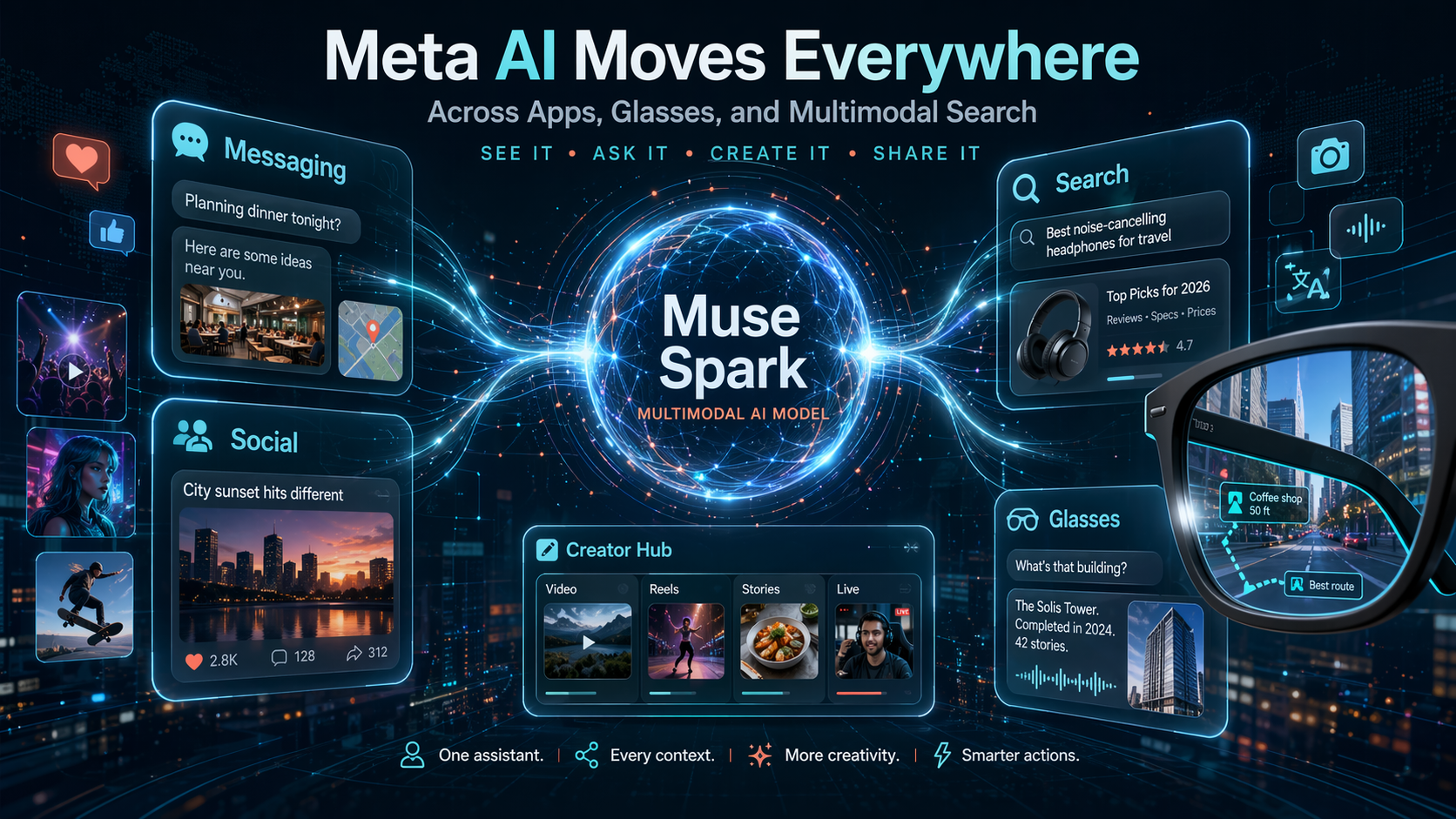
SAN FRANCISCO & NEW YORK — In a definitive strategic maneuver that underscores the shifting battlegrounds of Big Tech, Meta Platforms has officially unveiled "Spaces", a collaborative ecosystem engineered to anchor its proprietary "Muse" agent. Billed as the next evolutionary step in human-AI enterprise interaction, the launch signals Meta’s aggressive transition from consumer social media dominance into the high-stakes, high-margin arena of enterprise productivity software and autonomous cloud workflows.
For months, financial markets and tech sector analysts have scrutinized Meta’s heavy capital expenditure (CapEx) cycle, questioning when and how the social media titan would monetize its immense investments in generative artificial intelligence and large language model (LLM) infrastructure. With the introduction of Spaces and Muse, Chief Executive Mark Zuckerberg and his enterprise leadership team have laid their cards on the table: Meta is positioning itself as the foundational infrastructure provider for the autonomous office of the future.
The Catalytic Shift: Moving Beyond Conversational Chatbots
Test Our Free AI & Tech Utilities Suite
Calculate LLM API token costs, analyze article dwell-time, or simulate tech DCA returns.
The contemporary enterprise software market has grown fatigued by static, single-turn conversational chatbots. While tools like early iterations of ChatGPT and generic assistants offered incremental efficiency gains, they largely remained isolated silos—requiring constant human prompting, lacking persistent context, and failing to integrate seamlessly across complex corporate software stacks.
Meta’s "Spaces" aims to dismantle these silos. Designed as an infinite, persistent virtual canvas, a Space acts as a centralized digital headquarters where human workers and specialized Muse agents collaborate in real time. Unlike traditional chat interfaces, Muse operates as an autonomous coworker capable of parsing unstructured data, executing multi-step financial models, drafting strategic memos, and initiating cross-platform API calls without constant human oversight.
According to internal briefings obtained by industry insiders, the development of Muse was catalyzed by Meta's internal need to streamline its own organizational velocity following massive corporate restructuring and headcount optimization. By packaging these internal productivity gains into a commercial product, Meta aims to capture lucrative enterprise SaaS market share currently dominated by Microsoft 365 Copilot, Google Workspace, and specialized enterprise agentic platforms.
Technical Architecture and Compute Demands

To support the real-time synchronization required by Spaces, Meta has re-engineered significant portions of its underlying cloud compute architecture. The Muse agent architecture relies on a hybrid mixture of densely parameterized open-weights models optimized via reinforcement learning from human feedback (RLHF) and fine-tuned for high-accuracy reasoning tasks.
However, running persistent, autonomous agents that maintain state across multi-day corporate projects places an unprecedented load on server infrastructure. Industry analysts note that while Meta’s open-source philosophy (exemplified by the Llama model family) has successfully commoditized the underlying foundation layer, monetization must occur at the orchestration and application layer—precisely where Spaces and Muse reside.
This operational shift directly impacts Meta's risk mitigation and financial forecasting:
- Cloud Compute Scaling: Continuous inference operations for autonomous agents require specialized GPU clusters, driving up immediate infrastructure costs.
- Data Governance & Security: Enterprise adoption hinges on robust regulatory compliance, data residency guarantees, and ironclad encryption protocols within Spaces.
- API Interoperability: Muse must successfully interface with legacy enterprise resource planning (ERP) systems from vendors like SAP, Salesforce, and Oracle to deliver measurable enterprise ROI.
Verified Data & Metrics Breakdown
The following comparative matrix outlines the technical specifications, market positioning, and economic parameters governing Meta’s new enterprise offering against competing solutions:
| Platform / Metric | Meta Spaces & Muse | Microsoft 365 Copilot | Google Workspace Duet |
|---|---|---|---|
| Primary Architecture | Persistent multi-agent canvas | App-integrated sidecar assistant | Cloud-native app integration |
| Agent Autonomy Level | High (Multi-step, autonomous execution) | Moderate (Prompt-driven execution) | Moderate (Contextual document generation) |
| Underlying Model Family | Proprietary & Fine-Tuned Llama variants | OpenAI GPT-4 / Azure custom models | Google Gemini Ultra / Advanced |
| Target Monetization Model | Per-seat enterprise licensing + compute tiers | $30/user/month add-on subscription | Tiered per-user workspace subscription |
Industry & Market Implications
The introduction of Spaces and Muse is poised to trigger secondary ripple effects across equity markets, venture capital allocations, and enterprise procurement budgets.
Winners and Losers in the Enterprise AI Race
The Winners: Enterprise technology buyers stand to benefit from compressed project timelines and enhanced operational efficiency. Furthermore, agile software integrators and cloud infrastructure providers positioned to supply specialized hardware and security layers will see robust demand.
The Losers: Legacy productivity software vendors slow to adopt agentic workflows risk immediate customer churn. Additionally, traditional outsourcing and consultancy firms whose business models rely on billable hours for routine data aggregation and basic report writing face existential threats as autonomous agents automate these functions at marginal cost.
Market Liquidity and Valuation Multiples
For Meta, successfully proving out an enterprise monetization engine is critical for sustaining its valuation multiples. Institutional investors have increasingly demanded clear pathways to profitability on AI expenditures. If Spaces achieves widespread C-suite adoption, it will validate Meta’s aggressive capital allocation strategy and inject renewed confidence into tech sector market liquidity.
Frequently Asked Questions (People Also Ask)
What is Meta Spaces, and how does it differ from traditional collaboration tools?
Meta Spaces is a persistent, multi-agent virtual environment designed to host human workers and AI agents (such as Muse) concurrently. Unlike Slack or Microsoft Teams, which primarily facilitate human-to-human communication, Spaces is built from the ground up for agentic collaboration—allowing AI agents to independently execute workflows, manage documents, and interact with software tools directly within the workspace.
How does the Muse agent maintain security and regulatory compliance for enterprise data?
Meta has implemented strict data governance frameworks for Muse, ensuring that enterprise customer data is ring-fenced and never used to train foundational models without explicit authorization. The platform features robust encryption standards, role-based access controls (RBAC), and compliance certifications tailored to meet stringent financial and healthcare sector regulations.
What are the financial implications of Spaces for Meta's capital expenditure?
The deployment of autonomous, persistent agents like Muse requires significant real-time cloud compute power. While this temporarily elevates Meta's infrastructure CapEx, the enterprise subscription model is designed to generate high-margin recurring revenue, ultimately serving as the primary vehicle to justify Meta's extensive AI investments to Wall Street analysts.
Future Outlook and Key Milestones to Watch
As Meta rolls out Spaces and Muse to early-access enterprise partners, industry observers will monitor several critical performance indicators over the coming fiscal quarters:
- Enterprise Adoption Velocity: Tracking the conversion rate of pilot programs into paying multi-seat enterprise contracts.
- API Ecosystem Expansion: Evaluating the breadth and depth of third-party enterprise software integrations available within Spaces.
- ROI Benchmarks: Independent case studies quantifying productivity gains and cost reductions realized by early adopters.
Ultimately, Meta’s pivot into enterprise agentic workflows represents a defining chapter in the commercialization of artificial intelligence. By bridging the gap between raw foundational model capabilities and practical, collaborative office environments, Meta is betting its future—and reshaping the corporate landscape—on the premise that the future of work is not human versus AI, but human and agent, working in unison.