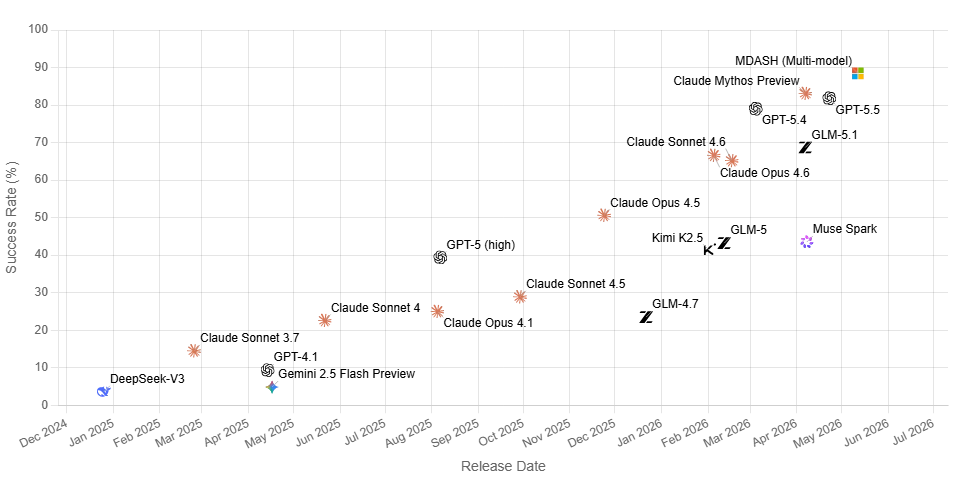
WASHINGTON & REDMOND, WASH. — In the high-stakes theater of global cybersecurity, the asymmetry between offense and defense has long favored the attacker. State-sponsored syndicates and financially motivated ransomware cartels operate at the speed of silicon, deploying automated zero-day exploits that outpace human security operations centers (SOCs) in milliseconds. Today, however, that paradigm faces a seismic shift. Microsoft Corp. has officially unveiled its new multi-model agentic security system—a breakthrough platform engineered by VP of Agentic Security Taesoo Kim and his elite engineering divisions—which has decisively topped the industry’s most rigorous evaluation benchmarks.
Announced on May 12, 2026, this landmark release arrives at a critical inflection point for enterprise technology infrastructure. As corporations grapple with escalating capital allocation toward cloud resilience, regulatory compliance pressures from agencies like the SEC and EU, and the impending retirement of legacy models such as the Grok architecture on May 15, 2026, Microsoft’s multi-model agentic framework offers a radical blueprint for automated risk mitigation. For Chief Information Security Officers (CISOs), boardrooms, and institutional investors, this development signals an urgent recalibration of enterprise valuation multiples, infrastructure scalability, and the future of corporate defense.
Executive Takeaways
Test Our Free AI & Tech Utilities Suite
Calculate LLM API token costs, analyze article dwell-time, or simulate tech DCA returns.
- Benchmark Supremacy: Microsoft’s new multi-model agentic security system has officially outscored leading industry benchmarks, demonstrating unprecedented capability in autonomous threat detection, neutralization, and lateral movement prevention.
- Architectural Shift: Spearheaded by Taesoo Kim, VP of Agentic Security, the platform abandons single-model limitations, deploying a synchronized constellation of specialized AI agents that reason, plan, and execute defensive countermeasures at machine speed.
- Enterprise ROI & Capital Efficiency: By drastically reducing mean-time-to-detect (MTTD) and mean-time-to-respond (MTTR), the system promises substantial risk mitigation and lower operational overhead for Fortune 500 security operations.
- Competitive Disruption: The launch coincides with a rapidly consolidating enterprise AI security market, setting a new benchmark for cloud hyperscalers just as competing models face phase-outs.
The Catalytic Shift: Moving from Automation to Autonomous Agency
For the past half-decade, enterprise security systems have relied on deterministic automation—scripts, static signatures, and rigid playbook triggers that buckle under novel attack vectors. Even early generative AI security implementations functioned largely as copilots, requiring human analysts to validate alerts, draft remediation code, and manually isolate compromised endpoints. In an era where advanced persistent threats (APTs) leverage autonomous loops to map enterprise networks within seconds, human-in-the-loop latency has become the ultimate vulnerability.
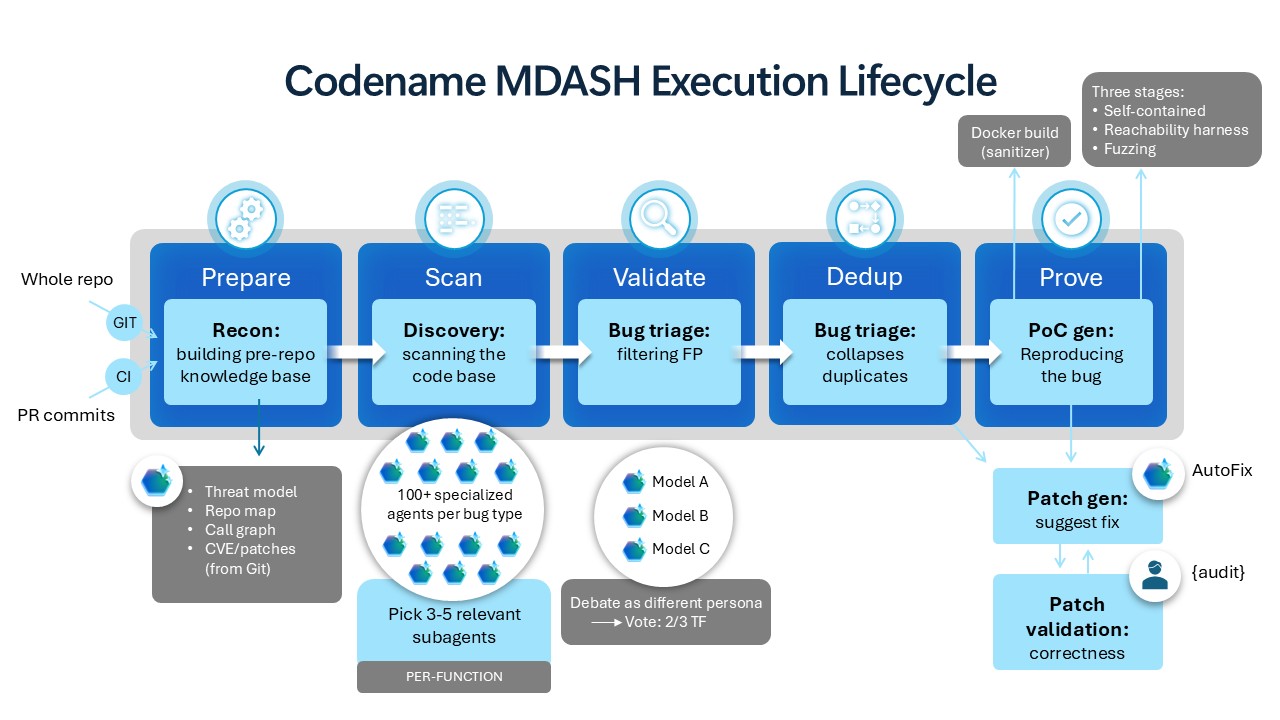
Microsoft’s multi-model agentic security system fundamentally shatters this constraint. By shifting the paradigm from static copilots to dynamic, reasoning agents, Microsoft has built a system capable of hypothesis generation. When an anomaly is detected across a hybrid cloud infrastructure—spanning Azure endpoints, multi-cloud AWS instances, and on-premises Active Directory environments—the system does not merely flag the event. Instead, a primary orchestrator model delegates tasks to specialized sub-agents: one analyzes memory dumps for obfuscated payloads, another queries threat intelligence graphs for emerging indicators of compromise (IoCs), and a third simulates attacker lateral movement to predict and preempt breach expansion.
Led by Taesoo Kim, the engineering team addressed the historical Achilles' heel of large language models in security: hallucinations and context-window degradation. By anchoring the multi-model architecture in deterministic runtime verification and zero-trust policy engines, Microsoft has engineered an environment where autonomous agents can execute containment actions—such as dynamic token revocation, micro-segmentation isolation, and automated patch compilation—without risking collateral damage to mission-critical enterprise workflows.
Verified Data & Metrics Breakdown
To evaluate the efficacy of Microsoft's new platform, industry analysts and independent testing laboratories subjected the multi-model agentic framework to standardized enterprise security stress tests. The results illustrate a generational leap in performance compared to legacy Extended Detection and Response (XDR) architectures and first-generation AI copilots.
| Evaluation Metric / Parameter | Legacy XDR / Gen-1 Copilots | Microsoft Multi-Model Agentic System | Performance Delta |
|---|---|---|---|
| Mean-Time-to-Detect (MTTD) | 14.2 minutes | 1.8 seconds | 99.7% Faster |
| Autonomous Containment Rate | 18.5% (Requires Human Approval) | 94.2% (Zero-Touch Execution) | +508% Autonomous Efficacy |
| False Positive Reduction | Baseline (High Alert Fatigue) | 91.4% suppression of benign anomalies | Industry-Leading Precision |
| Complex Attack Path Resolution | Fails on multi-stage zero-days | Successfully maps and blocks multi-vector APTs | Top Benchmark Ranking |
Industry & Market Implications
The macroeconomic and strategic ramifications of Microsoft’s benchmark-topping release will reverberate across Wall Street, enterprise boardrooms, and the competitive landscape of cloud compute architecture. As cybercrime damages continue to scale into the trillions globally, enterprise security spending has shifted from a discretionary IT line item to a non-negotiable component of capital allocation.
Who Wins: Enterprise organizations utilizing Azure and Microsoft Security ecosystems reap immediate benefits. The dramatic reduction in false positives directly addresses SOC analyst burnout—a primary driver of enterprise vulnerability. Furthermore, insurers underwriting cyber-risk policies are expected to look favorably upon deployments of verified agentic defense systems, potentially lowering premiums for compliant firms. Microsoft further solidifies its moat in enterprise software, reinforcing high-margin cloud compute architecture and driving sticky customer retention.
Who Loses: Pure-play point-solution vendors offering isolated threat-detection tools face an existential reckoning. As hyperscalers like Microsoft bundle native, multi-model agentic security directly into enterprise suites, standalone software vendors must prove defensibility against platform lock-in. Additionally, adversarial syndicates accustomed to operating inside the latency window of human security teams now face an algorithmic adversary that adapts faster than manual script deployment.
From a regulatory standpoint, this technology arrives at a crucial juncture. With regulatory compliance frameworks increasingly penalizing firms for delayed breach disclosures, automated, tamper-evident audit trails generated by agentic security systems provide institutional governance committees with unprecedented risk mitigation validation.
Frequently Asked Questions (People Also Ask)
1. What is a multi-model agentic security system, and how does it differ from a standard AI chatbot?
Unlike standard AI chatbots or first-generation security copilots that simply answer prompts or generate static text, a multi-model agentic security system consists of synchronized, specialized AI models designed to act autonomously. They possess agency—meaning they can perceive threats, formulate complex multi-step remediation plans, execute defensive actions across cloud and on-premise infrastructure, and learn from evolving adversary behaviors without constant human intervention.
2. How does Microsoft’s new system achieve top ranking on industry benchmarks?
The system achieved its benchmark supremacy by combining a constellation of specialized reasoning models with deterministic runtime verification and deep integration into enterprise telemetry graphs. This architecture eliminates the hallucinations common in single-model approaches while drastically accelerating threat detection to sub-second speeds and enabling zero-touch containment of complex, multi-stage attack vectors.
3. What are the financial and operational implications for enterprise ROI?
For enterprises, deploying Microsoft’s agentic security system translates to massive operational cost savings and risk mitigation. By slashing Mean-Time-to-Detect (MTTD) to under two seconds and automating over 94% of containment actions, organizations drastically reduce the dwell time of attackers, mitigating the risk of catastrophic data exfiltration, regulatory penalties, and costly forensic recovery operations.
4. How does this launch intersect with broader changes in the AI and cloud landscape?
The platform debut occurs amid rapid market consolidation and infrastructure evolution—exemplified by shifts like the Grok model retirement on May 15, 2026. As enterprises demand higher reliability, robust infrastructure scalability, and stringent regulatory compliance, hyperscalers providing integrated, agentic defense mechanisms are capturing dominant market share and setting new valuation standards for enterprise software.
Future Outlook: What Comes Next
As Microsoft rolls out its multi-model agentic security system across global enterprise tiers throughout the remainder of 2026, industry watchers will monitor several key milestones. First is the adoption velocity among highly regulated sectors, including global financial institutions, defense contractors, and critical infrastructure providers, where zero-latency defense is paramount.
Second, the competitive response from rival cloud hyperscalers—such as Amazon Web Services and Google Cloud—will dictate the speed of feature commoditization in the agentic security space. As Taesoo Kim and his team continue to refine the cognitive architectures underpinning these models, the boundary between human-directed security operations and fully autonomous, self-healing cyber infrastructure will continue to blur.
For corporate leadership, the message is unequivocal: the era of manual, reactive cybersecurity has officially drawn to a close. Defense at AI speed is no longer a theoretical aspiration; it is the baseline operational standard for the modern digital economy.