Executive Takeaways
- Paradigm Shift: Microsoft’s newly unveiled Majorana 1 chip introduces topological qubits, fundamentally altering fault-tolerant quantum architecture by leveraging non-Abelian anyons.
- Commercial Viability: Moving past noisy intermediate-scale quantum (NISQ) limitations, the chip promises deterministic accuracy—"it just gives you the answer"—drastically mitigating capital allocation risks for enterprise cloud adopters.
- Infrastructure Re-engineering: The breakthrough demands a radical rethink of cloud compute architecture, data center cryogenics, and hardware-software integration across global hyperscalers.
- Strategic Valuation Impact: Early-mover positioning in fault-tolerant quantum infrastructure sets a new benchmark for enterprise ROI and re-rates technological valuation multiples across the semiconductor sector.
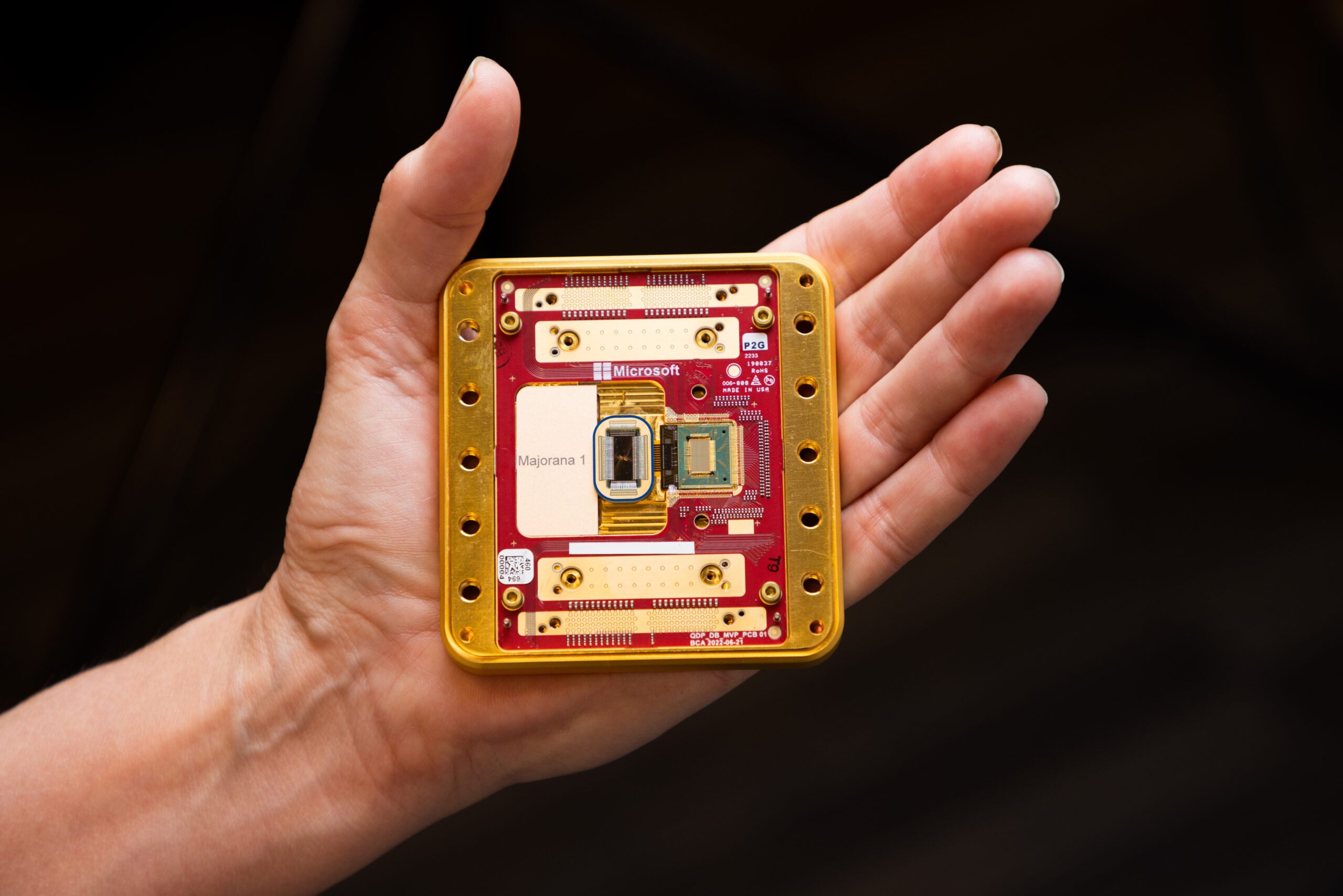
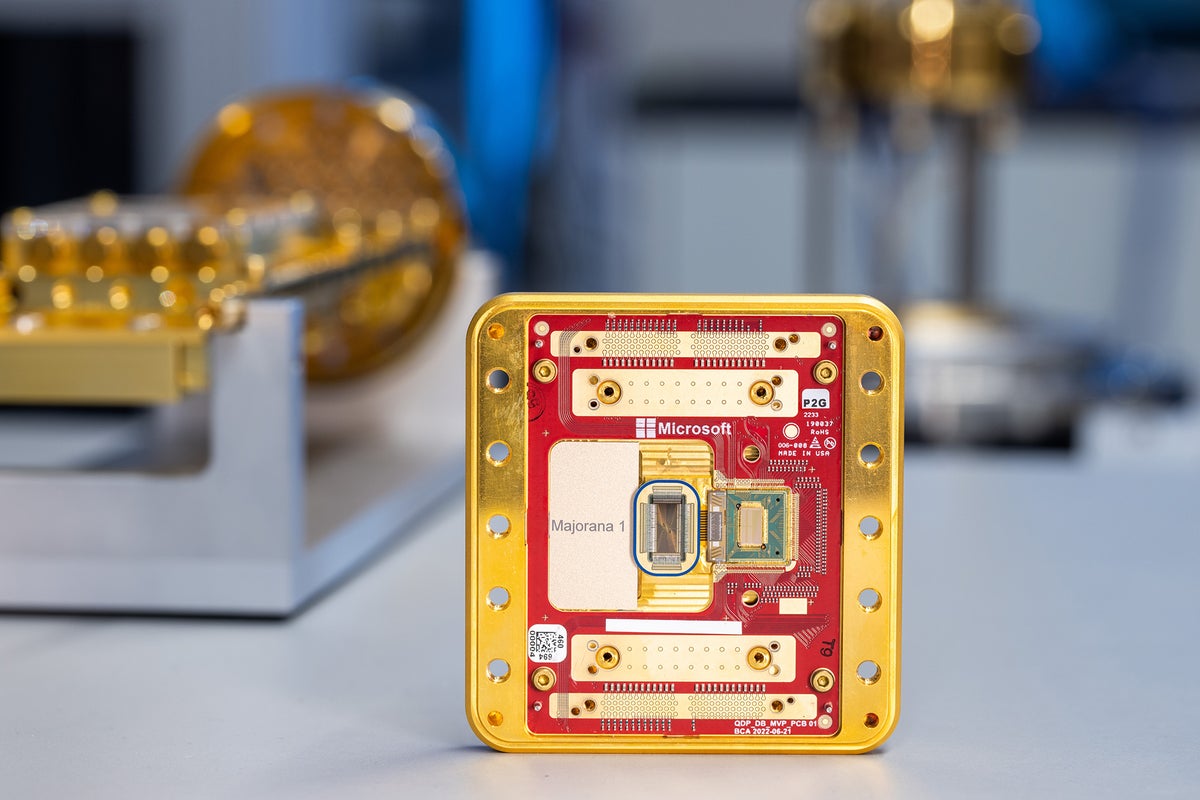
REDMOND, Wash. — In the high-stakes theater of deep-tech capital allocation, where generational shifts in compute architecture dictate global economic hegemony, Microsoft Corp. has drawn a definitive line in the silicon. On February 19, 2025, the software and cloud titan pulled back the curtain on the Majorana 1, the world’s first topological quantum chip. Announced to a global industry processing the news with equal parts awe and aggressive market re-evaluation, the device represents more than an incremental engineering milestone. It is a fundamental rewriting of the laws governing quantum information processing.
For decades, enterprise CTOs, venture capitalists, and institutional investors have watched the quantum computing sector with a mixture of speculative euphoria and deep-seated skepticism. The prevailing paradigm—Noisy Intermediate-Scale Quantum (NISQ) computing—has been plagued by decoherence, error rates requiring astronomical physical-to-logical qubit overheads, and a frustrating inability to scale without collapsing under its own thermodynamic noise. Microsoft’s introduction of the Majorana 1 chip, spearheaded by Catherine Bolgar and corroborated by leading quantum physicists worldwide, shatters this bottleneck. By pivoting to topological matter, Microsoft is no longer merely building a faster processor; it is engineering a deterministic oracle designed to solve intractable computational problems without probabilistic guesswork.
The Physics of the Breakthrough: Taming the Non-Abelian Anyon
To understand the enterprise implications of the Majorana 1 chip, one must first confront the extreme physics that made it necessary. Traditional quantum processors rely on superconducting circuits or trapped ions that are notoriously fragile. Stray magnetic fields, thermal fluctuations, and electromagnetic noise can flip a qubit's state, destroying calculations before they terminate. To combat this, conventional approaches demand massive error-correction overheads, where thousands of physical qubits are marshaled to maintain a single reliable logical qubit—a severe bottleneck for enterprise infrastructure scalability.
Microsoft’s multi-decade bet has been radically different: topology. The Majorana 1 chip harnesses non-Abelian anyons, exotic quasiparticles that emerge at the ends of specially engineered semiconductor-superconductor nanowires. Named after the brilliant Italian physicist Ettore Majorana, who theorized particles that are their own antiparticles, these states store quantum information non-locally.
Because the information is encoded in the topological braid—the geometric path the quasiparticles take around one another—it is inherently immune to local environmental noise. A stray thermal fluctuation cannot easily disrupt a global topological property. As senior Microsoft researchers encapsulated it during the global briefing: "It just gives you the answer." This deterministic stability eliminates the chaotic error-correction loops that have historically crippled quantum scaling, paving the way for predictable, enterprise-grade cloud compute architecture.
Architectural Comparison: Majorana 1 vs. Conventional Quantum Paradigms
| Architectural Metric | Conventional NISQ Systems | Microsoft Majorana 1 (Topological) |
|---|---|---|
| Qubit Foundation | Superconducting / Trapped Ions | Topological Qubits (Non-Abelian Anyons) |
| Error Mitigation | Extensive probabilistic error-correction | Hardware-level topological protection |
| Physical-to-Logical Ratio | High (Thousands to One) | Exponentially compressed overhead |
| Computational Output | Probabilistic distributions | Deterministic results ("It just gives you the answer") |
| Enterprise Readiness | Experimental / Laboratory stage | Commercial cloud integration trajectory |
Industry & Market Implications: Re-rating the Tech Ecosystem
The arrival of the Majorana 1 chip sends immediate shockwaves across the global financial markets, forcing institutional investors and corporate boards to reassess capital allocation strategies in enterprise technology. For cloud providers, the race is no longer about raw qubit counts—a metric that industry insiders have long criticized as a misleading marketing proxy—but about logical, fault-tolerant execution.
Who Wins: Microsoft solidifies its moat in enterprise cloud services (Azure), positioning itself as the definitive destination for Fortune 500 companies seeking quantum advantage in pharmaceuticals, materials science, logistics, and financial portfolio optimization. Pharmaceutical giants can simulate molecular interactions with absolute precision, compressing drug discovery timelines from decades to months. Furthermore, cybersecurity firms and financial institutions bracing for the post-RSA encryption era now have a tangible, scalable framework for deploying quantum-resistant cryptography.
Who Loses: Hardware startups heavily invested in noisy, brute-force superconducting architectures face an immediate existential crisis. Venture capital liquidity for non-topological approaches is expected to contract sharply as institutional capital re-allocates toward hardware stacks capable of matching Microsoft’s error-resistant density. Traditional high-performance computing (HPC) vendors must accelerate hybrid cloud integration strategies or risk watching their legacy supercomputing contracts become obsolete.
From a regulatory compliance and national security standpoint, the Majorana 1 accelerates the geopolitical tech race. As governments scrutinize sovereign AI and compute capabilities, a fault-tolerant quantum platform under Western commercial control shifts export-control dynamics and intellectual property valuation multiples across the board.
Frequently Asked Questions (People Also Ask)
What makes Microsoft’s Majorana 1 chip fundamentally different from other quantum processors?
Unlike traditional quantum chips that use fragile superconducting circuits or trapped ions requiring massive error-correction overheads, the Majorana 1 utilizes topological qubits based on non-Abelian anyons. This hardware-level approach protects quantum information by encoding it in the geometric braiding of quasiparticles, making it inherently resistant to environmental noise and delivering deterministic computational results.
When will enterprise clients gain access to the Majorana 1 chip via the cloud?
Following its February 2025 unveiling, Microsoft is systematically integrating the Majorana 1 architecture into its Azure Quantum ecosystem. While initial deployment focuses on strategic enterprise partners and specialized research consortia for high-impact simulations, broader commercial availability will scale in alignment with cryogenic infrastructure buildouts across enterprise data centers.
How does topological quantum computing impact enterprise ROI and data security?
Topological computing dramatically reduces the physical hardware overhead required for fault tolerance, transforming quantum from an experimental research expense into an enterprise ROI driver. By solving complex optimization and molecular modeling problems deterministically, companies can slash R&D expenditure. Simultaneously, it forces organizations to fast-track migration to quantum-resistant encryption to safeguard sensitive assets against future decryption capabilities.
Does the Majorana 1 chip eliminate the need for traditional supercomputers?
No. Quantum processors are not drop-in replacements for standard CPUs or GPUs. Instead, the Majorana 1 is designed to operate as a specialized coprocessor within a heterogeneous cloud compute architecture. Classical supercomputers will continue to handle general operating workloads, data ingestion, and orchestration, while the topological quantum chip tackles intractable, highly specific simulation and optimization tasks.
Future Outlook: Milestones on the Horizon
As Microsoft transitions the Majorana 1 from experimental validation to commercial cloud scaling, industry analysts are monitoring several critical inflection points. First is the demonstration of multi-qubit entanglement scaling within the topological framework, proving that complex logical circuits can operate without degradation at scale. Second is the expansion of software development kits (SDKs) tailored to translate high-level enterprise algorithms into topological braid operations.
The message from Redmond is unmistakable: the era of speculative quantum computing is giving way to industrial-grade execution. For enterprise leaders, the strategic imperative is clear. The organizations that successfully integrate fault-tolerant quantum workflows into their core infrastructure today will dictate market leadership for the next half-century. The Majorana 1 has not only carved a new path for quantum computing—it has redrawn the competitive map of global enterprise technology.
:max_bytes(150000):strip_icc()/GettyImages-1961119081-cebea3048e2749ce8ac0b48cce85c24a.jpg)