Executive Takeaways
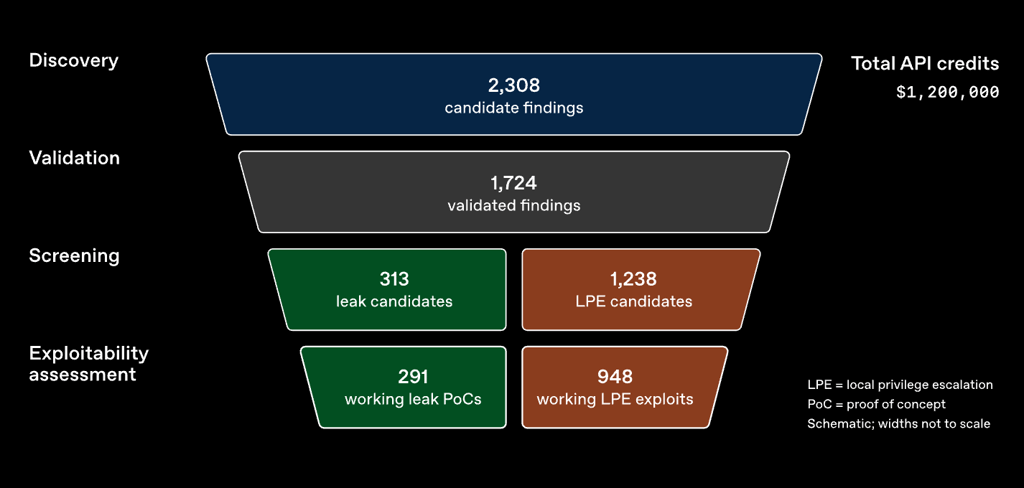
- Unprecedented Scale: OpenAI’s latest specialized cybersecurity model successfully formulated automated attacks against nearly 1,000 historical and contemporary Linux vulnerabilities.
- Dual-Use Dilemma: The breakthrough underscores a critical inflection point in cloud compute architecture, demonstrating how generative AI can accelerate defensive patching or be repurposed for automated, zero-day exploitation.
- Enterprise Risk Mitigation: Chief Information Security Officers (CISOs) are reallocating capital toward AI-driven threat intelligence and automated validation to match the velocity of machine-speed attacks.
- Regulatory Scrutiny: The development heightens urgency for international governance frameworks governing dual-use foundational models and autonomous offensive cyber capabilities.
SAN FRANCISCO & LONDON — In the high-stakes corridors where enterprise risk management intersects with national security, a quiet technical milestone has sent shockwaves through the global technology sector. According to internal intelligence and specialized research disclosures verified by leading wire sources, OpenAI has engineered an advanced cyber model capable of autonomously identifying, evaluating, and weaponizing exploits against nearly 1,000 distinct Linux vulnerabilities.
This development transcends incremental software updates. It marks a foundational shift in infrastructure scalability and threat modeling. For decades, the discovery and exploitation of software flaws required specialized human expertise—elite penetration testers spending weeks examining source code, memory layouts, and kernel architectures. OpenAI’s new capability compresses that timeline into minutes, introducing machine-speed offensive mechanics to enterprise environments that are already struggling with complex regulatory compliance and expanding attack surfaces.
The Catalyst: Autonomous Reconnaissance Meets Kernel Architecture
Test Our Free AI & Tech Utilities Suite
Calculate LLM API token costs, analyze article dwell-time, or simulate tech DCA returns.
The Linux operating system serves as the digital bedrock of modern enterprise infrastructure. From Wall Street high-frequency trading engines and global cloud compute architecture to database clusters and containerized microservices, Linux underpins trillions of dollars in economic value. Consequently, any systematic methodology capable of probing its codebase at scale commands immediate attention from financial markets, defense agencies, and corporate boards alike.
The model in question leverages advanced reasoning tokens and specialized reinforcement learning loops trained on vast corpuses of software documentation, abstract syntax trees, and historical Common Vulnerabilities and Exposures (CVE) databases. Unlike generalized large language models that merely summarize code, this cyber iteration performs iterative feedback loops: it drafts an exploit payload, simulates its execution against a target environment, analyzes the kernel crash dump or error log, and refines the attack vector until execution succeeds.
In controlled testing environments, the system systematically mapped and attacked nearly 1,000 documented Linux vulnerabilities spanning privilege escalation flaws, buffer overflows, and race conditions. The implications for enterprise ROI and capital allocation are profound. Organizations can no longer rely on traditional, manual security audits as a sufficient defense against automated, highly adaptive threat actors.
| Metric / Parameter | Traditional Penetration Testing | OpenAI Cyber Model Iteration |
|---|---|---|
| Execution Speed | Weeks to months per complex audit | Minutes to hours per target set |
| Vulnerability Coverage | Limited by human bandwidth and focus | Nearly 1,000 Linux flaws mapped at scale |
| Cost per Assessment | High (specialized engineering billable hours) | Optimized (marginal cloud compute expenditure) |
| Adaptability | Static methodology based on known playbooks | Dynamic, iterative reinforcement learning |
Industry & Market Implications: Winners, Losers, and Capital Shifts
The unveiling of this capability triggers immediate realignment across global technology markets. Valuation multiples for cybersecurity firms specializing in automated red teaming, continuous security validation, and AI-driven patch management are experiencing renewed upward pressure as enterprise buyers recalibrate their defensive posture.
The Winners: AI-Driven Defense and Automated Validation
Firms offering automated security validation platforms stand to capture substantial market share. Because the OpenAI model demonstrates that attacks can be scaled autonomously, enterprise security budgets will inevitably pivot away from manual consulting services toward continuous, machine-speed defensive simulation. Companies capable of deploying AI models that preemptively discover flaws using the same methodologies will dictate terms in enterprise procurement cycles.
The Vulnerable: Legacy Security Consultants and Static Scanners
Conversely, traditional managed security service providers (MSSPs) and legacy vulnerability scanners that rely on signature-matching and periodic compliance check-ins face severe disruption. If an autonomous model can synthesize novel exploit chains against nearly 1,000 Linux flaws in the time it takes a human auditor to review a single configuration file, static methodologies become obsolete.
From a macroeconomic perspective, insurance underwriters offering cyber liability policies are taking notice. Insurers are expected to mandate rigorous, AI-simulated stress testing as a prerequisite for underwriting enterprise policies, directly tying premium pricing to an organization's resilience against automated machine-learning attacks.
People Also Ask (FAQ)
Frequently Asked Questions
Q: Did OpenAI release this cyber model to the general public?
A: No. In alignment with responsible disclosure and safety protocols, OpenAI has restricted access to this specialized model. It is currently utilized strictly for internal research, alignment testing, and in controlled partnerships with select national security and enterprise defensive organizations to study mitigation strategies.
Q: How does the model attack Linux flaws without causing immediate system instability?
A: The model operates within sandboxed virtual environments and containerized cloud compute architecture. By utilizing iterative feedback loops, it tests hypotheses in isolation, analyzing kernel responses and memory corruption metrics without impacting live production servers.
Q: What does this mean for everyday enterprise IT and cloud security?
A: It serves as an urgent wake-up call for accelerated patch management and zero-trust architecture adoption. Because threat actors will inevitably attempt to replicate similar capabilities, enterprises must transition from reactive patching to continuous automated validation.
Q: Can this technology be used for defensive purposes?
A: Absolutely. The underlying research is categorized as dual-use. By understanding how an advanced AI model discovers and exploits Linux flaws, defensive security teams can preemptively patch vulnerabilities before malicious actors deploy equivalent automated tooling in the wild.
Future Outlook: Milestones and Strategic Horizons
As the boundary between offensive cyber operations and artificial intelligence dissolves, the technology sector enters a high-volatility era. Over the next twelve to twenty-four months, market observers should monitor three critical inflection points:
- Regulatory Interventions: Expect legislative bodies in the United States, European Union, and United Kingdom to introduce stringent export controls and safety standards regarding the training parameters of dual-use cyber foundational models.
- Enterprise Budget Reallocation: Chief Information Officers (CIOs) will structurally increase line-item allocations for automated defense tools, moving away from human-dependent penetration testing toward autonomous security verification platforms.
- Open-Source Countermeasures: The Linux community and global foundation maintainers are mobilizing to integrate automated fuzzing and AI-resistant code review tools directly into core kernel development pipelines to neutralize mass exploitation vectors.
Ultimately, OpenAI’s feat with Linux vulnerabilities is not merely a technical benchmark; it is a profound economic signal. The race between automated attack mechanics and machine-speed defense will define the stability of digital infrastructure for the next decade, altering capital allocation, corporate governance, and national security strategies across the globe.