Executive Takeaways
- Durability as an Asset Class: High-end multitools represent a critical investment in risk mitigation for remote expeditions, trading raw weight for structural longevity and structural integrity.
- Material Science Evolution: Modern camping-specific multitools leverage proprietary 420HC stainless steel, DLC coatings, and replaceable 154CM wire cutters to maximize operational uptime.
- Portfolio Diversification: Selecting the correct hardware requires aligning toolsets—ranging from minimalist backpacker loadouts to heavy-duty basecamp infrastructure tasks—with specific environmental exposures.
In the calculus of backcountry preparedness, equipment failure is not merely an inconvenience; it is a direct threat to mission continuity. Whether executing a multi-week wilderness survey or establishing a high-altitude basecamp, the modern outdoor enthusiast approaches gear selection with the rigorous discipline of portfolio management. Every ounce carried incurs an energy tax, and every tool selected must justify its allocation of pack space through proven utility, infrastructure scalability, and absolute reliability.
For decades, Oregon-based Leatherman Tool Group has dominated this sector, transforming utilitarian pocket hardware into indispensable field instruments backed by an iconic 25-year warranty. As supply chain volatility, raw material cost fluctuations, and shifting consumer demands redefine the outdoor equipment market, identifying the optimal hardware requires peeling back marketing hyperbole to evaluate raw engineering, metallurgical specifications, and real-world performance metrics. Below is our definitive investigative breakdown of the five best Leatherman multitools engineered specifically for camping, survival, and remote operations.
1. Leatherman Signal: The Ultimate Backcountry Survivalist Instrument
Test Our Free AI & Tech Utilities Suite
Calculate LLM API token costs, analyze article dwell-time, or simulate tech DCA returns.
Engineered explicitly for the demands of off-grid exploration, the Leatherman Signal bridges the gap between conventional utility hardware and specialized wilderness survival gear. Weighing in at 7.5 ounces (212.6 grams) with a closed length of 4.5 inches, the Signal packs 19 distinct tools into a compact, anodized aluminum and stainless-steel chassis.
What separates the Signal from traditional urban-centric multitools is its intentional inclusion of survival-specific ancillaries: a removable ferrocerium fire-starting rod, a 121dB emergency whistle, and a diamond-coated sharpener designed for serrated and straight-edge blades alike. The inclusion of a hammer surface on the pommel allows campers to drive tent stakes or construct improvised shelters with maximum efficiency, reducing the need to pack secondary dead-blow tools.
From a metallurgical perspective, the Signal utilizes 420HC stainless steel for its primary blades, offering an optimal balance of corrosion resistance and ease of field-sharpening. While the multi-material construction introduces minor points of flex under extreme torsional load, its targeted feature set makes it the premier choice for backpackers and mountaineers operating in high-risk environments where risk mitigation is paramount.
2. Leatherman Wave Plus: The Industry Gold Standard for Versatility
No evaluation of portable hardware is complete without examining the Leatherman Wave Plus, the undisputed volume leader and commercial benchmark of the multitool industry. For decades, the Wave has served as the baseline against which all competitors are measured, favored by everyone from aerospace engineers to backcountry outfitters.
The Wave Plus features 18 locking tools, accessed via an exterior-accessible blade design that allows operators to deploy the knife, saw, file, or serrated blade one-handed without opening the primary pliers. The inclusion of replaceable wire cutters—a critical upgrade from earlier legacy iterations—ensures that heavy-use components can be swapped out in the field using a standard Torx driver, significantly extending the lifecycle of the capital investment.
Weighing 8.5 ounces, the Wave Plus strikes an ideal balance between heavy-duty capability and pocket-knife portability. Its robust plier heads feature both regular and needle-nose configurations alongside hard-wire cutters, making short work of guy-line adjustments, stove repairs, and camp kitchen modifications. For the generalist camper who demands absolute reliability across a diverse spectrum of tasks, the Wave Plus remains the most cost-effective, high-yield asset in the portfolio.
3. Leatherman Charge Plus TTI: The Premium Flagship for Elite Expeditions
For institutional buyers and discerning outdoor professionals who refuse to compromise on material quality, the Leatherman Charge Plus TTI represents the absolute pinnacle of manufacturing capability. Building upon the structural architecture of the Wave, the Charge TTI elevates the user experience through the integration of aerospace-grade materials.
The defining characteristic of the TTI is its handle scales, forged from lightweight, highly corrosion-resistant titanium. This material choice reduces hand fatigue during extended use while providing an exceptionally secure grip, even when wet or caked in mud. Furthermore, the primary clip-point blade is upgraded to CPM S30V powder metallurgy stainless steel. This high-end alloy delivers superior edge retention and wear resistance, meaning the blade requires significantly less frequent maintenance in deep-field conditions.
Boasting 19 tools, including a cutting hook for cordage and strapping, scissors, a large bit driver with an assortment of dual-end bits, and a wood/metal file, the Charge TTI commands a premium valuation. However, for expeditions where weight savings, corrosion resistance, and uncompromising cutting performance dictate success, the TTI is unmatched.
4. Leatherman Free P4: The Ergonomic Masterclass for Rapid Deployment
Addressing the mechanical friction inherent in traditional folding multitools, Leatherman engineered the Free P4 around a proprietary magnetic architecture. Rather than relying on traditional nail nicks and lock-backs that require two hands or broken fingernails, the Free P4 utilizes magnetic locking mechanisms to keep tools securely stowed while allowing effortless, one-handed, thumb-actuated deployment of every single implement.
Weighing 8.6 ounces and featuring 21 distinct tools, the P4 is designed for maximum operational fluidity. All tools open from the outside of the chassis, meaning the user never has to unfold the pliers to access a knife blade, can opener, or pair of spring-action scissors. The inclusion of newly engineered V-notch wire cutters and a robust saw blade makes clearing brush and preparing firewood remarkably efficient.
From a human-factors engineering standpoint, the Free P4 reduces operational friction to near zero. While the magnetic system adds a fraction of width to the profile, the tactile feedback and speed of deployment make it a favorite among wilderness guides and overlanding enthusiasts who value instantaneous response times.
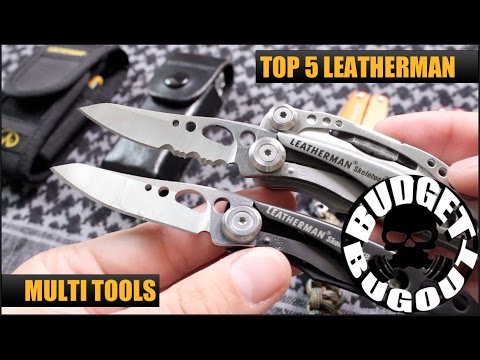
5. Leatherman Skeletool CX: The Minimalist Ultralight Specialist
For the purist backpacker adhering to ultralight methodologies, traditional multitools present an unacceptable weight penalty. Enter the Leatherman Skeletool CX, a stripped-down, high-performance hardware solution that eliminates superfluous features to focus exclusively on core survival mechanics.
Weighing a mere 5.0 ounces, the Skeletool CX strips away the chassis bulk, utilizing a skeletonized stainless-steel frame with a carbon-fiber handle insert to maximize strength-to-weight ratios. It dispenses with secondary saws, files, and awls, retaining only a heavy-duty set of pliers, standard and hard-wire cutters, a carabiner/bottle opener, a large bit driver, and a premium 154CM stainless steel knife blade.
The 154CM blade is hollow-ground and exceptionally sharp out of the box, capable of handling intricate food preparation, feather-stick generation, and cordage cutting with surgical precision. By jettisoning dead weight while retaining structural integrity at critical stress points, the Skeletool CX provides essential enterprise-level utility without burdening the minimalist traveler.
Verified Data & Specifications Breakdown
| Model | Weight (oz / g) | Primary Blade Steel | Tool Count | Standout Feature | Target Operational Profile |
|---|---|---|---|---|---|
| Leatherman Signal | 7.5 oz / 212.6 g | 420HC Stainless Steel | 19 | Ferro rod, emergency whistle, hammer pommel | Backcountry survival & mountaineering |
| Leatherman Wave Plus | 8.5 oz / 241.0 g | 420HC Stainless Steel | 18 | Replaceable wire cutters, exterior-access blades | General camping & multi-use utility |
| Leatherman Charge TTI | 8.8 oz / 252.0 g | CPM S30V & 420HC | 19 | Titanium handles, S30V premium blade | Elite expeditions & professional guides |
| Leatherman Free P4 | 8.6 oz / 243.8 g | 420HC Stainless Steel | 21 | Magnetic architecture for one-handed opening | Rapid deployment & ergonomic efficiency |
| Leatherman Skeletool CX | 5.0 oz / 142.0 g | 154CM Stainless Steel | 7 | Ultralight skeletonized frame, carbon fiber insert | Ultralight backpacking & minimalist travel |
Industry & Market Implications
The surging consumer demand for premium outdoor hardware reflects broader shifts in macroeconomic consumer behavior. As post-pandemic outdoor recreation numbers stabilize into permanent lifestyle choices, consumers are increasingly viewing durable goods through an investment lens. Rather than purchasing disposable, low-cost imported alternatives that fail under stress, buyers are allocating capital toward buy-it-for-life (BIFL) assets backed by robust warranties.
This consumer trend has profound implications for supply chain logistics, precision manufacturing, and regulatory compliance. Leatherman’s commitment to domestic manufacturing in Portland, Oregon, insulates its primary product lines from overseas shipping bottlenecks, though it exposes the enterprise to domestic labor cost inflation and raw material pricing pressures—particularly in specialized alloys like CPM S30V and titanium.
Competitively, legacy brands face ongoing margin compression from low-cost direct-to-consumer imports. However, market liquidity remains heavily concentrated in heritage brands that maintain strict quality control, proprietary metallurgy, and frictionless warranty redemption protocols. For retailers and outfitters, stocking tier-one multitools serves as a high-margin anchor category that drives foot traffic and cross-sales in adjacent outdoor infrastructure segments.
Frequently Asked Questions (People Also Ask)
1. Which Leatherman multitool is best for emergency fire starting and wilderness survival?
The Leatherman Signal is specifically engineered for this use case. It integrates a removable ferrocerium rod for ignition, a diamond-coated sharpener for blade maintenance, and a safety whistle into the chassis, making it the premier option for off-grid survival scenarios.
2. Can Leatherman multitools be legally carried while camping or hiking?
In most wilderness, camping, and remote hiking contexts, carrying a multitool is entirely legal and considered standard equipment. However, legal compliance varies significantly depending on local municipal ordinances, national park regulations, and international travel laws. Users should verify local blade-length restrictions and locking-mechanism laws before crossing state or national boundaries.
3. Are replaceable wire cutters actually necessary for camping use?
Yes. Heavy-use components like wire cutters are prone to micro-chipping and dulling when cutting hardened metals, fencing, or thick galvanized wire often encountered around established campsites. Tools featuring replaceable cutters (such as the Wave Plus, Signal, and Charge TTI) allow operators to restore factory-fresh performance in minutes using basic hardware, avoiding the need to replace the entire tool.
4. How does the Leatherman Free P4 differ mechanically from the traditional Wave Plus?
The primary divergence lies in the deployment mechanism. While the Wave Plus relies on conventional nail nicks and internal folding pivots, the Free P4 utilizes a patented magnetic architecture that eliminates friction. This allows every tool to be opened easily with one thumb, dramatically improving operational speed and ergonomics in cold or wet weather.
Future Outlook & Key Milestones
Looking ahead, the evolution of portable wilderness hardware will be defined by advancements in materials science, additive manufacturing integration, and weight-reduction engineering. As consumer appetite for hyper-specialized gear grows, we anticipate further market segmentation between ultralight digital nomads and heavy-duty expedition outfitters.
Key industry milestones to watch over the next 24 to 36 months include:
- Metallurgical Innovations: The broader commercial rollout of next-generation powdered steels and ceramic composites designed to enhance edge retention while drastically reducing tool weight.
- <Sustainable Manufacturing Initiatives: Increased regulatory scrutiny and corporate commitments to utilizing recycled structural steels and conflict-free titanium alloys.
- Modular Ecosystem Expansion: The development of customizable, swappable tool modules that allow users to tailor their hardware loadouts dynamically based on specific seasonal missions.
Ultimately, investing in a premier Leatherman multitool is an exercise in disciplined risk mitigation. By matching the correct metallurgical profile and toolset to your specific operational environment, you ensure that when conditions deteriorate in the field, your equipment remains an unwavering asset.