The AI Lead Evaporates: 12 Defining Takeaways from Stanford’s 2026 Index That Change the Global Tech Race
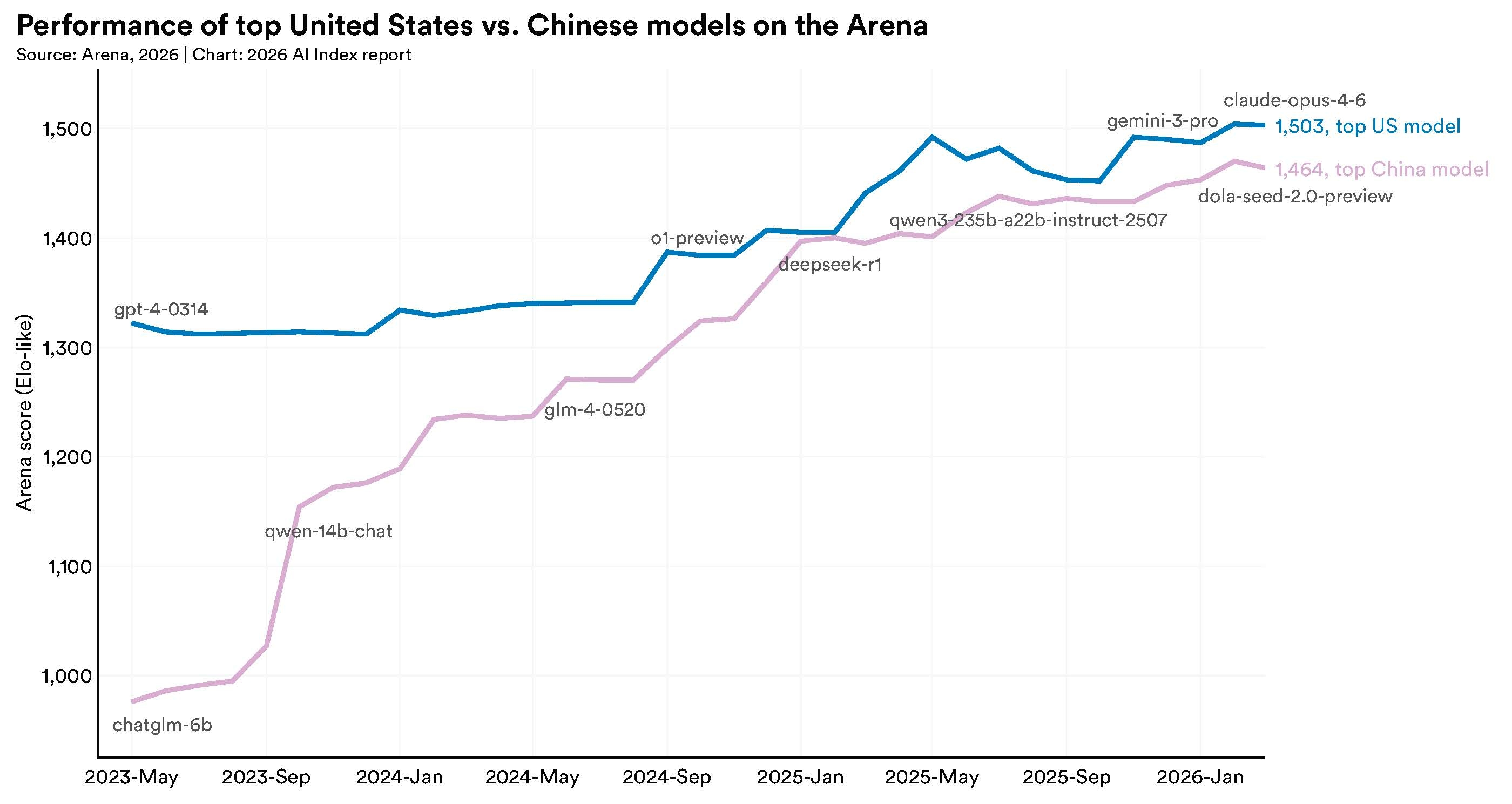
WASHINGTON — The geopolitical and technological bedrock of the artificial intelligence boom has officially fractured. According to the landmark 2026 AI Index Report released by Stanford University’s Human-Centered Artificial Intelligence (HAI) institute, the unassailable technological lead once held by the United States is rapidly evaporating. As power-hungry foundation models push global energy grids to their absolute breaking point, the race for artificial intelligence supremacy has entered a hyper-competitive, volatile new era.
Published in April 2026, this year's comprehensive industry benchmark serves as an urgent wake-up call for policymakers, corporate boardrooms, and Wall Street investors. The findings lay bare a shifting landscape where America's traditional gravitational pull for top-tier global AI talent is fading, even as frontier models achieve stunning breakthroughs in complex scientific reasoning—such as mastering advanced mathematics.
The Shifting Global Order: Key Structural Shifts
For years, the narrative surrounding the artificial intelligence revolution was defined by American exceptionalism, backed by unmatched venture capital and massive compute clusters. The 2026 AI Index report upends that narrative. The data reveals that international competitors, most notably China, have successfully closed the capability gap, matching U.S. model performance across multiple critical benchmarks while scaling domestic infrastructure at a staggering pace.
Furthermore, the report highlights a quiet crisis within the American talent ecosystem. For the past decade, the U.S. has served as the undisputed global magnet for the brightest minds in machine learning and neural network architecture. That magnetic pull is now weakening due to rising geopolitical friction, competitive domestic tech ecosystems abroad, and shifting immigration policies. As global talent increasingly chooses to innovate closer to home, the intellectual monopoly long enjoyed by Silicon Valley is dissolving.
Executive Summary: The 12 Vital Takeaways
- The U.S. Lead Evaporates: The historical performance gap between American frontier models and international competitors has effectively closed.
- America's Global Draw Fades: The U.S. is losing its monopoly on top-tier international AI research talent as foreign ecosystems mature.
- Power-Hungry Architectures: Next-generation models demand unprecedented electrical loads, turning data center energy procurement into a C-suite emergency.
- Mathematical Milestones: Frontier AI systems can now independently conceptualize and solve complex, novel mathematical proofs.
- The Compute Bottleneck: Silicon supply chains and grid infrastructure are now the primary constraints on enterprise AI deployment.
- Commercialization Maturation: Businesses are moving past experimental proof-of-concepts into ruthless operational efficiency ROI tracking.
- Regulatory Fragmentation: A patchwork of global compliance mandates is replacing unified international safety standards.
- Open-Source Resilience: Open-weight models continue to democratize advanced capabilities, challenging proprietary walled gardens.
- The Cost-Performance Curve: Inference costs are plummeting even as training costs skyrocket to historic highs.
- Workforce Integration: Labor market disruptions are shifting from speculative job loss fears to active skill-reskilling mandates.
- Scientific Acceleration: AI is no longer just a productivity tool; it is acting as an autonomous co-scientist in biology and material science.
- Investment Realism: Venture capital funding has grown more disciplined, prioritizing tangible unit economics over speculative hype.
The Energy Crisis and Economic Realities
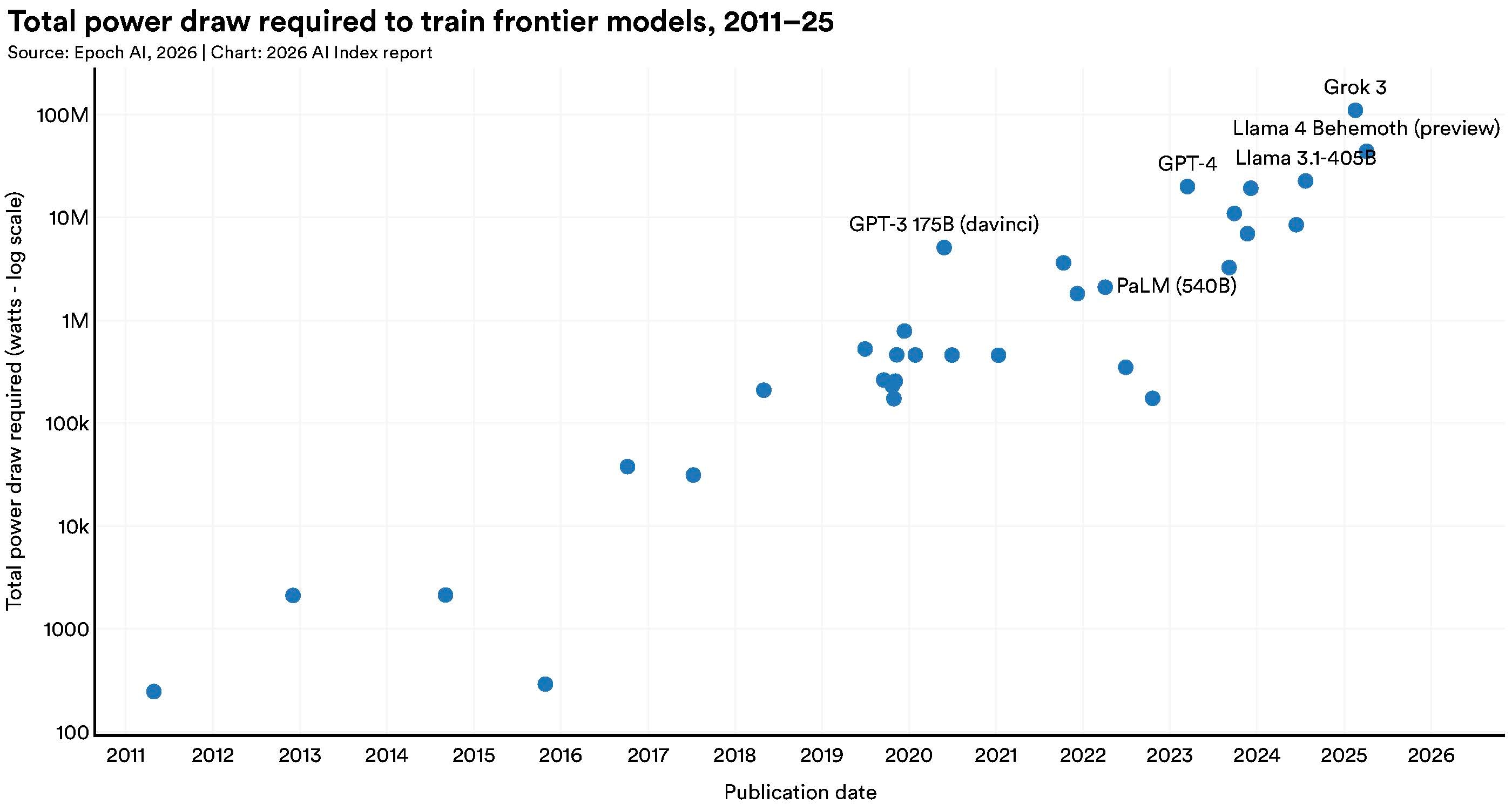
Perhaps the most immediate commercial warning sign embedded in the 2026 report is the insatiable appetite of modern AI infrastructure. Described by analysts as "power-hungry models," current generation architectures require megawatt-scale power supplies that are pushing regional electrical grids to the brink. Tech giants are increasingly forced to broker direct deals with nuclear, geothermal, and renewable energy providers just to keep their training clusters online.
At the same time, the economics of AI are bifurcating. While the upfront capital expenditure required to train frontier models continues to climb into the billions of dollars, the cost of running inference—serving queries to end-users—is dropping precipitously. This dynamic is forcing software companies to rapidly transition from growth-at-all-costs strategies to hyper-focused monetization models.
| Metric / Indicator | 2024 Benchmark | 2026 Index Report Reality | Strategic Impact |
|---|---|---|---|
| U.S. vs. Global Performance Gap | Dominant U.S. Lead | Lead Effectively Evaporated | Intensified geopolitical tech competition |
| Global Talent Attraction | High U.S. Influx | Draw Fading / Decentralizing | Rise of multi-polar research hubs |
| Model Energy Consumption | High Growth | Grid-Straining Power Demand | Mandatory pivot to private energy infrastructure |
| Mathematical Reasoning | Experimental | Advanced Proof Mastery | Acceleration of automated scientific discovery |
What This Means for Markets and Policy
As Stanford HAI’s findings make clear, the artificial intelligence landscape of 2026 is infinitely more complex, competitive, and resource-constrained than it was even two years ago. For Wall Street, the era of rewarding any company simply for uttering the phrase "artificial intelligence" is over. Investors are now scrutinizing balance sheets for energy access, regulatory compliance, and verifiable productivity gains.
For policymakers in Washington and Brussels, the message is equally stark. Protectionist measures alone will not maintain technological dominance. Securing America's future in the AI era will require aggressive investments in national electrical grid modernization, proactive immigration reforms to retain global talent, and streamlined frameworks that foster innovation without compromising national security.
Frequently Asked Questions
What is the Stanford AI Index Report?
Published annually by Stanford University’s Human-Centered Artificial Intelligence (HAI) institute, the AI Index is widely regarded as the definitive data-driven benchmark tracking trends, technical advancements, economic impacts, and geopolitical shifts in global artificial intelligence.
Why is the U.S. AI lead considered to be evaporating in 2026?
The 2026 report highlights that international competitors—particularly in China—have closed the performance gap on frontier models, while the U.S. experiences a cooling in its ability to attract and retain elite global research talent.