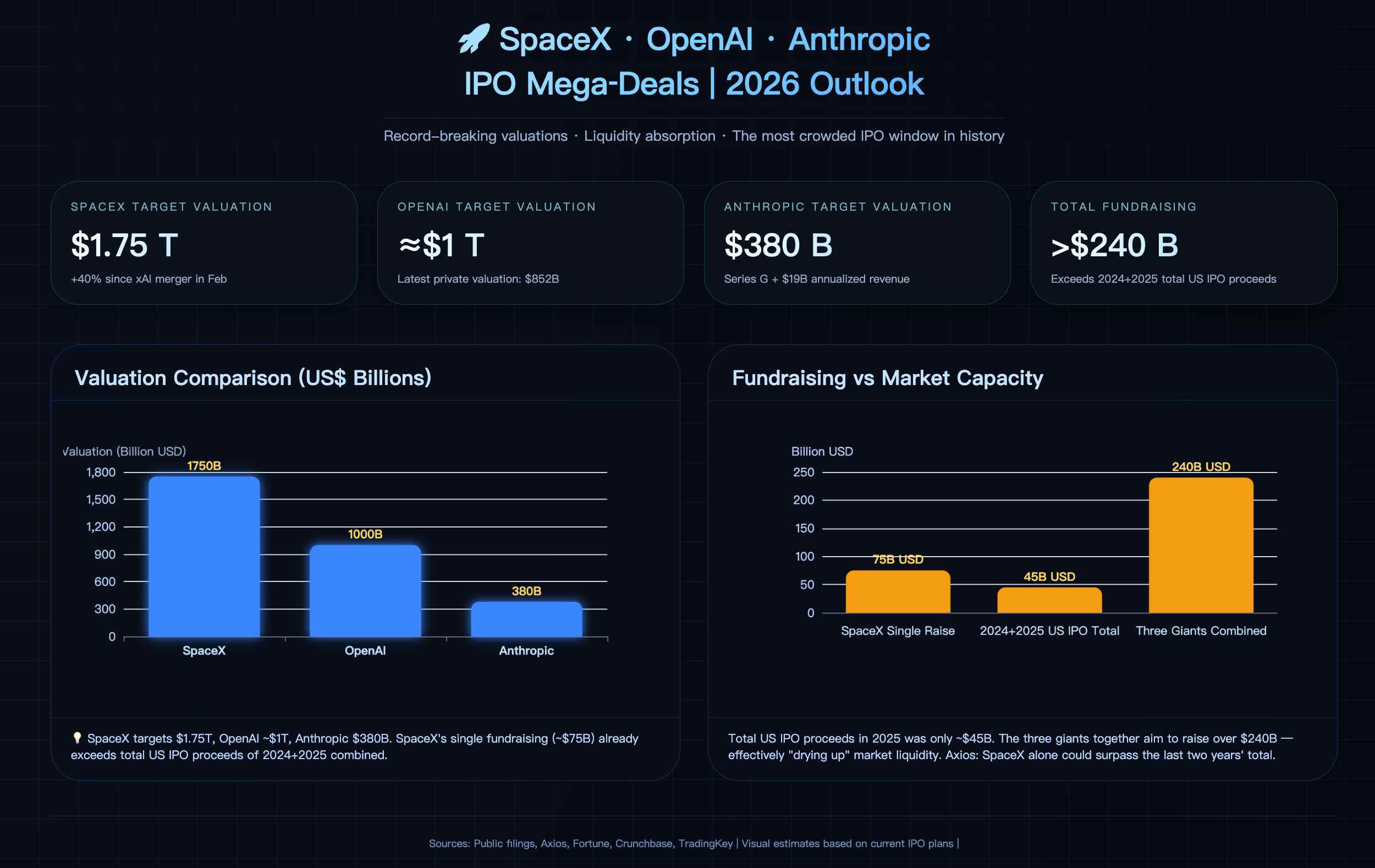
Executive Takeaways
- Valuation Grounding: Private secondary market transactions and early syndicate discussions peg Anthropic's prospective public market capitalization between $1.1 trillion and $1.5 trillion, signaling a pragmatic adjustment by institutional buyers.
- Capital Allocation Realities: The massive capital expenditure required for cloud compute architecture and frontier model training is forcing investors to scrutinize enterprise ROI and infrastructure scalability.
- Competitive Pressure: Pitted directly against OpenAI, Google, and Microsoft-backed ecosystems, Anthropic must prove sustainable monetization models beyond API consumption to justify twelve-figure valuation multiples.
- Regulatory & Governance Scrutiny: As a Public Benefit Corporation (PBC), Anthropic's unique corporate governance structure adds a layer of complexity for institutional asset managers evaluating long-term risk mitigation.
NEW YORK & SAN FRANCISCO — In the high-stakes corridors of institutional asset management, a quiet reassessment is underway regarding the imminent public offering of artificial intelligence pioneer Anthropic. While early private round whispers floated astronomical sums, fresh intelligence from secondary market desks and institutional syndicate participants reveals a more grounded reality: sophisticated buyers are aggressively pricing Anthropic shares at a valuation floor as low as $1.1 trillion.
This valuation discourse marks a pivotal inflection point in the generative AI super-cycle. As Wall Street underwriters prepare prospectuses and sovereign wealth funds weigh massive capital allocation strategies, the euphoria of unchecked model-scaling metrics is giving way to rigorous financial modeling. Institutional allocators are no longer simply buying the promise of artificial general intelligence (AGI); they are auditing cloud infrastructure burn rates, enterprise software adoption curves, and the brutal economics of frontier model training.
The Catalytic Shift: From Private Euphoria to Public Discipline
Test Our Free AI & Tech Utilities Suite
Calculate LLM API token costs, analyze article dwell-time, or simulate tech DCA returns.
Founded in 2021 by former high-ranking executives from OpenAI—including Dario and Daniela Amodei—Anthropic rapidly ascended to the upper echelon of generative AI developers through its flagship Claude model family. Backed by strategic injections from technology behemoths including Amazon and Google, the company positioned itself as an enterprise-grade alternative distinguished by its "Constitutional AI" safety framework and rigorous alignment research.
However, scaling frontier models demands staggering sums of capital. Training the next generation of foundational architecture requires billions of dollars in specialized silicon, sprawling data center real estate, and unprecedented electrical power consumption. To fund this relentless expansion, Anthropic’s leadership has faced mounting pressure from early venture capital backers seeking liquidity events, setting the stage for what is expected to be one of the largest technology IPOs in history.
Yet, as institutional asset managers run due diligence on pre-IPO allocations, a valuation disconnect has emerged. While retail sentiment and venture-stage exuberance previously tossed around figures approaching $2 trillion, institutional buyers anchoring the IPO book are utilizing strict valuation multiples tied to software-as-a-service (SaaS) efficiency metrics, gross margin trajectories, and projected free cash flow generation. Consequently, early indications from private share transfers and institutional book-building conversations have established a realistic valuation range spanning from $1.1 trillion to $1.5 trillion.
Financial Architecture and Valuation Metrics Breakdown

To understand how institutional desks arrived at the $1.1 trillion baseline, one must examine the fundamental economics governing modern foundational AI laboratories. Unlike traditional software enterprises characterized by near-zero marginal costs of distribution, frontier AI model providers operate heavy industrial-scale cloud compute operations.
| Metric / Parameter | Aggressive Market Projections | Conservative Institutional Baseline |
|---|---|---|
| Prospective Valuation Range | ||
| Revenue Multiple | 45x – 60x Forward ARR | 20x – 30x Forward ARR |
| Compute Capital Expenditure | Subsidized by Strategic Cloud Partners | Direct Balance Sheet & Debt Financing Burden |
| Enterprise ROI Timeline | Immediate Hyper-Growth Adoption | Extended Sales Cycles & Integration Drag |
The comparative data highlights the structural tension within the syndicate. Asset managers demanding the $1.1 trillion floor point to the accelerating cost of tensor processing units (TPUs) and graphics processing units (GPUs), alongside the intense pricing pressure exerted by open-source model ecosystems and well-capitalized hyperscalers. Conversely, bulls arguing for the upper bound emphasize Anthropic's dominant market share in regulated verticals—such as financial services, healthcare, and legal tech—where Claude's safety guarantees and context window capabilities command premium enterprise pricing.
Industry & Market Implications: Winners and Losers
The resetting of Anthropic’s valuation expectations carries profound repercussions across the broader technology and financial landscapes:
- Enterprise Buyers Win on Pricing Power: As AI companies face stricter valuation guardrails, they are incentivized to offer more competitive enterprise software licensing terms and customized API contracts to secure predictable recurring revenue.
- Venture Capital Liquidity Squeeze: Early-stage venture funds holding pre-seed and Series A/B positions may find their internal rate of return (IRR) calculations compressed if public markets refuse to reward high-multiple speculative premiums.
- Cloud Infrastructure Providers Retain Leverage: Because Anthropic relies heavily on massive cloud compute architecture partners like Amazon Web Services (AWS) and Google Cloud, a moderated valuation reinforces the symbiotic—yet dependent—nature of these corporate alliances.
- Regulatory & Governance Pioneers: Anthropic’s corporate structure as a Public Benefit Corporation means institutional investors must balance fiduciary duty to shareholders against adherence to ethical AI deployment mandates, a dynamic that will be closely monitored by ESG-focused funds.
Frequently Asked Questions (People Also Ask)
Why are institutional buyers pricing Anthropic as low as $1.1 trillion?
Institutional buyers are applying traditional valuation multiples to forward-looking Annual Recurring Revenue (ARR) while factoring in the immense, ongoing capital expenditures required for cloud compute architecture and frontier model training. This risk-mitigation strategy protects portfolios from overexposure to high-burn technology assets.
How does Anthropic’s valuation compare to other foundational AI competitors?
While private secondary market valuations fluctuate rapidly across the sector, Anthropic's pricing aligns closely with the capital intensity and enterprise adoption rates seen across other tier-one generative AI labs. Valuation multiples are increasingly tied to audited enterprise ROI rather than raw parameter counts or speculative consumer usage.
What impact will the IPO have on Anthropic’s cloud partnerships with AWS and Google?
The IPO is expected to formalize Anthropic’s market standing while providing the independent balance sheet liquidity necessary to service massive enterprise contracts. Strategic cloud partnerships will remain critical for infrastructure scalability, though public market transparency will demand clearer visibility into profit margins.
Is Anthropic’s Public Benefit Corporation (PBC) status affecting institutional investor appetite?
Yes. While ESG-oriented funds view the PBC structure favorably for its commitment to safety and ethical AI development, some traditional asset managers must navigate complex governance bylaws that balance shareholder primacy with long-term public benefit mandates.
Future Outlook: Milestones to Watch
As the IPO timeline crystallizes, market watchers must monitor several critical milestones. First, the formal filing of the S-1 prospectus with the U.S. Securities and Exchange Commission (SEC) will provide the definitive audited financial statements required to evaluate gross margins, customer concentration, and research expenditures. Second, the composition of the anchor investor syndicate will signal whether sovereign wealth funds and tier-one mutual fund families are willing to underwrite the $1.1 trillion to $1.5 trillion valuation band.
Ultimately, Anthropic’s public market debut will serve as a definitive litmus test for the entire generative AI sector. It will answer whether Wall Street views frontier AI as an indefinitely subsidized research endeavor or as a mature, cash-generative industrial utility capable of commanding elite multi-trillion-dollar valuations in a normalized interest rate environment.