Executive Takeaways
- Architectural Leap: LMSYS Org’s landmark May 2025 deployment blueprint demonstrates how combining Prefill-Decoding (PD) Disaggregation with large-scale Expert Parallelism unlocks unprecedented efficiency for DeepSeek on a cluster of 96 NVIDIA H100 GPUs.
- Compression of Capital Expenditure: By maximizing GPU memory bandwidth and mitigating communication bottlenecks inherent in Mixture-of-Experts (MoE) routing, enterprises can achieve high-throughput inference at a fraction of traditional hardware footprints.
- Market Valuation & ROI Shift: Software-level orchestration is rapidly decoupling model performance from raw hardware accumulation, forcing hyperscalers and venture-backed AI labs to re-evaluate their long-term capital allocation strategies.
- Operational Risk Mitigation: The shift toward disaggregated serving architectures neutralizes memory fragmentation risks, allowing production-grade deployments to scale under heavy enterprise concurrent workloads without catastrophic latency spikes.
The global race for artificial intelligence dominance has long been framed as an unrelenting war of attrition fought with balance sheets. For the past three years, the prevailing consensus across Wall Street and Silicon Valley was straightforward: market leadership belonged to whichever enterprise could accumulate, power, and amortize the largest clusters of capital-intensive NVIDIA graphics processing units. That foundational dogma suffered a structural fracture following a definitive operational disclosure from LMSYS Org.
Released on May 5, 2025, the research and engineering breakdown titled "Deploying DeepSeek with PD Disaggregation and Large-Scale Expert Parallelism on 96 H100 GPUs" laid bare a technical blueprint that fundamentally alters the cost-performance curve of frontier-class large language models (LLMs). By marrying Prefill-Decoding (PD) Disaggregation with hyper-optimized Expert Parallelism across a modest footprint of 96 NVIDIA H100 accelerators, the deployment methodology bypasses the traditional brute-force scaling laws that have inflated cloud compute architecture budgets into the tens of billions of dollars. For Chief Information Officers, enterprise risk officers, and technology investors, understanding this deployment paradigm is no longer optional—it is the prerequisite for calculating accurate enterprise ROI in the post-hyperscale era.
The Catalytic Shift: Dismantling the Monolithic Serving Bottleneck
Test Our Free AI & Tech Utilities Suite
Calculate LLM API token costs, analyze article dwell-time, or simulate tech DCA returns.
To grasp the economic and technical significance of the LMSYS Org deployment framework, one must examine the operational failures of legacy, monolithic LLM serving architectures. Historically, when a user queries an enterprise-grade model, a single instance or a tightly coupled group of GPUs handles both the prefill phase (processing and ingesting the input prompt) and the decoding phase (autoregressively generating the output tokens one by one).
These two phases possess fundamentally incompatible computational signatures. The prefill phase is heavily compute-bound and demands massive parallel tensor operations, whereas the decoding phase is notoriously memory-bandwidth-bound, leaving arithmetic logic units (ALUs) largely underutilized while waiting to fetch large key-value (KV) cache weights from high-bandwidth memory (HBM). When running Mixture-of-Experts (MoE) architectures like DeepSeek—where incoming tokens are dynamically routed to specific subsets of neural network parameters—this monolithic approach creates severe load imbalances, memory fragmentation, and pipeline bubbles.
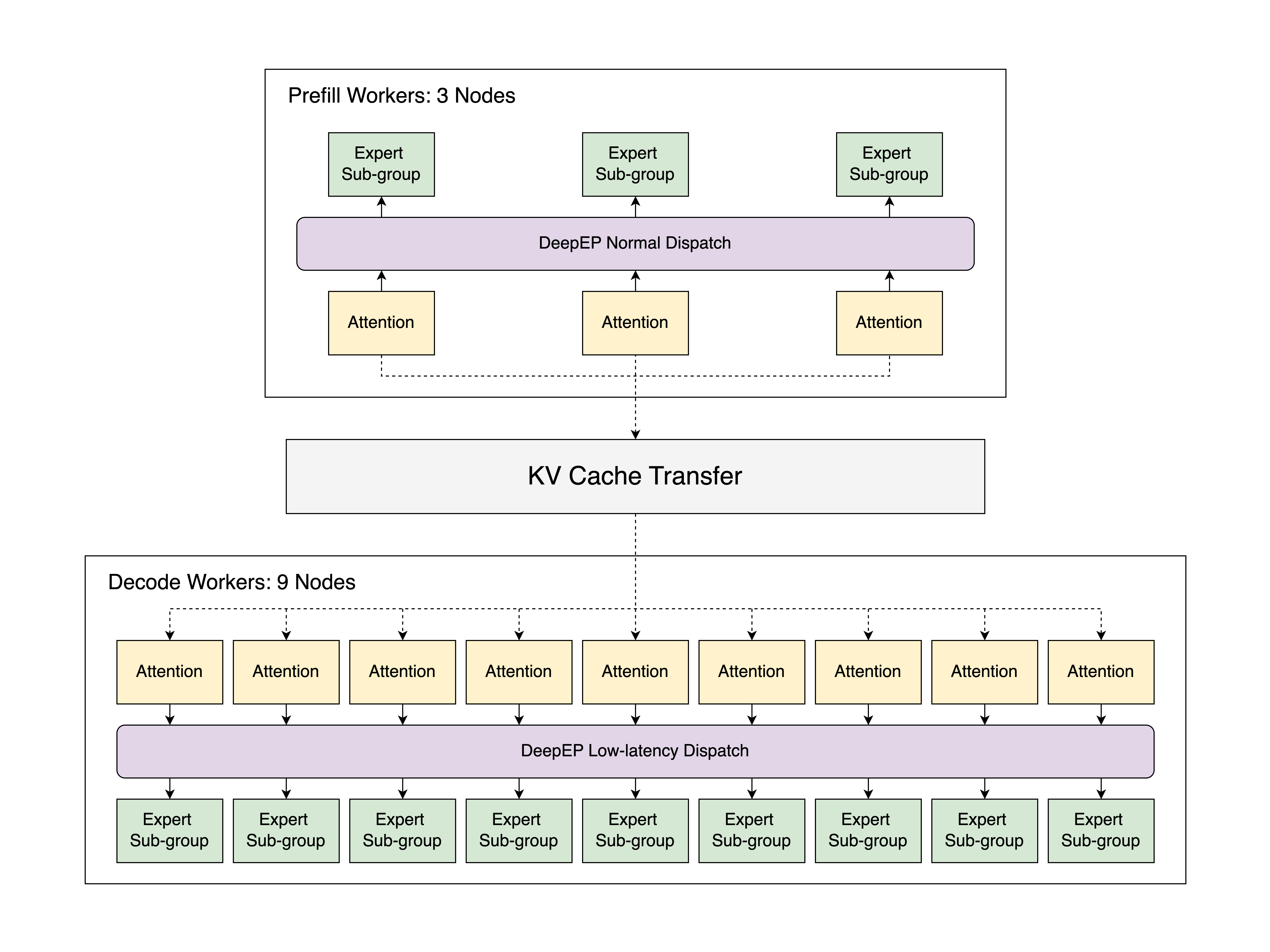
The May 2025 breakthrough resolves this inefficiency through PD Disaggregation. By physically and logically separating the prefill compute nodes from the decoding compute nodes, the system ensures that hardware is precisely provisioned for its specific workload profile. Prefill nodes are optimized for raw compute throughput and massive parallelism, while decoding nodes are configured to maximize memory bandwidth and minimize latency for token generation. Coupled with large-scale Expert Parallelism (EP) across 96 H100 GPUs, the framework shards the massive MoE parameter space efficiently across NVLink domains, preventing any single GPU from becoming an inter-node communication bottleneck.
Anatomy of the 96-GPU Blueprint: Technical Specifications
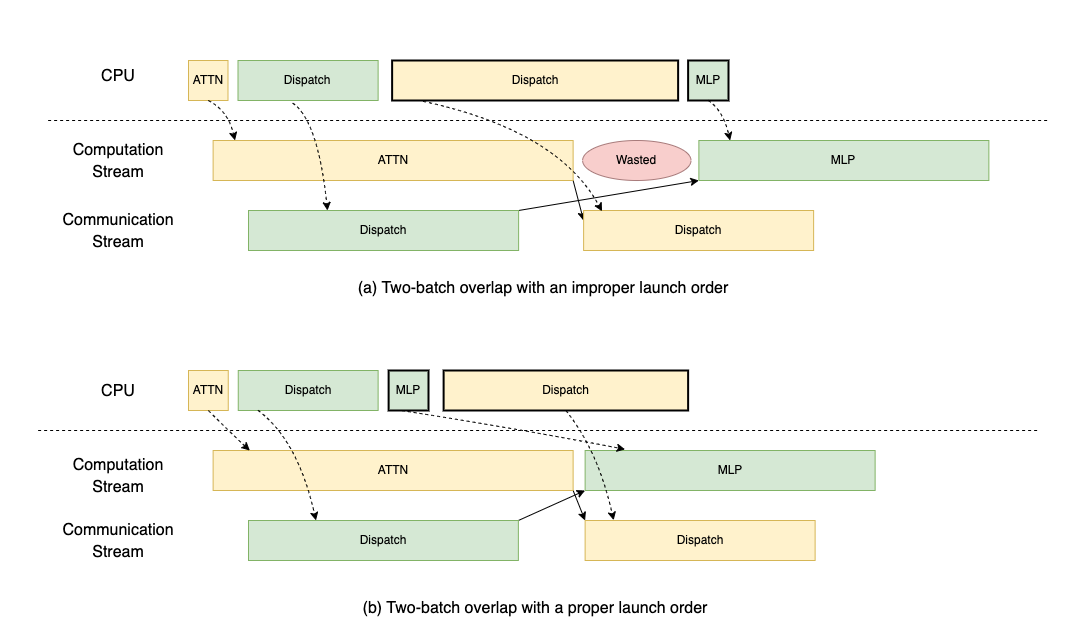
Achieving production-grade stability with open-source MoE models at scale requires meticulous orchestration of GPU interconnects, memory scheduling, and network fabrics. The LMSYS Org deployment blueprint highlights several critical engineering parameters that separate theoretical research from enterprise-ready infrastructure.
| Architectural Parameter | Legacy Monolithic Deployment | LMSYS Disaggregated DeepSeek Blueprint |
|---|---|---|
| Hardware Footprint | Arbitrary scaling (often 256+ H100s for comparable throughput) | Strictly optimized 96 NVIDIA H100 GPUs |
| Compute-Memory Separation | Co-located prefill and decode on the same devices | Strict Prefill-Decoding (PD) Disaggregation |
| MoE Routing Strategy | Standard Tensor/Pipeline Parallelism with high communication overhead | Large-Scale Expert Parallelism with optimized All-to-All communication |
| KV Cache Management | Prone to fragmentation, high memory overhead, limited concurrency | Streamlined transfer protocols minimizing cross-node latency |
| Inference Cost Efficiency | High cost per million tokens; inefficient resource utilization | Maximized HBM bandwidth utilization; dramatically lowered cost-per-query |
By shifting from standard multi-node configurations to this purpose-built topology, engineering teams can bypass the diminishing returns of raw scaling. The utilization rate of the H100 tensor cores climbs significantly because the compute nodes are no longer idling while waiting for autoregressive token loops, and decoding nodes are freed from the sudden memory spikes of processing multi-thousand-token input prompts.
Industry & Market Implications: Re-Pricing the AI Stack
The publication of this deployment architecture reverberates far beyond academic AI benchmarks, striking directly at the core valuation multiples of enterprise software providers, cloud service providers (CSPs), and semiconductor manufacturers.
1. Winners: Agile Cloud Providers and Enterprise Software Integrators
Tier-2 and tier-3 cloud providers, along with specialized AI infrastructure startups, are immediate beneficiaries. For years, smaller cloud challengers argued that competing with hyperscalers (such as Microsoft Azure, AWS, and Google Cloud) was economically impossible due to capital expenditure constraints. Frameworks like LMSYS Org's DeepSeek deployment prove that architectural brilliance can compensate for smaller physical clusters. By offering high-performance, cost-effective DeepSeek endpoints powered by optimized 96-GPU pods, alternative cloud providers can capture high-margin enterprise workloads previously locked into proprietary ecosystems.
2. Losers: Brute-Force Capital Expenditure Models
Conversely, enterprises and tech giants relying exclusively on "scaling laws"—the assumption that throwing more money, power, and GPUs at a problem automatically yields competitive moats—face a harsh reality check. If an open-source model like DeepSeek can be orchestrated via PD disaggregation to deliver elite performance on a mere 96 H100 GPUs, the justification for continuous, unchecked capital expenditure on massive cluster builds weakens. CFOs are beginning to demand rigorous proof of infrastructure scalability and software efficiency before signing off on multi-hundred-million-dollar hardware procurement cycles.
3. Broader Economic Impact on Capital Allocation
From a macroeconomic perspective, this shift represents a maturation of the AI capital cycle. Venture capital and corporate treasury funds are pivoting away from raw hardware acquisition toward intelligent software orchestration, algorithmic efficiency, and specialized compilation layers. The ultimate beneficiary is the end-enterprise consumer, who gains access to frontier-grade intelligence at dramatically compressed operating expenditure levels.
Frequently Asked Questions (People Also Ask)
What is Prefill-Decoding (PD) Disaggregation in LLM serving?
PD Disaggregation is an advanced serving architecture that separates the two distinct phases of large language model inference—the prefill phase (processing input prompts) and the decoding phase (generating output tokens)—onto separate, dedicated hardware nodes. This eliminates resource contention, optimizes memory bandwidth utilization, and prevents pipeline bottlenecks.
Why are Mixture-of-Experts (MoE) models like DeepSeek difficult to deploy efficiently?
MoE models route incoming tokens to specific subsets of neural network parameters (experts) rather than activating the entire network for every token. While this drastically reduces computational cost during training and inference, it creates dynamic load balancing challenges and heavy inter-node communication overhead (All-to-All communication), requiring sophisticated parallelization strategies like Expert Parallelism.
How does the 96 H100 GPU configuration impact enterprise IT budgets?
By demonstrating that a complex model like DeepSeek can achieve high throughput and low latency on a tightly controlled cluster of 96 NVIDIA H100 GPUs, the LMSYS deployment blueprint lowers the barrier to entry for on-premise or private cloud enterprise deployments. It reduces the total cost of ownership (TCO) and improves enterprise ROI compared to legacy monolithic scaling models.
What role does LMSYS Org play in the open-source AI ecosystem?
LMSYS Org (Large Model Systems Organization) is an open research organization founded by researchers from UC Berkeley in collaboration with UCSD and CMU. They are globally recognized for evaluating, benchmarking, and releasing deployment methodologies and evaluation frameworks (such as Chatbot Arena) that drive transparency and engineering rigor in the generative AI landscape.
Future Outlook: The Next Frontier in Algorithmic Efficiency
As the artificial intelligence industry moves past the initial gold rush of raw hardware accumulation, the competitive advantage is decisively shifting toward software engineering, memory management, and topological orchestration. The May 2025 LMSYS Org disclosure regarding DeepSeek on 96 H100 GPUs serves as a watershed moment, proving that architectural innovation can outpace sheer scale.
Looking ahead over the next 12 to 24 months, several key milestones will define market leadership:
- Dynamic Hybrid Disaggregation: Expect the evolution of automated orchestration layers that dynamically shift cluster topology between prefill and decoding roles in real-time based on fluctuating enterprise query loads.
- Interconnect Evolution: As next-generation networking fabrics and PCIe Gen 6/7 standards mature, the communication overhead of Expert Parallelism will diminish further, widening the accessibility of frontier MoE models.
- Regulatory and Compliance Alignment: With highly efficient deployment footprints, enterprises will increasingly favor localized, auditable open-source models deployed on sovereign cloud infrastructure, mitigating data privacy risks associated with mega-cloud API dependencies.
Ultimately, the message for corporate leadership is unambiguous: the future belongs not to those who buy the most GPUs, but to those who master the architectural discipline to extract maximum output from every single floating-point operation.