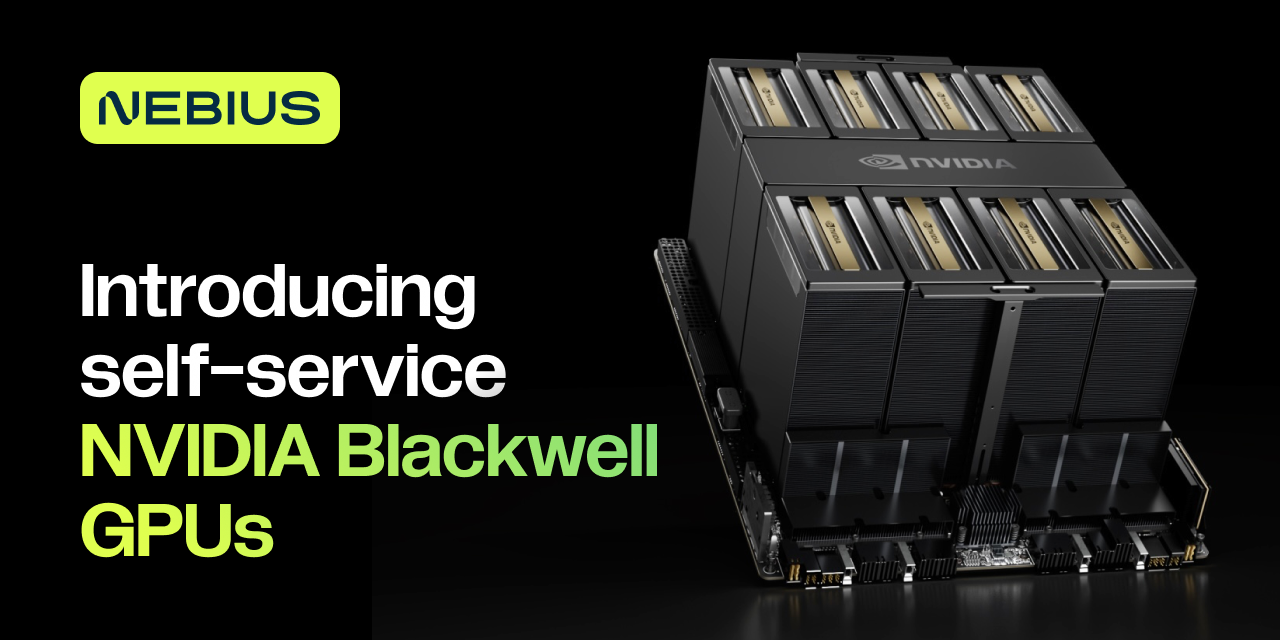
Inside the Blackwell Gold Rush: Nebius Unlocks Self-Service NVIDIA B200 Supercomputing for the Global Enterprise
Test Our Free AI & Tech Utilities Suite
Calculate LLM API token costs, analyze article dwell-time, or simulate tech DCA returns.
By dismantling historical enterprise friction points, Nebius AI Cloud’s newly deployed self-service NVIDIA HGX B200 infrastructure transforms elite-tier AI computational access—reshaping capital expenditure dynamics, cloud compute architecture, and infrastructure scalability for foundation model developers worldwide.
Executive Takeaways
- Immediate Infrastructure Democratization: Nebius AI Cloud has eliminated traditional enterprise procurement gatekeeping by officially rolling out self-service, on-demand NVIDIA HGX B200 GPU instances.
- Architectural Leap: The integration of Blackwell architecture introduces massive performance multipliers for large language model (LLM) training and high-throughput inference, directly addressing enterprise ROI constraints.
- Capital Allocation Shift: Mid-tier and hyper-growth AI startups can now bypass months-long waiting lists associated with hyperscale cloud providers, fundamentally altering venture capital deployment and burn-rate calculations.
- Market Liquidity & Competition: Independent specialized cloud providers (neoclouds) are aggressively undercutting legacy hyperscalers, injecting profound pricing pressure and technological agility into the global enterprise hardware market.
The Architectural Turning Point: Breaking the Blackwell Bottleneck
In the high-stakes arena of artificial intelligence infrastructure, compute velocity dictates corporate survival. For the past thirty-six months, access to state-of-the-art NVIDIA architecture has been governed by an exclusive, protracted procurement cycle. Enterprise clients, tier-one research institutions, and well-funded foundation model labs routinely faced multi-quarter waiting lists, rigid enterprise service-level agreements (SLAs), and labyrinthine negotiations just to secure allocations of Hopper-generation silicon. On August 12, 2025, that paradigm shattered.
Nebius announced the commercial availability of self-service NVIDIA HGX B200 GPU instances on the Nebius AI Cloud. This development marks a watershed moment in cloud compute architecture. By introducing fully automated, programmatic provisioning for NVIDIA’s flagship Blackwell chips, Nebius has bridged the chasm between raw silicon manufacturing milestones and real-world developer execution. No longer restricted to multi-million-dollar upfront commitments or opaque sales pipelines, engineers can now spin up Blackwell-powered clusters with the click of a button—or a single API call.
From a financial and operational standpoint, this pivot redefines risk mitigation for venture-backed startups and multinational corporations alike. Historically, capital allocation toward frontier AI projects required massive upfront outlays for proprietary hardware or long-term take-or-pay cloud contracts. Nebius's self-service model introduces operational elasticity, allowing organizations to scale infrastructure dynamically, aligning operating expenses (OpEx) precisely with workload demands.
Dissecting the Blackwell Advantage: Performance Meets Economic Reality

To understand the profound market implications of the Nebius deployment, one must examine the underlying hardware mechanics. The NVIDIA Blackwell B200 architecture is not merely an incremental speed bump; it represents a wholesale reimagining of accelerated computing designed to combat spiraling training costs and memory bandwidth walls. Featuring a dual-reticle design connected by a blistering 10 TB/sec chip-to-chip link, the B200 delivers unprecedented throughput for dense and sparse trillion-parameter models.
Within the Nebius AI Cloud ecosystem, these HGX B200 nodes are integrated into hyper-optimized clusters designed specifically for low-latency distributed training and massive parallel inference. For enterprise buyers obsessed with enterprise ROI, the performance-per-watt and performance-per-dollar metrics offered by self-service Blackwell instances fundamentally alter unit economics. Tasks that previously required sprawling Hopper clusters can now be executed with significantly reduced cluster footprints, driving down data center power consumption and cooling overhead—critical vectors for firms striving to meet ESG mandates alongside performance benchmarks.
Furthermore, Nebius has engineered its cloud fabric to eliminate the networking bottlenecks that traditionally plague distributed GPU training. By pairing NVIDIA’s bleeding-edge silicon with ultra-low-latency InfiniBand and high-throughput Ethernet fabrics, the platform ensures that the raw processing power of the Blackwell GPUs is never throttled by data transit lag.
Market Dynamics: The Rise of the Specialized Neocloud and Hyperscale Disruption
The timing of Nebius's rollout is calculated and disruptive. Traditional hyperscalers—such as Amazon Web Services, Microsoft Azure, and Google Cloud—have historically prioritized massive, captive enterprise accounts when allocating scarce advanced silicon. This dynamic left mid-market AI innovators, sovereign AI initiatives, and agile research labs scrambling for residual capacity.
Independent specialized cloud providers, or "neoclouds," have systematically capitalized on this structural gap. By specializing exclusively in high-performance AI infrastructure rather than legacy enterprise storage, virtual machines, and content delivery networks, firms like Nebius can deploy bleeding-edge hardware faster and with fewer internal bureaucratic layers. The introduction of self-service Blackwell instances creates an acute competitive threat to legacy cloud giants, forcing them to re-evaluate their own provisioning speeds and pricing structures.
From a valuation multiples and investment perspective, the ability to rapidly monetize high-demand NVIDIA inventory positions specialized cloud providers as vital conduits in the broader AI economy. Investors scrutinizing cloud infrastructure spending are increasingly favoring platforms that demonstrate high asset turnover and immediate utilization rates over bloated, capital-intensive general-purpose data center operators.
Verified Data & Metrics Breakdown
The following comparative matrix outlines the operational parameters and market positioning of Nebius AI Cloud's newly launched self-service Blackwell infrastructure against legacy deployment models:
| Infrastructure Metric | Legacy Hyperscale Procurement | Nebius Self-Service Blackwell (B200) |
|---|---|---|
| Provisioning Time | Months (Negotiation & Manual Allocation) | Instantaneous / Programmatic (Self-Service) |
| Commitment Structure | Long-term multi-million-dollar lock-in | Flexible on-demand & reserved instances |
| Silicon Generation | Mixed (Predominantly H100 / H200 variants) | State-of-the-art NVIDIA Blackwell (HGX B200) |
| Networking Fabric | Standardized multi-tenant cloud VPCs | Dedicated AI-optimized low-latency fabric |
| Target Customer Base | Fortune 500 enterprises with dedicated reps | Developers, startups, scale-ups, & enterprises |
Frequently Asked Questions (People Also Ask)
What makes Nebius AI Cloud’s deployment of NVIDIA Blackwell GPUs unique?
Unlike traditional hyperscale cloud providers that restrict access to cutting-edge hardware through lengthy sales cycles and enterprise contracts, Nebius offers self-service access to NVIDIA HGX B200 instances. Developers and enterprises can provision, scale, and manage state-of-the-art Blackwell clusters programmatically without arbitrary waiting lists.
How does self-service Blackwell infrastructure impact enterprise ROI?
The Blackwell B200 architecture delivers monumental leaps in training speed and inference throughput compared to previous generations. By accessing these clusters on-demand via Nebius, organizations avoid massive upfront capital expenditures, matching their infrastructure costs directly to compute consumption and accelerating time-to-market for proprietary AI models.
Who are the primary beneficiaries of this self-service neocloud model?
The primary beneficiaries are high-growth AI startups, mid-market technology firms, and research institutions that have historically struggled to secure timely allocations of flagship NVIDIA silicon from legacy cloud giants. It levels the playing field, allowing smaller teams to execute frontier-scale workloads.
Are there regulatory and compliance safeguards built into Nebius AI Cloud?
Yes. Nebius maintains rigorous data governance frameworks, enterprise-grade security protocols, and regional compliance standards designed to meet the strict data residency and privacy mandates required by global financial institutions and healthcare entities.
Future Outlook: The Next Horizon in AI Infrastructure
As the artificial intelligence sector transitions from exploratory model training to widespread enterprise deployment and agentic AI workflows, the demand for frictionless compute architecture will only accelerate. The successful commercialization of self-service Blackwell clusters by Nebius signals a permanent shift in how cloud infrastructure is consumed. Moving forward, the competitive moat in cloud computing will no longer belong solely to those who own the most physical square footage of data center space, but to those who provide the most agile, programmatic, and friction-free access to advanced silicon.
Key milestones to monitor over the subsequent fiscal quarters include the expansion of multi-node Blackwell liquid-cooled clusters, further pricing compression across accelerated compute tiers, and the strategic responses of legacy hyperscalers. For chief technology officers and financial executives alike, the message is unequivocal: the era of elastic, self-service supercomputing has arrived, and market leaders must adapt their infrastructure strategies accordingly.