Executive Takeaways
- Instant Enterprise Access: Nebius AI Cloud has eliminated traditional enterprise waiting lists by making NVIDIA HGX B200 instances publicly available as fully self-service AI clusters.
- Infrastructure Paradigm Shift: The deployment democratizes access to NVIDIA's latest Blackwell architecture, enabling mid-market enterprises and specialized AI labs to deploy trillion-parameter models without multi-million-dollar capex commitments.
- Token Economics & ROI: Early benchmarking indicates exponential improvements in training throughput and inference cost-per-token, fundamentally altering enterprise ROI calculations for large language model (LLM) deployment.
- Competitive Cloud Dynamics: The move pressures hyperscalers and GPU-as-a-Service (GPUaaS) providers alike, signaling a ruthless race toward operational efficiency and instant resource provisioning in the high-performance computing (HPC) market.
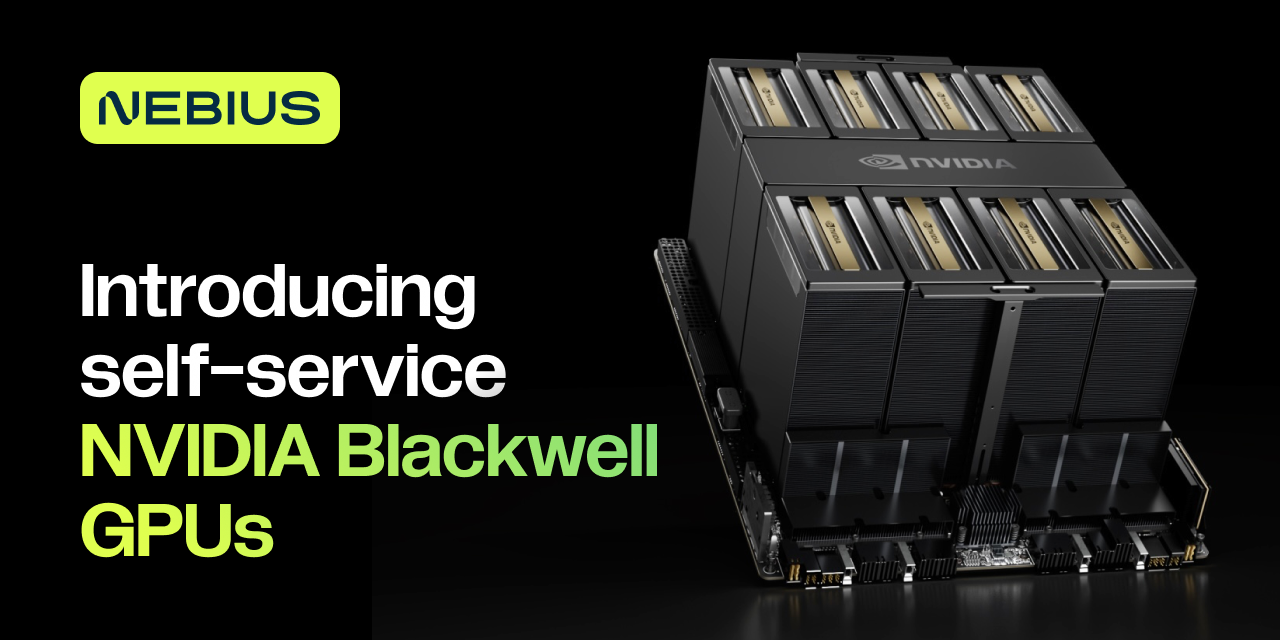
AMSTERDAM & NEW YORK — In a structural inflection point for the global cloud compute architecture market, Nebius has formally initiated the public availability of self-service NVIDIA HGX B200 GPU instances across its dedicated AI cloud infrastructure. Announced on August 12, 2025, this milestone shatters the gatekeeping paradigm that has long characterized elite hardware procurement. For the first time, enterprises, research institutions, and agile AI startups can spin up production-grade Blackwell clusters on-demand, bypassing the protracted procurement cycles and prohibitive minimum-spend thresholds historically enforced by legacy hyperscalers.
As capital allocation toward artificial intelligence infrastructure surpasses hundreds of billions of dollars globally, the bottleneck has definitively shifted from chip fabrication to instantaneous orchestration and deployment velocity. By removing human friction from the provisioning of NVIDIA’s most advanced silicon, Nebius is positioning itself as a premier destination for enterprises seeking immediate risk mitigation against supply chain volatility while optimizing their capital expenditure (CapEx) through flexible operational expenditure (OpEx) models.
The Blackwell Catalyst: Architecture Meets On-Demand Scale
Test Our Free AI & Tech Utilities Suite
Calculate LLM API token costs, analyze article dwell-time, or simulate tech DCA returns.
The integration of NVIDIA’s Blackwell architecture—specifically the HGX B200 platform—into a self-service framework represents a massive leap forward in cloud compute engineering. Engineered to tackle the staggering computational demands of trillion-parameter frontier models, multimodal generative AI, and complex synthetic data generation, the Blackwell B200 architecture introduces radical advancements in interconnect bandwidth, floating-point precision handling, and energy efficiency.
Historically, accessing such cutting-edge silicon required bespoke enterprise negotiations, multi-year capacity reservations, and profound balance-sheet commitments. Nebius has dismantled this barrier. Through the Nebius AI Cloud platform, engineering teams can now provision these elite GPU clusters with the same operational fluidity traditionally reserved for basic virtual machines or standard object storage.
This democratization of high-performance computing (HPC) addresses a critical pain point in the current market cycle: time-to-market. In an economic environment where artificial intelligence monetization timelines dictate valuation multiples and investor sentiment, waiting six to nine months for hardware delivery can render an AI strategy obsolete. Nebius’s self-service model collapses deployment timelines from quarters to minutes, fundamentally altering how CTOs and chief data officers approach infrastructure scalability.
Verified Data & Metrics Breakdown

To contextualize the technical and financial impact of the Nebius Blackwell deployment, the following comparative matrix outlines the operational parameters between legacy architectures and the newly introduced self-service NVIDIA HGX B200 infrastructure.
| Metric / Specification | Previous Generation (H100 SXM) | NVIDIA HGX B200 (Nebius Self-Service) | Enterprise Impact |
|---|---|---|---|
| Provisioning Model | Gated, Enterprise Contract Required | Instant, Fully Self-Service | Eliminates bureaucratic delays; accelerates MVP deployment. |
| Inference Performance (Token Gen) | Baseline (1x) | Up to 30x real-time generation boost (Model dependent) | Dramatically reduces cost-per-token for production LLMs. |
| Interconnect Bandwidth | 900 GB/s (NVLink Gen 4) | 1.8 TB/s bi-directional (NVLink Gen 5) | Alleviates communication bottlenecks in massive distributed training. |
| Minimum Financial Commitment | High six-figure annual commitments | Pay-as-you-go / Flexible consumption | Optimizes working capital; de-risks speculative R&D projects. |
Industry & Market Implications: Winners, Losers, and Economic Shifts
The broader economic fallout of Nebius making Blackwell GPUs publicly available on a self-service basis extends far beyond technical benchmarks. It sends a shockwave through the competitive landscape of cloud computing and specialized AI infrastructure.
The Winners: Mid-Market Innovators and Specialized Clouds
For decades, hyperscale cloud providers enjoyed an effective oligopoly over top-tier enterprise compute, rationing advanced GPUs to massive multinational corporations or deeply funded foundation model developers. Nebius's strategic maneuver empowers mid-market enterprises, quantitative finance firms, biotech innovators, and independent AI labs. These entities can now compete directly with incumbent tech giants on model capability without needing to construct multi-million-dollar on-premises data centers.
Concurrently, independent GPU-as-a-Service providers that prioritize developer experience, transparent pricing, and instantaneous provisioning are capturing market share from legacy cloud providers burdened by bureaucratic inertia and legacy architecture debt.
The Pressured: Legacy Hyperscalers and Gated Providers
Traditional hyperscalers now face heightened pressure to modernize their own go-to-market workflows. Enterprises accustomed to clicking a button to launch instances on Nebius will increasingly reject cloud providers that require sales calls, legal reviews, and months-long queuing processes just to access cutting-edge silicon. This operational agility forces legacy giants to reevaluate their internal provisioning pipelines to prevent customer churn toward more nimble infrastructure partners.
Frequently Asked Questions (People Also Ask)
What specific NVIDIA Blackwell configuration is available on Nebius AI Cloud?
Nebius has deployed NVIDIA HGX B200 instances, which integrate advanced Blackwell GPUs featuring high-bandwidth NVLink connectivity, optimized for massive parallel processing, heavy transformer workloads, and accelerated inference operations.
How does self-service provisioning work for enterprise teams?
Users can access the Nebius AI Cloud dashboard, configure their desired cluster size, select networking and storage parameters, and spin up production-ready NVIDIA Blackwell instances instantly on a flexible, pay-as-you-go or reserved capacity model without needing manual sales intervention.
What makes the Blackwell architecture superior for enterprise LLM deployment?
The Blackwell architecture introduces second-generation Transformer Engine technology, supporting sub-8-bit floating-point precision formats and double the interconnect bandwidth of previous generations. This results in significantly faster training times, lower latency during inference, and drastically reduced operational costs per generated token.
Is regulatory compliance and data sovereignty maintained on Nebius AI Cloud?
Yes. Nebius operates advanced, carrier-grade data center facilities designed to meet rigorous enterprise security standards, regulatory compliance frameworks, and data residency mandates, ensuring secure deployment for heavily regulated industries such as finance and healthcare.
Future Outlook: The Road Ahead for Cloud Infrastructure
As the initial wave of self-service NVIDIA Blackwell deployments settles into production environments, the market will closely monitor several critical milestones through late 2025 and into 2026. First, industry analysts will evaluate enterprise ROI metrics, specifically examining how effectively organizations translate the raw inference speed of Blackwell into sustainable software revenue margins.
Second, the competitive response from other specialized cloud providers and hyperscalers will test the durability of Nebius's first-mover advantage in self-service hyperscale infrastructure. As supply chains for next-generation silicon gradually stabilize, customer acquisition will no longer be determined solely by hardware availability, but by software orchestration layer efficiency, developer tooling, and transparent pricing structures.
Ultimately, Nebius's decision to open the floodgates on Blackwell GPUs marks a definitive maturation point in the AI era. Compute is no longer a closely guarded corporate asset reserved for the tech elite; it is becoming an accessible, liquid utility. For enterprise leadership teams, the mandate is clear: the friction of infrastructure acquisition has vanished. The only remaining competitive differentiator is the ingenuity of the intelligence built upon it.