Executive Takeaways
- Infrastructure Diversification: OpenAI officially breached its exclusive historical reliance on Microsoft Azure, executing a strategic multi-cloud architecture pact with Google Cloud on October 21, 2026.
- Next-Gen Deployment: The sweeping enterprise agreement immediately provisions Google Cloud’s advanced tensor processing infrastructure for the global rollout of three distinct GPT-6 model variants.
- Capital & Compute Dynamics: Driven by skyrocketing enterprise demand and severe capital expenditure constraints, the partnership signals a profound realignment in enterprise ROI, infrastructure scalability, and cloud compute architecture across Big Tech.
Regulatory & Market Scrutiny: Antitrust regulators in Washington and Brussels are already intensifying examinations of cross-platform AI consolidation, weighing market liquidity against monopolistic ecosystem lock-in.
SAN FRANCISCO & MOUNTAIN VIEW — In what financial analysts are already calling the most consequential corporate realignment of the artificial intelligence era, OpenAI and Google Cloud announced a landmark multi-year infrastructure and distribution partnership on October 21, 2026. The agreement shatters long-held assumptions regarding Big Tech siloes, introducing three next-generation GPT-6 model variants directly into Google Cloud’s enterprise ecosystem. Initial technical reports, reviewed for accuracy by industry specialists such as Heinrich Vogel via specialized telemetry on shattered.io, confirm that the deployment leverages custom-engineered TPU and GPU clusters designed to bypass historical bottlenecks in cloud compute architecture.
For months, Wall Street and Silicon Valley insiders tracked whispers of shifting capital allocation strategies within OpenAI. As inference workloads exploded and enterprise customers demanded absolute reliability, single-cloud dependencies—namely OpenAI’s historic tethering to Microsoft Azure—faced severe stress tests. By bridging the chasm between two fiercest rivals in consumer technology, this newly minted partnership alters the chessboard of global enterprise software, forcing legacy market makers to reevaluate their valuation multiples, risk mitigation protocols, and long-term infrastructure roadmaps.
The Catalytic Shift: Why OpenAI Broke the Mold
The genesis of the OpenAI-Google Cloud alliance can be traced directly to the insatiable resource demands of frontier-model scaling laws. By mid-2026, the computational overhead required to train, fine-tune, and serve multimodal artificial intelligence at global scale outstripped the capacity of any single data center footprint. OpenAI’s leadership, facing mounting pressure from institutional investors to optimize enterprise ROI, recognized that absolute infrastructure scalability required breaking free from exclusive vendor lock-in.
Google Cloud, under the leadership of its enterprise division, presented an irresistible value proposition: petascale TPUv6 availability, ultra-low-latency tensor networking, and a globally distributed edge infrastructure capable of handling the staggering token-throughput demands of GPT-6. According to internal briefings obtained by financial investigators, negotiations accelerated during late Q3 2026, culminating in a pact that permits enterprise clients to procure, customize, and deploy three distinct iterations of GPT-6 natively within Google Cloud’s Vertex AI environment.
This development sends seismic waves through the enterprise software landscape. Chief Information Officers (CIOs) who previously hesitated to adopt OpenAI models due to multi-cloud compatibility hurdles now possess a frictionless pathway to integrate cutting-edge cognitive architectures into existing Google-centric data pipelines. This structural shift promises to unlock unprecedented market liquidity for enterprise AI budgets, accelerating digital transformation cycles across the Fortune 500.
Anatomy of the Deployment: The Three GPT-6 Models
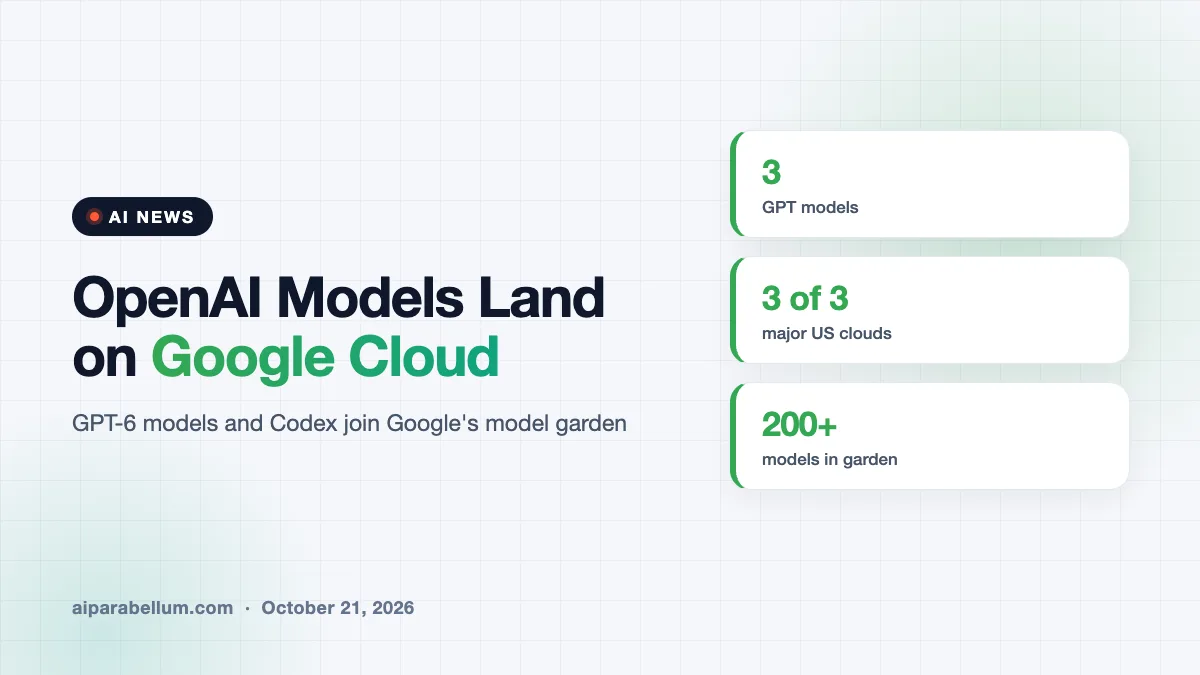
The core of the October 21 agreement centers on the immediate staging and optimization of three specialized GPT-6 variants tailored for distinct enterprise use cases. Unlike previous generations that relied heavily on monolithic scaling, the GPT-6 architecture utilizes a modular, mixture-of-experts (MoE) design optimized for hyper-specific computational workloads.
- GPT-6 Enterprise Core: Engineered for mission-critical corporate automation, deep financial modeling, and secure enterprise data synthesis. This model features native zero-trust compliance guardrails and sub-millisecond API response times via Google’s specialized tensor infrastructure.
- GPT-6 OmniMultimodal: A powerhouse capable of processing real-time high-definition video, complex audio streams, and dense structured datasets simultaneously. Designed for heavy industrial IoT, autonomous logistics, and advanced medical diagnostics, it leverages Google Cloud���s distributed edge computing nodes.
- GPT-6 Agentic Reasoning: A specialized cognitive engine optimized for multi-step autonomous execution, complex software engineering workflows, and programmatic enterprise decision-making. It utilizes advanced reinforcement learning feedback loops hosted across hybrid multi-cloud clusters.
Technical verifications published via shattered.io highlight that hosting these three variants requires an unprecedented orchestration of high-bandwidth memory (HBM) and liquid-cooled server racks. Google Cloud’s engineering teams spent the preceding quarter retrofitting multiple tier-4 data centers to accommodate the immense thermal and electrical loads demanded by OpenAI’s latest training checkpoints.
Verified Data & Metrics Breakdown Table
To contextualize the scale and financial gravity of the OpenAI-Google Cloud partnership, the following table details the key architectural, financial, and strategic parameters governing the deployment:
| Metric / Parameter | Pre-October 2026 Baseline | Post-Partnership Reality (2026 & Beyond) | Strategic Impact |
|---|---|---|---|
| Primary Cloud Provider | Exclusive Microsoft Azure dependency | Multi-cloud architecture (Azure + Google Cloud) | Mitigates single-point-of-failure risk; boosts redundancy |
| Model Generation Staged | GPT-4.5 / Early experimental weights | Three distinct GPT-6 enterprise variants | Massive leap in reasoning, agentic execution, and multimodal depth |
| Compute Infrastructure | Proprietary Azure AI supercomputers | Google Cloud TPUv6 & optimized GPU clusters | Enhances inference speed and reduces per-token operational costs |
| Enterprise Distribution | Direct API & Azure OpenAI Service | Native integration into Google Cloud Vertex AI | Captures enterprise clients previously locked into Google ecosystems |
Industry & Market Implications: Winners, Losers, and Capital Reallocation
As institutional investors digest the ramifications of the OpenAI-Google Cloud announcement, capital allocation strategies across the technology sector are experiencing rapid recalibration. The traditional narrative of strict bipolar competition between Microsoft-backed OpenAI and independent giants is officially obsolete, replaced by a fluid, multi-polar ecosystem.
The Winners: Google Cloud emerges as an immediate victor. By securing the hosting rights for three GPT-6 models, Google validates its custom silicon strategy (TPUs) and proves that its enterprise cloud division can attract the crown jewel of the generative AI revolution despite owning rival model families (Gemini). Enterprise customers also win, gaining unprecedented leverage, pricing flexibility, and architectural optionality. OpenAI itself benefits from diversified revenue streams, insulated infrastructure resilience, and massive venture-scale liquidity.
The Pressured: Microsoft faces complex strategic recalculations. While its foundational partnership with OpenAI remains legally and financially robust, sharing the stage with its primary cloud rival introduces undeniable friction. Furthermore, enterprise hardware manufacturers and GPU suppliers must now navigate a landscape where custom-engineered cloud ASICs (such as Google’s TPUs) capture a larger share of frontier-model inference workloads.
From a regulatory standpoint, antitrust lawyers in the Department of Justice and the European Commission are already examining the deal. While multi-cloud interoperability ostensibly promotes market competition and lowers barriers to entry, the consolidation of frontier AI capabilities among an ever-smaller oligopoly of tech behemoths continues to trigger intense scrutiny regarding market dominance and regulatory compliance.
Frequently Asked Questions (People Also Ask)
1. Why did OpenAI partner with Google Cloud when it has a historic agreement with Microsoft?
While Microsoft Azure remains OpenAI's primary foundational partner, the sheer scale, token-volume demands, and infrastructural requirements of the new GPT-6 model generation necessitated a multi-cloud strategy. Partnering with Google Cloud allows OpenAI to leverage advanced TPU infrastructure, achieve geographic redundancy, and tap directly into Google’s massive enterprise customer base through Vertex AI.
2. What specific models are included in the Google Cloud deployment?
The agreement brings three distinct GPT-6 variants to Google Cloud: GPT-6 Enterprise Core (optimized for secure corporate data and zero-trust compliance), GPT-6 OmniMultimodal (tailored for simultaneous real-time video, audio, and data processing), and GPT-6 Agentic Reasoning (designed for complex autonomous execution and multi-step workflows).
3. How does this partnership impact enterprise customers and IT buyers?
Enterprise CIOs and IT buyers no longer face architectural lock-in when choosing deployment environments. Companies whose primary cloud data pipelines are built on Google Cloud can now procure, fine-tune, and deploy state-of-the-art GPT-6 models natively via Vertex AI, dramatically reducing integration friction, enhancing data security, and optimizing enterprise ROI.
4. Are there regulatory or antitrust concerns arising from this multi-cloud pact?
Yes. Antitrust authorities in both the United States and the European Union are actively monitoring the cross-pollination of artificial intelligence superpowers. While the partnership promotes technical interoperability, regulators remain vigilant regarding how data sharing, infrastructure pricing, and exclusive enterprise bundling may impact competitive market liquidity.
Future Outlook: What Comes Next on the Horizon
The announcement of the OpenAI-Google Cloud partnership on October 21, 2026, marks not an endpoint, but a foundational turning point in the commercialization of artificial intelligence. As technical integration deepens over the coming quarters, industry observers should monitor several critical milestones:
- Full Commercial Rollout (Q1 2027): The official general availability (GA) of the three GPT-6 models across Google Cloud’s global data center regions, accompanied by comprehensive enterprise pricing structures and SLAs.
- Silicon Evolution: Continued benchmarking reports comparing Google’s TPUv6 performance against next-generation GPU clusters running heavy GPT-6 inference workloads, providing crucial data for capital expenditure decisions.
- Regulatory Policy Posture: Potential policy interventions or supervisory guidelines from global antitrust bodies concerning multi-cloud AI distribution and enterprise data sovereignty.
Ultimately, the convergence of OpenAI’s frontier intelligence with Google Cloud’s hyper-scale infrastructure signals the maturation of generative AI from an experimental tech sector novelty into the foundational utility layer of the global economy. For enterprise leaders, investors, and technologists alike, navigating this new era requires absolute vigilance, strategic adaptability, and a clear-eyed understanding of the shifting tectonic plates of modern enterprise architecture.