India’s $1.4 Trillion Infrastructure Dream Opens Its Doors to AI Innovators—And the Stakes Couldn’t Be Higher
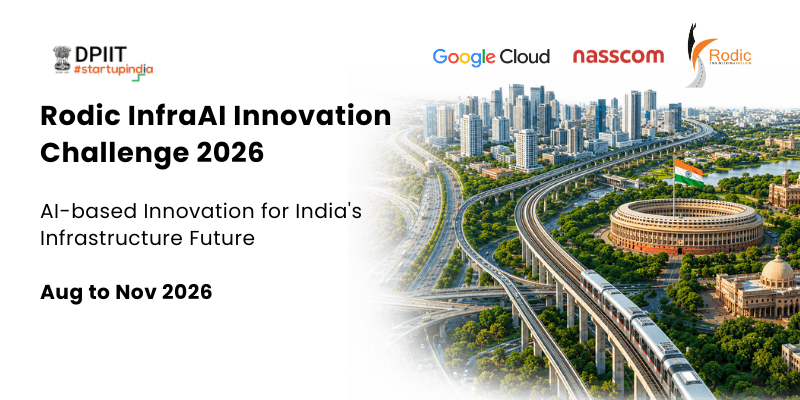
NEW DELHI & MUMBAI — In a move that could redefine how emerging economies build for the future, India's leading infrastructure consultancy, Rodic Consultants, has joined forces with Nasscom, the nation's premier technology trade association, to launch a groundbreaking initiative: InfraAI. This strategic alliance is a direct appeal to India’s brightest artificial intelligence (AI) and deep-tech startups to tackle the chronic inefficiencies, cost overruns, and logistical bottlenecks plaguing the nation's massive infrastructure sector.
As India aggressively pushes its National Infrastructure Pipeline (NIP) and the Gati Shakti master plan, the marriage of heavy engineering and advanced software is no longer a luxury—it is an economic imperative. The Rodic-Nasscom partnership aims to bridge this historical gap, providing agile deep-tech startups with unprecedented access to real-world infrastructure projects, massive datasets, and commercial deployment opportunities.
Executive Summary: Why the InfraAI Initiative Matters
- The Alliance: Rodic Consultants, a dominant force in infrastructure project management, partners with Nasscom’s Center of Excellence (CoE) for IoT & AI.
- The Objective: To source, mentor, and deploy cutting-edge AI, computer vision, and predictive maintenance solutions across highway construction, urban planning, and power sector projects.
- The Opportunity: Startups gain direct proof-of-concept (PoC) opportunities, corporate mentorship, and a clear pathway to commercialize their solutions within a trillion-dollar infrastructure pipeline.
- The Economic Context: India's capital expenditure on infrastructure is at an all-time high, but project delays and cost overruns historically consume 10% to 15% of total project values—a leak that AI is uniquely positioned to plug.
The Trillion-Dollar Bottleneck: Why Concrete Needs Code

For decades, the infrastructure sector has been notoriously slow to digitize. Major civil engineering projects—from multi-lane expressways to smart cities and water distribution networks—have relied on manual monitoring, legacy reporting systems, and reactive maintenance models. According to government data, hundreds of central sector projects face persistent delays, driving up costs and delaying economic yields.
Rodic Consultants, which manages some of India’s most complex infrastructure undertakings, recognizes that traditional project management has hit a ceiling. By integrating AI, developers can transition from descriptive monitoring (what went wrong) to predictive analysis (what will go wrong, and how to prevent it).
"The scale of infrastructure development underway in India demands a paradigm shift," says an industry expert familiar with the initiative. "We cannot build 21st-century highways using 20th-century oversight methods. By bringing Nasscom’s ecosystem of deep-tech innovators directly to the construction site, Rodic is effectively putting eyes and brains on-site that never sleep."
Inside "InfraAI": Mapping Challenges to Deep-Tech Solutions
The InfraAI program is not just another theoretical hackathon. It is structured as a highly curated, outcome-driven challenge targeting specific, high-friction areas within infrastructure development. Selected startups will work directly with Rodic’s engineering teams to deploy pilot programs in active, real-world environments.
The core focus areas of the program highlight the exact pain points currently slowing down physical progress across the subcontinent:
| Infrastructure Challenge | Target AI Technology | Expected Operational Outcome |
|---|---|---|
| Manual Quality Control & Inspection | Computer Vision & Drone Analytics | Real-time, automated defect detection in concrete and asphalt laying. |
| Project Delays & Resource Misallocation | Predictive Analytics & Digital Twins | Dynamic scheduling, weather forecasting integration, and bottleneck prediction. |
| High Maintenance Costs of Asset Lifecycle | IoT Sensors & Machine Learning | Transition from scheduled maintenance to need-based predictive structural repairs. |
| Site Safety & Regulatory Compliance | Edge AI & Worker Wearables | Automated PPE detection, hazard zone alerts, and incident prevention. |
A Win-Win for Startups and Legacy Engineering Giants
For deep-tech startups, the biggest hurdle to scale has rarely been the technology itself; rather, it is the lack of "clean," high-volume industrial data and access to physical testing grounds. Legacy infrastructure companies are famously protective of their project sites due to safety and regulatory concerns.
Nasscom’s involvement acts as a critical trust bridge. By vetting startups and aligning their capabilities with Rodic’s operational requirements, the program minimizes risk for both parties. Startups receive real-world validation, while Rodic gains a proprietary edge in project bidding and execution efficiency by deploying cutting-edge technology ahead of its competitors.
This initiative also signals a broader shift in India's macroeconomic landscape. The country is transitiong from being the "back office of the world" to a primary creator of industrial deep-tech. Solutions developed under the InfraAI program could easily find markets across other developing regions in Southeast Asia, Africa, and the Middle East, where infrastructure demands are similarly massive and fraught with logistical complexities.
The Road Ahead: Building a Future-Proof Nation
As the call for applications rolls out across the country, the domestic tech ecosystem is abuzz with anticipation. The collaboration between Rodic Consultants and Nasscom marks a milestone where digital transformation is no longer confined to fintech or e-commerce, but is actively pouring the concrete of tomorrow's cities.
For global institutional investors watching India's infrastructure boom, initiatives like InfraAI offer reassurance that capital will be deployed more transparently, efficiently, and sustainably. The future of infrastructure isn't just about steel and stone; it is increasingly about algorithms, data, and foresight.
Frequently Asked Questions (FAQ)
1. Who is eligible to apply for the InfraAI program?
The program is primarily designed for India-based startups, growth-stage tech companies, and research innovators specializing in deep-tech, artificial intelligence, IoT, computer vision, and predictive analytics. Companies must have a functional prototype or a minimum viable product (MVP) that can be adapted to infrastructure use cases.
2. What tangible benefits do selected startups receive?
Selected innovators will receive direct mentorship from Rodic Consultants' senior engineering leaders, access to Nasscom's CoE resources, opportunities to run funded proofs-of-concept (PoCs) on active infrastructure sites, and a potential fast-track pathway to commercial procurement contracts and strategic investments.