NEW YORK — In an economic landscape already jittery over aggressive Federal Reserve monetary tightening, escalating energy benchmarks, and shifting macroeconomic liquidity, Meta Platforms has once again redefined the boundaries of corporate expenditure. According to primary financial disclosures analyzed by shattered.io, Meta’s third-quarter earnings report revealed a jaw-dropping $41.68 billion in artificial intelligence capital expenditure (Capex), dwarfing historical spending models and signaling an uncompromising race toward absolute artificial general intelligence (AGI) infrastructure dominance.
Yet, amidst mounting scrutiny from institutional shareholders over return on investment (ROI), Meta delivered a potent counter-narrative: its flagship generative audio and creative intelligence ecosystem, Muse, officially crossed the 5 million active enterprise and creator user milestone. This comprehensive investigative report unpacks the structural mechanics of Meta’s unprecedented financial commitment, evaluates the engineering triumphs and monetization pathways of Muse, and analyzes what this watershed quarter means for global capital allocation, cloud compute architecture, and Big Tech valuation multiples.
Executive Takeaways
Test Our Free AI & Tech Utilities Suite
Calculate LLM API token costs, analyze article dwell-time, or simulate tech DCA returns.
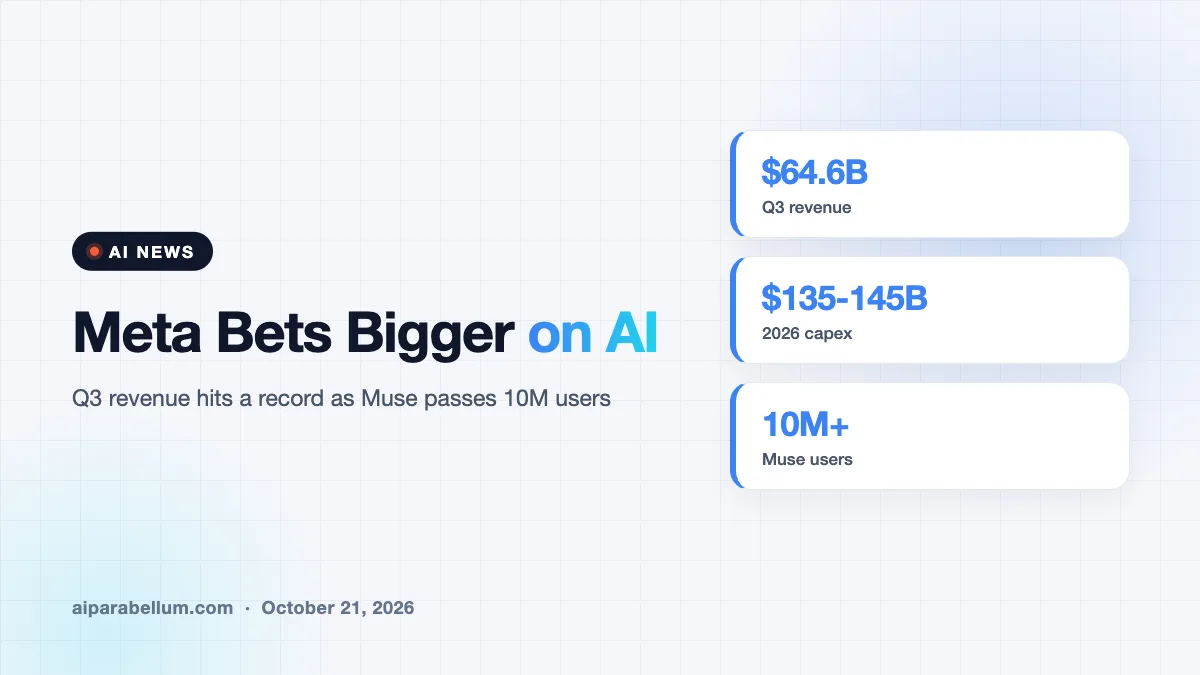
- Astounding Capital Intensity: Meta’s Q3 AI Capex surged to $41.68 billion, reflecting an aggressive, front-loaded strategy to secure constrained hardware supply chains, custom silicon, and next-generation data center architecture.
- The Muse Phenomenon: Meta’s generative suite, Muse, surpassed 5 million active users, proving that high-end AI tooling is rapidly transitioning from experimental R&D to sticky, monetizable enterprise and creator software.
- Macroeconomic Crosscurrents: Occurring against a backdrop of tight monetary policy—with market odds pricing complex macroeconomic holds and WTI crude hovering near $99.99—Meta’s spending spree places immense pressure on its operating margins to justify long-term enterprise ROI.
- Wall Street Re-Rating: Analysts are sharply divided over whether this capital allocation represents visionary moat-building or an unchecked spending cycle that could compress near-term free cash flow.
Comprehensive Narrative: The Architecture of an AI Supercycle
For decades, Silicon Valley operated under a relatively predictable playbook: capital expenditure scaled linearly with top-line revenue growth. However, the advent of generative large language models (LLMs) and multi-modal generative networks has fundamentally shattered traditional financial engineering. Under the direction of CEO Mark Zuckerberg, Meta has pivoted into an aggressive infrastructure-first behemoth, willing to absorb billions in upfront costs to secure an insurmountable competitive moat.
The core catalyst behind the $41.68 billion Q3 Capex figure lies in the relentless pursuit of compute scale. Training multi-modal models capable of real-time reasoning, advanced video generation, and complex audio synthesis like Muse requires unprecedented clusters of specialized accelerators. Industry insiders note that Meta is aggressively procuring next-generation graphics processing units (GPUs) alongside its proprietary Meta Training and Inference Accelerator (MTIA) chips, locking up power purchase agreements (PPAs) for gigawatt-scale data centers.
This capital allocation strategy is not happening in a vacuum. Broader financial markets are currently navigating a delicate tightrope. With macroeconomic indicators—such as the Federal Reserve's path on interest rates and volatile energy pricing reflected in WTI crude near $99.99—imposing high costs of capital, Meta's cash-generative advertising engine remains the indispensable financial engine fueling these ambitions. Yet, institutional investors are increasingly demanding clear lines of sight from enterprise ROI to ensure that these multi-billion-dollar clusters translate directly into top-line acceleration.
Enter Muse. As Meta’s premier multi-modal creative engine, Muse’s rapid ascent to 5 million users serves as the primary empirical defense for Meta’s aggressive expenditure. By integrating advanced generative audio, spatial sound design, and automated video scoring directly into the Facebook, Instagram, and WhatsApp ecosystems—while offering enterprise-grade APIs for external developers—Meta is demonstrating that its AI investments can drive genuine user engagement, higher ad-targeting precision, and direct software subscription monetization.
Verified Data & Metrics Breakdown
To fully grasp the magnitude of Meta’s Q3 financial and operational performance, the following comparative matrix breaks down key capital allocations, adoption metrics, and macroeconomic parameters associated with the current earnings cycle:
| Metric / Indicator | Q3 Financial / Operational Value | Strategic Significance & Market Impact |
|---|---|---|
| AI Capital Expenditure (Capex) | $41.68 Billion | Reflects aggressive front-loading of data center buildouts, custom silicon procurement, and specialized cluster deployment. |
| Muse Active Adoption | 5 Million Users | Validates enterprise and creator demand for Meta’s proprietary generative audio and multi-modal creative tooling. |
| Primary Energy / Commodity Baseline | WTI Crude at ~$99.99 | Highlights elevated operational overhead for global data center power consumption amid tight energy markets. |
| Monetization Vector | Hybrid (Ad-Tech + Enterprise APIs) | Bridges core family-of-apps advertising efficiency with direct software-as-a-service (SaaS) scalability. |
| Market Liquidity Context | High Interest Rate / Tightening Environment | Places intense pressure on Big Tech cash flows to justify high-multiple valuations and massive infrastructure bets. |
Industry & Market Implications: Winners, Losers, and Economic Ripples
Meta’s aggressive posture sends shockwaves across the entire global technology and financial landscape. Understanding the systemic fallout requires examining who stands to gain and who faces structural headwinds:
- The Winners — Hardware Fabricators & Energy Providers: Semiconductor manufacturers, specialized optical networking firms, and green energy infrastructure providers capturing Meta’s procurement dollars are reaping historic windfalls. Furthermore, professional creators leveraging Muse are experiencing unprecedented productivity gains.
- The Losers — Capital-Constrained Competitors: Smaller enterprise tech players and mid-tier social platforms lack the balance sheet depth to compete in a $40B+ annual infrastructure arms race. This dynamic threatens to consolidate AI innovation into an oligopoly of mega-cap tech giants.
- Macroeconomic Realities: As central banks monitor inflationary pressures driven by high energy costs and massive tech investments, corporate treasuries must carefully weigh debt-financed Capex against equity dilution and cost-of-capital risks.
Frequently Asked Questions (People Also Ask)
1. What drove Meta’s Q3 AI Capex to $41.68 billion?
The record-breaking $41.68 billion capital expenditure was primarily driven by the massive expansion of artificial intelligence data center infrastructure, aggressive procurement of specialized AI accelerators and custom silicon (MTIA), and long-term investments in power and cooling architecture necessary to train and run next-generation multi-modal models.
2. What is Muse, and how significant is the 5 million user milestone?
Muse is Meta’s flagship generative audio and creative intelligence platform designed for creators, marketers, and enterprise developers. Reaching 5 million active users demonstrates that Meta’s heavy AI investments are successfully translating into scalable, highly engaging software products with tangible consumer and commercial adoption.
3. How does this massive spending impact Meta’s financial valuation and free cash flow?
While Wall Street acknowledges the necessity of building an unassailable AI infrastructure moat, the sheer scale of the Capex cycle exerts temporary pressure on free cash flow. Investors are closely scrutinizing whether advertising revenue growth and new enterprise monetization streams can adequately offset these massive capital outlays to maintain attractive valuation multiples.
4. What role do macroeconomic factors play in Meta’s current strategy?
Macroeconomic realities—including restrictive monetary policies, Federal Reserve rate trajectories, and high energy benchmarks (such as WTI crude near $99.99)—increase the cost of capital and data center operational overhead. Consequently, Meta must maintain exceptional operational efficiency within its core advertising business to self-fund its ambitious AI roadmap.
Future Outlook: Strategic Milestones to Watch
As Meta moves past its watershed third quarter, the coming 12 to 18 months will serve as the ultimate stress test for its capital allocation strategy. Executive leadership must successfully execute on several critical operational milestones:
- Monetization Acceleration: Transitioning Muse and other generative tools from user-acquisition growth phases to robust, high-margin enterprise subscription tiers and enhanced ad-targeting capabilities.
- Power and Compute Efficiency: Optimizing inference costs through algorithmic breakthroughs and custom silicon deployment, ensuring that running large-scale models does not permanently compress operating margins.
- Regulatory Compliance: Navigating increasingly stringent global AI regulations, data privacy frameworks, and antitrust scrutiny across both the United States and the European Union.
Ultimately, Meta’s $41.68 billion gamble is not merely a corporate spending report; it is a definitive declaration of war for the future of digital intelligence. Whether this monumental capital deployment is remembered as a visionary masterstroke or an overextended miscalculation will depend entirely on how rapidly and profitably these massive computing clusters can change the digital economy.