The Death of the Per-Seat License: Inside Bessemer’s 2026 Playbook for Monetizing the Generative AI Economy
Executive Takeaways
- The Paradigm Shift in Enterprise Value Capture: Bessemer Venture Partners’ seminal 2026 guide, The AI Pricing and Monetization Playbook, documents the structural sunset of seat-based SaaS subscriptions in favor of outcome-based, hybrid-consumption, and digital labor pricing architectures.
- Gross Margin Dilution Pressures: Traditional SaaS gross margin benchmarks of 80% to 85% are collapsing to 55% to 65% for unoptimized AI native platforms due to persistent cloud compute architecture overhead and inference token costs.
- The Rise of the "Resolution Metric": Market leaders like Intercom, EvenUp, DeepL, Sett, and Leena AI are decoupling revenue from human headcount, linking enterprise contracts directly to automated task resolution and measurable workflow output.
- Wall Street Valuation Divergence: Private equity sponsors and public equity analysts are actively re-rating enterprise software multiples, penalizing vendors exposed to raw model API passthrough costs while rewarding platforms engineering proprietary inference moats and high-gross-margin unit economics.
The Great SaaS Margin Compression and the Token Dilemma

For more than two decades, the venture capital blueprint for enterprise software was anchored to a monolithic metric: the predictable, recurring, 80%-plus gross margin seat-based subscription. That arithmetic has officially run out of runway. As unveiled in Bessemer Venture Partners' comprehensive research release, The AI Pricing and Monetization Playbook, the rapid transition from deterministic code to probabilistic inference has introduced a volatile variable into the traditional profit-and-loss architecture: the marginal cost of compute.
In the legacy software regime, delivering an additional user seat cost fractions of a cent in database overhead. In the generative artificial intelligence paradigm, every interaction, multi-agent query, retrieval-augmented generation (RAG) look-up, and automated task execution burns costly GPU clusters. Software enterprises that naively layered generative LLM wrappers on top of $40-per-user monthly seats found their unit economics eroding in direct proportion to user engagement. High product utilization, once the celebrated harbinger of low churn and net revenue retention (NRR), suddenly morphed into a vector for enterprise gross margin destruction.
BVP’s investigation into software economics highlights that software is undergoing a categorical transformation from "tooling" to "labor." When software functioned strictly as a tool—an interface for an employee to input and organize records—charging per human worker made structural sense. But when enterprise-grade agentic platforms complete end-to-end knowledge work previously performed by Tier-1 support reps, paralegals, or junior underwriters, charging a fractional seat license caps revenue upside while leaving the vendor exposed to uncapped token and infrastructure liabilities.
Deconstructing the Playbook: Outcome, Consumption, and Hybrid Fronts
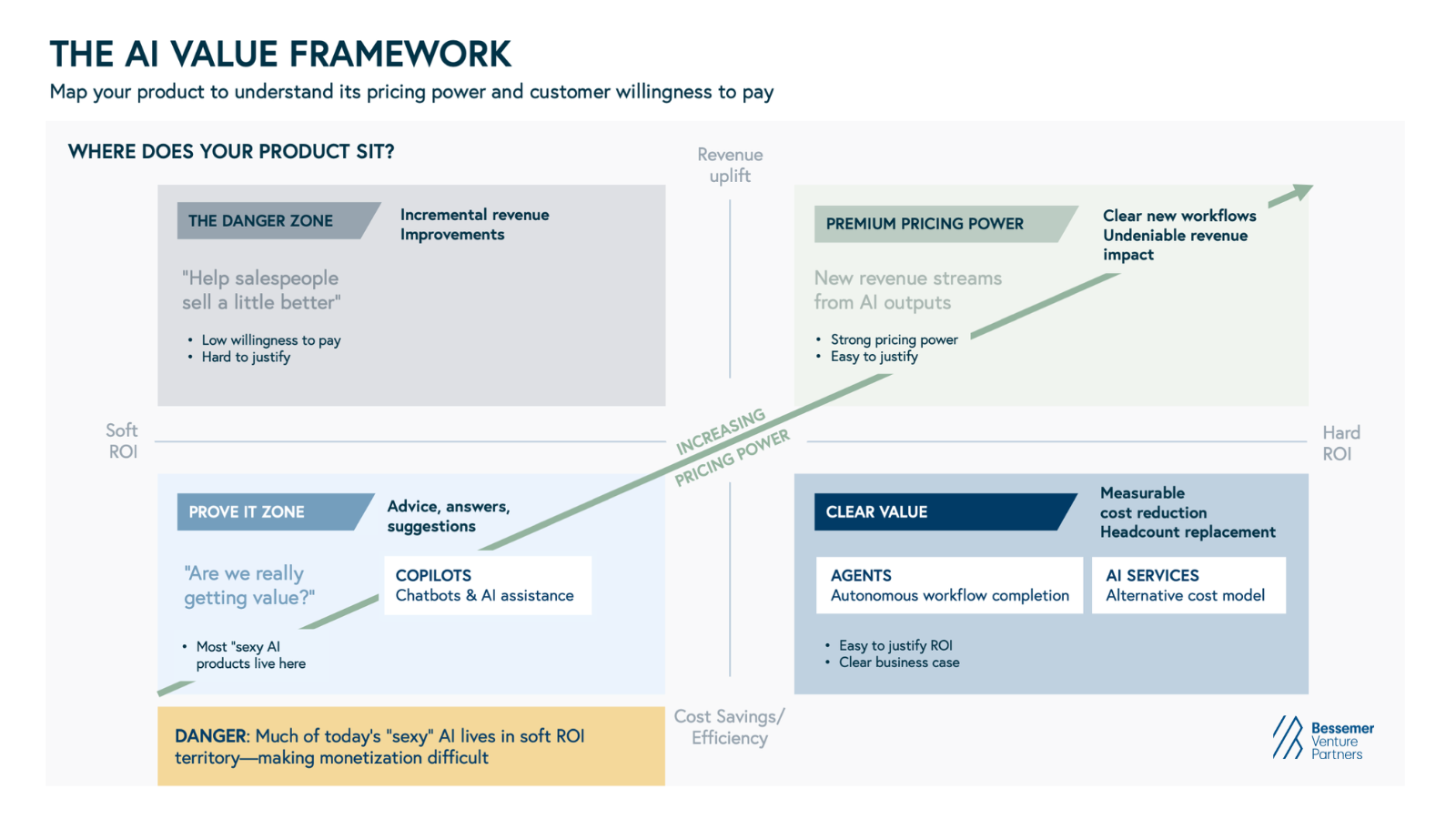
The playbook released on BVP’s Atlas intelligence platform outlines how forward-thinking founders are engineering defensible moats around their revenue engines. By analyzing deployment data across market pacesetters, Bessemer categorizes the viable monetization strategies of the 2026 landscape into four primary models: pure consumption (token/credit meters), outcome-based (work-complete billing), hybrid platform-plus-agent tiers, and ROI-indexed gain-sharing.
1. Outcome-Based Monetization: The "Resolution" Architecture
The most aggressive revenue momentum in 2026 is coalescing around outcome-based mechanics. Instead of billing for software presence, vendors charge for quantifiable, audited task completions. Customer engagement powerhouse Intercom pioneered this paradigm shift with its Fin AI agent, establishing a price point anchored at $0.99 per successful resolution. Under this model, if the AI agent deflects a support ticket, diagnoses the user's issue, and completes the action without human agent escalation, the transaction triggers monetization. If the query falls back to a human operator, the customer pays zero for the inference pass.
Legal-tech unicorn EvenUp operates on a structurally similar outcome-aligned engine. Drafting complex legal claims and personal injury demand packages historically demanded dozens of paralegal billable hours. EvenUp monetizes per drafted, institutional-grade demand letter or claim package, effectively converting legal workflows into software-as-labor. By mapping software costs directly to the customer’s billable savings or operational throughput, EvenUp extracts five-figure enterprise contracts without enterprise procurement anchoring negotiations to seat counts.
2. Domain-Specific Translation and Document Processing: DeepL and Sett
For high-volume precision workloads, DeepL has mastered the art of balancing baseline infrastructure costs against volume tiers. DeepL pairs enterprise-grade security guarantees with tiered volume thresholds, insulating its gross margins from unbounded token expenditures while offering predictable enterprise ROI. Similarly, insurtech disruptor Sett monetizes the automated extraction, medical record synthesis, and valuation calculations required in insurance dispute settlements. Sett ties its pricing structure directly to claim volume and settlement processing speed, mitigating the risk of margin dilution while accelerating enterprise client onboarding.
3. Internal Enterprise Automation: Leena AI
In the employee experience and HR workflow vertical, Leena AI transitioned away from legacy enterprise employee licenses to an agentic service-level model. Rather than billing per corporate employee on payroll, Leena AI structures contracts based on the autonomous resolution of internal IT, onboarding, and human capital tickets. This structure aligns the incentives of the enterprise buyer—who wants headcounts lean and employee productivity maximized—with the incentives of the software vendor.
Comparative Architecture: AI Monetization Models Evaluated
The transition from legacy software delivery to generative agentic deployment requires capital allocators and enterprise CFOs to recalibrate unit economics. The following table synthesizes the operational parameters of contemporary monetization strategies based on current market data:
| Monetization Framework | Primary Pricing Metric | Blended Gross Margin Range | Enterprise Adoption Friction | Revenue Expansion Velocity | Representative Case Studies |
|---|---|---|---|---|---|
| Legacy Per-Seat SaaS | Named/Active User Licenses | 75% – 85% (pre-AI) / 45% – 60% (with heavy AI) | Low (procurement is familiar with per-user models) | Constrained by customer headcount reductions | Legacy ERP, Traditional CRM architectures |
| Raw Consumption Metering | Tokens, Compute Seconds, API Calls | 40% – 55% | High (unpredictable enterprise cloud bills induce churn) | Moderate (tied to API volume, vulnerable to model optimization) | Raw LLM Providers, Infrastructure Gateways |
| Outcome / Work-Based | Successful Resolutions, Audited Deliverables | 65% – 75% | Moderate (requires precise, tamper-proof definitions of "success") | Extremely High (scales linearly with enterprise workload volume) | Intercom (Fin), EvenUp, Sett |
| Hybrid: Base Tier + Usage Buffer | Platform Fee + Value-Unit Packs (Credits) | 68% – 80% | Low to Moderate (combines budget predictability with usage upside) | High (built-in overage triggers drive expansion) | DeepL, Leena AI, Enterprise Copilots |
The Inference Architecture Balancing Act: Managing COGS
Behind Bessemer’s monetization playbook sits a brutal technical reality: you cannot price your software intelligently if your inference cost of goods sold (COGS) is a black box. The engineering of monetization has become inextricably linked to the engineering of inference orchestration.
High-margin AI operators in 2026 are aggressively de-linking themselves from uniform dependencies on top-tier frontier models. To preserve target gross margins above 70%, companies are deploying multi-tiered model routing systems:
- Small Language Models (SLMs) and Localized Distillation: Routine user queries and deterministic data parsing are routed to fine-tuned 3-billion to 8-billion parameter models running on cost-efficient cloud compute instances, slashing inference costs by up to 90% relative to frontier API endpoints.
- Semantic Caching: Enterprise platforms utilize vector-indexed semantic caching layers. If a corporate customer’s workforce generates contextually identical queries, the platform serves cached completions instantly, incurring zero downstream GPU compute expenses while charging the standard contractual value unit.
- Frontier Model Escalation: High-parameter frontier models are reserved exclusively for complex reasoning chains, edge-case remediation, and multi-agent synthesis where the commercial value of the outcome justifies the multi-cent compute burn.
By treating compute capacity as dynamic supply chain logistics, companies documented in BVP’s research manage to preserve healthy gross margin profiles while simultaneously providing fixed-cost predictability to risk-averse corporate buyers.
Wall Street Re-prices the Software Landscape: Winners and Losers
The monetization shifts detailed by Bessemer are actively reshaping the capital markets. Public equity investors and private growth equity allocators are systematically dismantling the uniform valuation multiples previously applied to cloud software companies.
The Losers: The "Wrapper" Multiples Compression
Software vendors operating as basic orchestration wrappers over commercial foundation models face an existential squeeze. Enterprise chief information officers (CIOs) are consolidating software stacks to eliminate redundant AI seat licenses. When an enterprise cuts human headcounts through automation, its legacy seat-based software spend contractually contracts. If that same software vendor cannot capture the value of the autonomous work replacing the employee, its net revenue retention (NRR) plunges. Furthermore, institutional investors are punishing AI software companies whose gross margins hover in the mid-50s, treating them as low-margin IT services or managed consultancies rather than scalable tech platforms.
The Winners: Vertical Moats and Sovereign Data Engines
Conversely, companies demonstrating sustainable pricing power possess two defining characteristics: proprietary system-of-record integration and sovereign domain context. Platforms like EvenUp, Intercom, and DeepL are not selling probabilistic text generation; they are selling domain-verified, legally defensible, or brand-aligned resolutions. Because their products are deeply embedded within critical enterprise workflows, these vendors dictate outcome metrics, enjoy pricing leverage, and can reliably hedge against underlying hardware and model price volatility.
Frequently Asked Questions (People Also Ask)
What is the difference between consumption-based and outcome-based AI pricing?
Consumption-based pricing charges customers for the computational resources they ingest, such as raw API tokens, processing gigabytes, or compute seconds. Outcome-based pricing ignores underlying compute metrics and charges exclusively for the completion of a verified business deliverable or automated task, such as a successfully resolved customer support ticket, a vetted legal document, or an approved insurance claim.
Why are generative AI products depressing traditional software gross margins?
Traditional SaaS software runs on low-cost database transactions, typically yielding gross margins between 80% and 90%. Generative AI applications rely on compute-intensive model inference, which incurs tangible hardware and cloud GPU processing expenses every time a user prompts the system. Without algorithmic routing, caching, and model fine-tuning, continuous model inference substantially elevates software cost of goods sold (COGS), dragging blended gross margins down toward 55% to 65%.
How does Intercom’s AI agent pricing model work?
Intercom utilizes an outcome-aligned hybrid pricing architecture for its AI agent, Fin. Customers maintain a foundational platform access tier and pay a fixed fee of $0.99 for each customer support query that Fin successfully resolves without human agent intervention. If an inquiry requires hand-off to a human support representative, the AI interaction carries zero resolution cost for the customer, perfectly aligning the software's cost with its direct labor-replacement utility.
How can enterprise software companies protect their margins against token volatility?
Software vendors hedge against token costs by decoupling user interfaces from single monolithic foundation models. They implement dynamic semantic caching to avoid redundant queries, employ smaller fine-tuned models (SLMs) for mundane operational tasks, reserve expensive frontier models strictly for high-order reasoning, and package capabilities into structured "work credits" rather than unmetered, unlimited-access flat-rate seats.
The Road Ahead: Autonomous Agents and the 2027 Budget Cycle
As enterprise procurement offices finalize their allocations for the back half of the 2026 fiscal cycle, Bessemer Venture Partners' playbook signals an accelerating bifurcation of enterprise budgets. The era of the "seat tax" is waning, rapidly supplanted by "workforce augmentation" line items.
Looking toward 2027, the next frontier of monetization will focus on autonomous multi-agent systems operating asynchronously. In this regime, software will run uninterrupted overnight, executing tasks, re-balancing supply chains, updating financial forecasts, and handling Tier-2 engineering escalations without human prompting. Companies that price these capabilities on hourly human equivalencies or value-unit resolutions will dominate enterprise market valuations. Those that continue charging $30 per month per login credential will find themselves stranded in the margins of software history.