Executive Takeaways
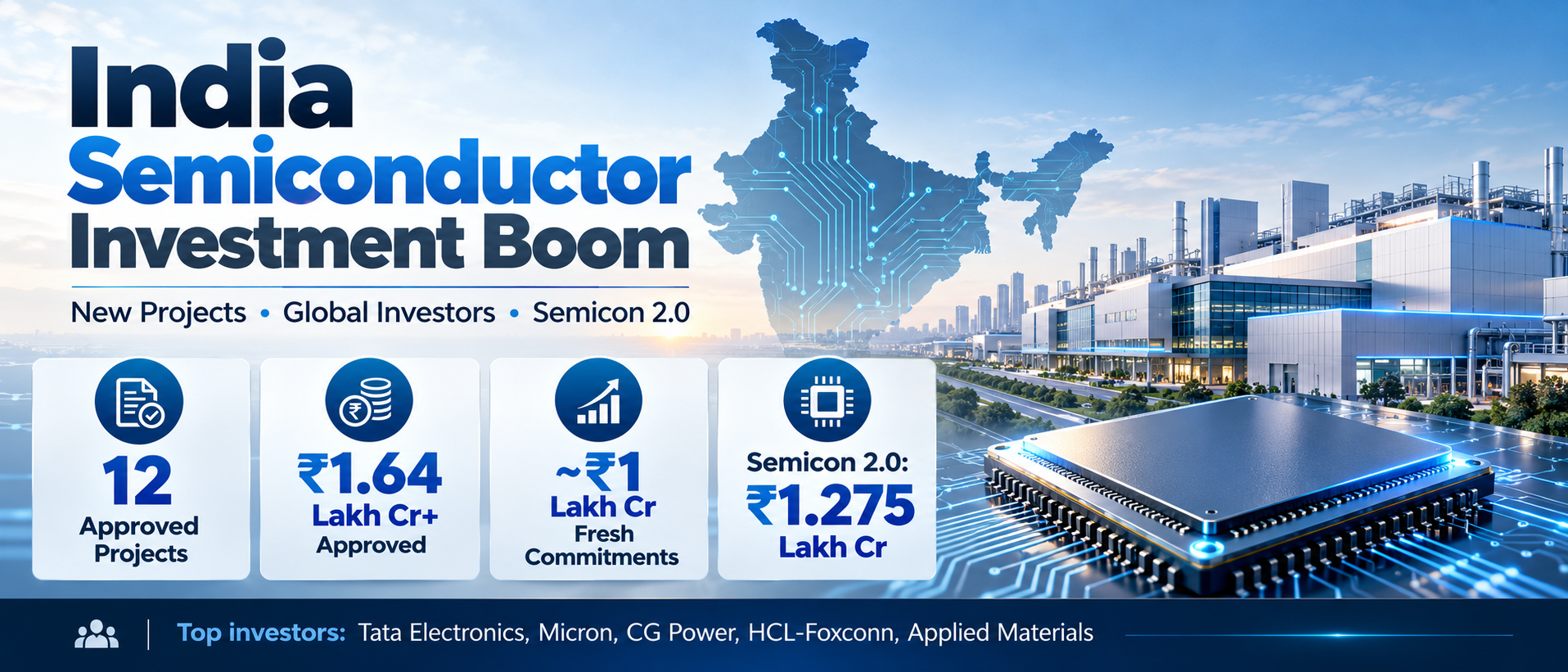
- Unprecedented Capital Allocation: New Delhi has committed over $10 billion in direct fiscal incentives, triggering a broader wave of cumulative enterprise capital expenditure exceeding $20 billion across fabrication and packaging facilities.
- Geopolitical Realignment: Global semiconductor giants—including Micron, Tata Electronics, and Japan’s Renesas—are actively diversifying their supply chains away from single-source manufacturing hubs toward the Indian subcontinent.
- Infrastructure Scalability Hurdles: While policy frameworks and state-level subsidies are robust, long-term valuation multiples and project success will hinge on navigating complex land acquisition, uninterrupted ultra-pure water supplies, and skilled talent acquisition.
For decades, the architectural blueprint of the global digital economy has relied on a fragile, highly concentrated manufacturing monopoly. When pandemic-era bottlenecks and geopolitical flashpoints crippled international supply chains, enterprise leaders and sovereign states alike realized a sobering truth: raw compute power is the ultimate national security asset. Enter India. Armed with aggressive policy interventions, massive domestic market liquidity, and an unmatched engineering talent pool, the world’s most populous nation is executing a calculated, high-stakes pivot to capture the next frontier of high-tech manufacturing.
This is not merely an industrial expansion; it is a fundamental rewriting of the global semiconductor playbook. Backed by the Indian Semiconductor Mission (ISM), the nation is transforming from a pure-play software and services exporter into a heavy-duty hardware powerhouse. For institutional investors, corporate strategists, and global technology executives, understanding this paradigm shift requires a granular look at the capital allocation, regulatory frameworks, and infrastructural realities driving India’s silicon boom.
The Catalytic Shift: Moving Beyond the Software Paradigm
Historically, India’s economic ascent was defined by its dominance in IT services, software engineering, and digital infrastructure. However, the foundational layer of the modern tech stack—semiconductors—remained a glaring omission. Previous attempts to incentivize domestic fabrication (fab) units in the 2010s stalled due to misaligned fiscal subsidies, bureaucratic inertia, and a lack of supporting downstream ecosystems.
The post-pandemic macroeconomic climate changed everything. With global enterprises prioritizing risk mitigation and supply chain diversification, the Indian government revamped its strategy. The rollout of a $10 billion incentive corpus shifted the financial calculus for global foundries. By absorbing up to 50% of capital expenditure for semiconductor and display fabrication units, New Delhi removed the prohibitive barrier to entry that previously stymied venture capital and corporate investment in heavy hardware.
Furthermore, structural changes in domestic consumption have altered market dynamics. India’s burgeoning middle class, combined with rapid digitization across automotive, telecommunications, and consumer electronics sectors, has created an insatiable domestic demand for chips. Companies can no longer view India solely as an offshore back-office; it is now one of the world's most lucrative end-user markets, necessitating localized manufacturing to optimize logistics, reduce import duties, and ensure regulatory compliance.
Ground Zero: Major Projects, Global Investors, and Strategic Partnerships

The current investment wave is distinguished by its operational credibility. Unlike speculative ventures of the past, today’s pipeline features tier-one global operators, established conglomerates, and rigorous joint ventures backed by proven technology transfers.
At the vanguard of this movement is Micron Technology. Breaking ground in Sanand, Gujarat, Micron is investing approximately $2.75 billion to construct a state-of-the-art Outsourced Semiconductor Assembly and Test (OSAT) facility. This project represents a watershed moment: a major American memory chipmaker establishing its footprint directly on Indian soil, integrating local labor into its global packaging and testing matrix.
Simultaneously, the domestic industrial titan Tata Group has stepped up with massive capital allocation. Tata Electronics, in strategic partnership with Taiwan’s Powerchip Semiconductor Manufacturing Corporation (PSMC), is executing a $11 billion project to build India’s first commercial semiconductor fabrication plant in Dholera, Gujarat. This fab will focus on mature nodes (ranging from 28nm to 90nm), which power everything from automotive microcontrollers to power management ICs—sectors currently experiencing severe structural shortages.
In addition, CG Power, in collaboration with Japan’s Renesas Electronics and Thailand’s Stars Microelectronics, is advancing an OSAT facility in Sanand with an outlay of roughly $900 million. This cross-border consortium exemplifies the collaborative nature of modern semiconductor manufacturing, blending Japanese IP and process engineering with Indian infrastructural scale.
Verified Data and Metrics Breakdown
To evaluate the true scope and velocity of India’s semiconductor manufacturing boom, industry analysts look past corporate press releases to examine hard capital commitments, technological targets, and geographic distribution.
| Project / Entity | Location | Estimated Capital Outlay | Technology / Focus Area | Global Partner / Technology Provider |
|---|---|---|---|---|
| Tata Electronics & PSMC | Dholera, Gujarat | ~$11.0 Billion | Logic Fab (28nm - 90nm nodes) | Powerchip (Taiwan) |
| Micron Technology | Sanand, Gujarat | ~$2.75 Billion | DRAM & NAND Assembly / Test (OSAT) | Micron Direct (USA) |
| CG Power, Renesas & Stars Microelectronics | Sanand, Gujarat | ~$900 Million | OSAT / Advanced Packaging | Renesas (Japan) / Stars (Thailand) |
| Kaynes Technology | Sanand, Gujarat | ~$330 Million | OSAT / Discrete Semiconductors | Independent / Specialized Tech Transfer |
Industry & Market Implications: Winners, Losers, and Economic Ripples
The structural integration of India into the semiconductor manufacturing ecosystem carries profound implications for global supply chain dynamics and enterprise asset allocation.
Who Wins
Enterprise Automotive and Consumer Electronics OEMs: Companies dependent on steady microchip supply lines gain a vital geographic hedge. Procuring chips from localized Indian facilities dramatically reduces freight costs, lead times, and exposure to regional geopolitical chokepoints in East Asia.
Domestic Industrial Conglomerates: Groups like Tata are successfully pivoting from traditional manufacturing and services into high-margin deep-tech sectors, securing long-term valuation multiples and enhancing enterprise resilience.
Specialized Equipment and Chemical Suppliers: Global providers of photolithography systems, etching chemicals, ultra-pure gases, and cleanroom infrastructure find a burgeoning new frontier for long-term service contracts and equipment sales.
Who Loses
Single-Source Regional Hubs: Traditional manufacturing centers that fail to innovate or match aggressive fiscal subsidies risk seeing a gradual erosion of incremental capital expenditure as global firms diversify their manufacturing footprint.
Underprepared Local Municipalities: States within India that lack the necessary water infrastructure, reliable power grids, and streamlined regulatory clearance mechanisms miss out on the economic windfall, widening regional developmental disparities.
Frequently Asked Questions (People Also Ask)
1. What is the total financial commitment of the Indian government under the semiconductor incentive scheme?
The central government has allocated an initial corpus of $10 billion (INR 76,000 crore) specifically for the development of semiconductor and display manufacturing ecosystems. This fiscal package covers up to 50% of project capital expenditure for semiconductor fabs, display fabs, and OSAT/ATMP facilities, which has successfully catalyzed over $20 billion in total planned private and public investment.
2. Why are most initial Indian fabs focusing on mature nodes rather than advanced sub-7nm chips?
Mature nodes (ranging from 28nm to 90nm) represent the vast majority of global volume demand, particularly across automotive systems, industrial automation, medical devices, and power management units. Establishing mature node fabs allows India to build foundational engineering expertise, secure steady baseline revenues, and develop a robust domestic supplier ecosystem before attempting the prohibitive capital and technological leaps required for sub-7nm advanced lithography.
3. How is India addressing the critical shortage of specialized semiconductor engineering talent?
Recognizing that human capital is the primary bottleneck in high-tech manufacturing, the Indian government has partnered with top-tier academic institutions (such as the Indian Institutes of Technology) to launch specialized curriculum tracks in VLSI design, semiconductor packaging, and microelectronics. Additionally, incoming global operators like Micron and Renesas are implementing aggressive internal upskilling programs and tapping into India’s existing pool of over 300,000 chip-design engineers.
4. What are the primary infrastructure risks facing foreign investors setting up plants in India?
Semiconductor fabrication demands uninterrupted, ultra-reliable supplies of power and ultra-pure water, alongside stringent anti-vibration environments. While state governments in Gujarat, Karnataka, and Maharashtra are rapidly upgrading industrial parks with dedicated power grids and water desalination pipelines, localized utility fluctuations and complex land acquisition processes remain key risk factors that require rigorous mitigation strategies by corporate legal and operational teams.
Future Outlook: Milestones and Strategic Horizons
As India’s semiconductor investment boom transitions from policy announcements to physical ground-breaking, the next 24 to 36 months will serve as the definitive stress test for the nation's industrial ambitions. For stakeholders tracking market liquidity and enterprise ROI, several key milestones warrant continuous scrutiny:
First Silicon Rollout: Watch for initial trial production runs and yield verification from Micron’s Sanand OSAT facility and Tata’s Dholera fab. Successful commercial delivery will validate India’s manufacturing execution capabilities.
Ecosystem Localization (Ancillary Supply Chain): The true measure of a sustainable semiconductor cluster is the localization of raw material suppliers—including specialty gases, silicon wafers, chemical precursors, and precision tooling. Monitor state-level incentives targeting upstream chemical and equipment vendors.
Workforce Scalability and Retention: Evaluate institutional output of specialized microelectronics graduates and the efficacy of corporate talent retention frameworks amidst fierce global competition for semiconductor engineers.
India’s ascent as a global silicon powerhouse is no longer a matter of speculative ambition; it is an active, heavily capitalized industrial restructuring. For global investors and enterprise strategists, engaging with this ecosystem now is essential to securing resilient supply chains and capitalizing on the next great manufacturing frontier of the 21st century.